Uncategorized

Determining Responsibility for Indirect Cost Variance Analysis – Part 3

, , ,

Indirect Cost Variance Analysis Process

The debate that has continued since the inception of the earned value concepts in the 1960’s has been: “Who should report on and analyze the cost variances attributable to indirect costs?”

This blog is the third in the series of blogs to help answer this question.  The first blog covered a few fundamentals about how indirect cost rates are established to set the stage.  The second blog discussed how indirect rates are applied and how project personnel display indirect costs for internal or performance reporting.  This blog concludes the discussion on the indirect cost variance analysis process.  It covers what the EIA-748 Standard for Earned Value Management Systems (EVMS) and related government agency guides have to say on the subject as well as discussing the best option for determining who is responsible for indirect cost variance analysis.  

Throughout a project’s execution phase, project managers and control account managers (CAMs) conduct their respective performance analysis at varying levels of detail to identify significant cost and schedule variances as well as variances at completion (VAC).  They use variance thresholds to focus on the work elements where challenges or problems are occurring.  As needed, they identify the root cause of the variance and determine the best path forward to mitigate or otherwise reduce the impact of an unfavorable variance.  

This effort includes performing additional analysis not just by the direct elements of cost (labor, material, subcontract, or other direct costs (ODCs)), but also by the indirect costs applied to those direct cost elements to identify the root cause.  For example, the CAMs check for labor variances (rate or efficiency/volume) and material variances (price or usage) to identify any potential issues.  As a side note, remember the rates used to calculate earned value are the same rates used for budget values.  Likewise, actual costs are collected into the same direct cost elements of cost and indirect cost pools as the budget plan elements of cost.  Those actual rates may vary from the budget/earned value rates.

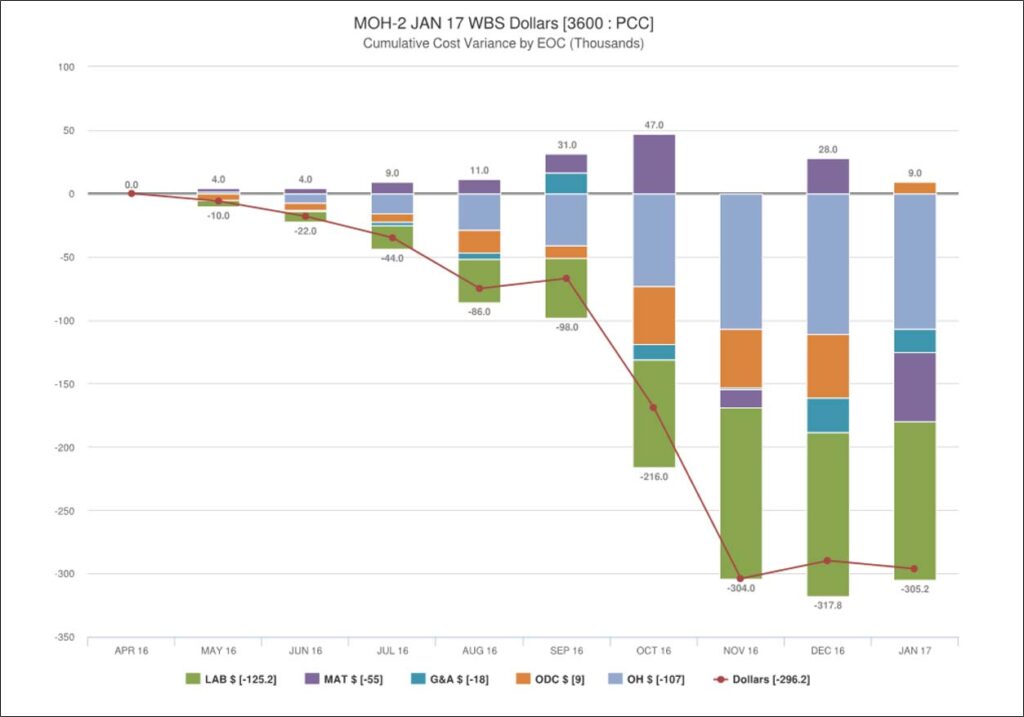
At the total project level, a project manager performs indirect element of cost analysis.  They need to assess whether indirect costs are contributing to the project’s cost variances and quantify the impact.  Since indirect costs are directly related to the base time phased direct costs, it follows the variances for the element of cost categories are similarly skewed.  Figure 1 shows an example (produced from Encore Analytics Empower) of a contract with the variances attributable to the elements of cost (see previous 3-part blog: Planning and Managing EVM by Elements of Cost (EOC)). The indirect cost variances tend to vary with the changes in the direct costs base and/or indirect elements of cost over time at a pool level.  While not common, these could be different from month to month (the lightest blue shaded boxes in Figure 1) when annual, semi-annual, or quarterly rate adjustments occur (the project manager would be notified when these occur).  

Figure 1: Example Cumulative Variance Analysis by Elements of Cost

The project manager and CAMs are also responsible for completing their variance analysis reports.  These include the Integrated Program Management Report (IPMR) Format 5 (Explanation and Problem Analysis) or Integrated Program Management Data and Analysis Report (IPMDAR) Performance Narrative Report.  As part of this analysis, they need to discuss whether rate changes are impacting the project’s current and cumulative cost and schedule variances, as well as the calculated EAC (cumulative to date actual costs plus ETC). 

Customers often require additional indirect cost detail on the formal performance reports when thresholds are exceeded.  The narrative reports are used to address those indirect cost pool base versus rate variances.  Project managers and CAMs (when indirect costs are displayed as part of their budgets), need base versus rate variance analysis from finance or accounting.  Finance or accounting is responsible for establishing the indirect cost rates to date and forecasting what the indirect rates will be for future fiscal years. 

Who is responsible for the indirect cost variance analysis?

Back to our original question: “Who should report on and analyze the cost variances attributable to indirect costs?”  Can the EIA-748 Standard for Earned Value Management Systems (EVMS) 32 guidelines provide any guidance?  There are also various government agencies that place EVMS requirements on contracts.  Do their policies, compliance business practices, or standard operating procedures provide any guidance?  

The fact is, the EIA-748 Guidelines, dating back to the Cost/Schedule Control Systems Criteria (C/SCSC) in the 1960s, have never specified the level where the management and analysis of indirect costs must occur.  The founders of the earned value concept realized there are several levels of management where indirect rates are applied versus the level at which they are displayed for management.  

The EIA-748 Standard for EVMS (Rev D) Guidelines say the following:

4. Identify the organization or function responsible for controlling overhead (indirect costs).

13. Establish overhead budgets for each significant organizational component of the company for expenses, which will become indirect costs. Reflect in the program budgets, at the appropriate level, the amounts in overhead pools that are planned to be allocated to the program as indirect costs.

19. Record all indirect costs which will be allocated to the program consistent with the overhead budgets.

24. Identify budgeted and applied (or actual) indirect costs at the level and frequency needed by management for effective control, along with the reasons for any significant variances.

The Defense Contract Management Agency (DCMA) Cross Reference Checklist (CRC) sub-questions for these guidelines do not specify any particular level where these actions must occur, and do not even mention the control account level.  For example, for the Guideline 4 sub-questions, they reference “the management position” assigned the responsibility and authority for controlling indirect costs.  For one of the Guideline 24 sub-questions, they ask: “Are the variances between budgeted and actual indirect costs identified and analyzed at the level of assigned responsibility for their control (indirect pool, department, etc.)?”  

Likewise, the Department of Energy’s (DOE) detailed Compliance Review Checklist is equally non-specific on the level of management where these actions occur.  Below are excerpts from that DOE document with text highlighted for reference.

E.1E.1 – Indirect Account Organization Structure 
E.1.1Indirect procedures must clearly identify managers who are assigned responsibility and authority for establishing budgets and controlling indirect costs and who have the authority to approve expenditure of resources.
E.1.3The management process for establishing and controlling indirect cost rates should be documented to ensure responsibility is clear.
E.2E.2 – Indirect Budget Management 
E.2.2The contractor must establish indirect (i.e., overhead, burden, cost of money, and G&A expense) budgets at the appropriate organizational level for each pool and cost sub‐ element.
E.2.3Contractor recurring DOE rate performance reviews should be conducted on a regular basis (i.e. monthly, quarterly, etc.) to ensure effective control and management of the indirect expenses and indirect budgets.
E.3E.3 – Record/Allocate Indirect Costs 
E.3.2Periodically, reviews must be made to assure that indirect costs are being charged to the appropriate indirect pools and by the appropriate incurring organization.
E.3.3If incurred indirect costs vary significantly from budgets, periodic adjustments must be made to prevent the need for a significant year‐end adjustment.
E.4E.4 – Indirect Variance Analysis
E.4.1This guideline requires a monthly documented indirect cost analysis to be performed by those assigned responsibility, comparing indirect budgets to indirect actual costs and explaining the cause of resultant variance(s).
E.4.4The contractor should define thresholds for each budget category and a process for management by exception for indirect performance and analysis.

It is not by accident the Guidelines and supporting questions/attributes do not specify any one way all contractors have to manage, analyze, and report on indirect cost variances.  Indirect costs can be handled in a number of different ways.  The Guidelines have always been designed to give contractors the flexibility to manage their projects within the bounds of those Guidelines.  

So, what is a best answer?

While contractors may choose other viable options, a best practice is for the corporate entity responsible for controlling those indirect costs to do the indirect cost variance analysis at the pool levels.  They control the rates, know the reason for variances, and can forecast what the rates will be over time.    As the first blog in this series pointed out, finance or accounting is responsible for establishing and maintaining the direct and indirect rates based on the contractor’s firm and potential direct business base (or volume).  

The designated higher level management entity should also be responsible for providing the necessary indirect cost variance analysis, rate impacts and narrative details to the project managers.  The project managers need to be aware of corporate actions and potential indirect rate revisions that impact the range of EACs they need to prepare for the IPMR or IMPDAR submittals.  This communication is essential so they have the data and narrative text necessary for managing their project, as well as for producing their performance reports explaining the source and impact of indirect cost variances on the project’s EAC to their customer. 

While not a hard requirement, many contractors elect to include both direct and indirect costs in the CAM control account work authorizations.  This does not make the CAMs responsible for these indirect costs since they have little to no control over the indirect rates – they simply apply the current or forecast rates that accounting provides.  But this format does  provide for the necessary visibility CAMs must have regardless in order to conduct the expected variance analysis, inclusive of an assessment of all cost elements (direct and indirect) and price/usage analysis, in order to explain impacts on performance and on their EACs. (See previous blog: EVMS Variance Analysis — EVMS Analysis and Management Reports.) They then forward these to higher level management to incorporate and to provide the rationale for the variances and to determine any corrective action to mitigate the problems. 

Another important advantage of providing CAMs fully burdened budgets, earned value, and actual cost data broken out by the direct and indirect cost elements includes but is not limited to facilitating “make to buy” and “buy to make” decisions because a CAM has an apples-to-apples cost comparison as noted in the second blog

Need help sorting out the best levels for reporting and managing your direct and indirect costs?  Call us today at (714) 685-1730.  


Other Posts from this Series

Determining Responsibility for Indirect Cost Variance Analysis – Part 3 Read Post »

Life After EVMS Certification – Surveillance

,

Your company has just spent a year or more pursuing the EVM System Certification, going through the formal Compliance Review by the DCMA, and clearing the Corrective Action Requests identified during that review.  Finally, the company has received that coveted System Certification notification from the DCMA!  So, now the company is finally through with that process, right? 

Well… not exactly!

Now comes the really hard part – living up to that certification throughout the life of the contract(s). 

Can you lose DCMA System Certification?

All too often contractors, who have suffered through many months of trying to get their EVM Systems accepted by the government, have tended to let their guard down once certification is attained, letting their implementation of EVMS fall into disrepair.  Doing so can only end badly: poor or late data submittals, cost and/ or schedule surprises (overruns/ missed delivery dates, etc.), and generally unhappy customers.  When the customer is not happy, nobody is happy!  Failure to correct this situation on the company’s part could ultimately result in what is known as a Review For Cause conducted by the DCMA to determine if the company’s EVM Certification should be withdrawn.  Losing the EVMS Certification not only means the contractor can no longer claim in proposals that they have a certified EVMS, it can also cause a company several unwanted contractual, monetary, and reputation impacts – and the recertification process itself is no picnic either.

EVMS Business Practices

To help avoid the above unpleasant consequences, part of the DCMA’s EVMS review series includes ongoing Surveillance of a contractor’s EVM System, starting immediately after it has been certified.  The DCMA has a series of EVMS related Business Practices (BP) [updated May 2020]

  • BP0 – Earned Value Management Systems-Overall guidance on DCMA EVMS assessments
    • BP1 – Pre-Award EVM System Plan Review -of contractor proposal for EVM compliance
    • BP2 – System Description Review –of contractors EVM System and related documents
    • BP3 – Program Support – DCMA’s general EVMS-related support (IBRs, data review, etc.)
    • BP4 – System Surveillance – post-EVMS ongoing review of continued EVMS compliance
    • BP5 – Review for Cause – to assess if an EVMS acceptance is to be withdrawn
    • BP6 – Compliance Review Execution – how a Compliance Review will be run

The focus of this article is BP4 – System Surveillance, but do note that there is also BP5 on conducting a Review For Cause (RFC) discussed briefly above.

The stated purpose of BP4 is that it: “Defines the process to evaluate contractor EVMS compliance through continuing surveillance.” 

Yes, this means it is a compliance review after a contractor has gone through their Compliance Review! The basic intent of this process is to keep some pressure on the contractor to make sure EVMS implementation remains high quality throughout the life of the contract.

Drive the Car

Using our building-a-car analogy from Part 1 of this series: we have designed and built our car and trained our people how to drive, so it is now time to DRIVE OUR CAR. If we do not maintain all the car’s systems properly we are likely to encounter a lot of warning indicator lights (poor performance). If we ignore those indicators, the car is likely to fail on us. If the car blows up, we may have to go through the whole car building process again.

The DCMA does not want a contractor’s EVM System to fall into disrepair either.  The Review For Cause (RFC) and overall recertification process is unpleasant for the DCMA, too. This is also why, unlike in the past, the EVMS Center team players for Surveillance reviews are pretty much the same ones who participated in the formal Compliance Review:

  • Director, EVMS Center
  • Group Lead, EVMS Center
  • Team Lead, EVMS Center
  • Team Member, EVMS Center

There will likely be fewer Team Members than were on the full Compliance Review team, but as you can see, the Leaders will be the same. The DCMA has been placed in charge of all surveillance activities, and Government Program if team members may be needed to augment the DCMA Team.

The Compliance Review (CR) process [BP6] consisted of 5 phases:

  1. Plan
  2. Execute Pre-Event activities
  3. Execute – CR Onsite Activities
  4. Report
  5. Closing Actions

The Surveillance Review process [BP4], however, is comprised of only 3 phases:

  1. Plan
  2. Conduct
  3. Report

The Surveillance Process is primarily conducted off-site, although some on-site interviews could be required if follow-up action is required because potential non-compliances exist as a result of the data analysis.  Typically, on-site actions would be interviews of CAMs or other contractor personnel.

Plan phase:

  • Identify Requirements:  The EVMS Center Team Member works with the contractor’s EVMS point of contact to establish or update an Annual EVMS Surveillance Plan (SP).  They will jointly identify the contracts with EVMS requirements that may be subject to the surveillance activities, which may include existing contracts, new contracts, modifications to existing contracts, or even subcontracts with EVMS requirements.
  • Risk Assessment: The EVMS Center Team Member will use a Risk Assessment Worksheet to “identify a population of representative contracts” against which the DCMA can test all aspects of the system.
  • Create/ Update the Surveillance Plan (SP):  Before the start of each Fiscal Year, the EVMS Center Team Member will create or update the Surveillance Plan to document the surveillance activities using all the candidate contracts for the upcoming Fiscal Year.  The Plan is to ensure the complete evaluation of all 32 Guidelines for the site’s EVMS over a 3-year cycle to support the site re-certification.  This evaluation includes data analysis and the DCMA EVMS Compliance Metrics (DECM) for the particular Guidelines identified in the plan for each surveillance event.  This means that over the 3-year cycle 10 or 11 Guidelines must be evaluated each year in order to cover the 32 Guidelines.  This Surveillance Plan must be reviewed and approved by the EVMS Center Group Lead.

Conduct Phase:

  • Data Call:  At least 45 days prior to each surveillance event, data will be required based on the specific Guidelines being covered in that particular event.  This will typically be a subset of the Data Call required for the Compliance Review.
  • Execute Data Analysis:  Using data provided in the Data Call, the Team Member will use the tests identified in the DECM for the Guidelines being reviewed in each surveillance event.  The contractor should be running these metric checks as part of their own self-evaluation, and the EVMS Center Team Member can use those results in addition to running independent calculations on those metrics.  This is often done if Joint Surveillance is used by the DCMA, but the DCMA Team Member must still perform independent assessments and document results of those checks.
  • Evaluate Results:  Identify potential compliance issues resulting from data analysis metric tests.
  • Follow-up:  Discuss issue with the contractor, get more data samples to test further, conduct interviews of contractor personnel, as needed.  Convey data analysis concerns to the contractor before the surveillance event.
  • Closeout:  To close out the action, one of these will take place:
  • Accept as the correct execution of the contractor system
  • Highlight as a risk for future surveillance
  • Issue a Corrective Action Request (CARs)

The EVMS Center Team Member provides an out brief at the end of the surveillance event.

Report Phase:

  • Document results:  summarize/ provide the following:
  • A report with an Executive Summary
  • Results from all metrics evaluated
  • Follow-up actions taken on metric results
  • Summary of CARs issued/ observations made
  • Summary of contractor internal CARs/ findings
  • Summary of reasons for a Risk Assessment/ Surveillance Plan update (if applicable)
  • Identified risks for evaluation at future surveillance events
  • CAR/ Corrective Action Plan (CAP) status for the site

The EVMS Center Team Member identifies any significant deficiencies to the Team Lead, and then (as necessary) to the Group Lead and the Director for concurrence and processing.  A letter will be issued to the Contracting Officer (CO) notifying them of the completion of the 3-year EVMS compliance assessment, current system status, and any outstanding Corrective Action Requests (CARs) or Corrective Action Plans (CAPs).  The EVMS Center Team Member enters the approved plans/ reports to the Integrated Workflow Management System (IWMS) and for subsequent distribution to appropriate offices and the contractor (as required).

Compliance Review Support

As you can see, this seems almost as involved as getting ready for a full-up Compliance Review.  This is probably by design, since the DCMA wants to emphasize the importance of maintaining the EVM System in a compliant state for the life of the contract.  As a contractor, it is equally important to you because if your system application falls apart and you lose your EVMS certification (via BP5), the recertification process (BP6) starts all over again.

Humphreys & Associates has people ready to help you wade through the government requirements for EVMS certification, whether you are new to EVMS, or you are an experienced contractor needing help getting ready for a Compliance Review, System Surveillance, or even a Review For Cause.  We also have a wide range of training courses for beginners in EVMS or advanced courses for experienced Earned Value professionals.  We can also prepare your company for Surveillance, an IBR, an RFC, or even a full blown Compliance Review. Contact us today at (714) 685-1730 or e-mail us.

Life After EVMS Certification – Surveillance Read Post »

Earned Value Management Pocket Guide

Earned Value Management Pocket Guide shown in an EVM Professionals PocketA pocketful of information goes a long way in Earned Value Management Systems (EVMS). Welcome to the Humphreys & Associates Pocket Guide to Project Management Using Earned Value. The real value in this little booklet is that it contains information commonly used in the industry in an easy-to-read, digestible format. This booklet augments earned value training and is a great resource for project managers and project personnel. With everything from formulae of basic analysis (such as schedule and cost variances, schedule performance index, and Independent Estimates at Completion—IEAC), to diagrams and charts of risk assessment and basic scheduling, this pamphlet also contains a glossary of abbreviations and acronyms common to the industry.


Succinct and Portable

The Humphreys & Associates Pocket Guide is best suited for project managers, team leads, control account managers (CAM)s, administrators, and other project stakeholders regardless of their level of EVM training and knowledge. This guide is a perfect supplement to any earned value management (EVM) education course because it provides a succinct description of EVM best practices. Small enough to fit in a pocket, the front of a folder, or the pocket of a briefcase, this handy booklet is the go-to reference for any manager or analyst evaluating and analyzing project performance.

Easy to Read

The information is presented in an easy-to-read outline format and is based on a typical industry performance measurement system using earned value management practices.  This pocket guide is carried daily by many earned value (EV) professionals and is frequently used to remind them of the equations and relationships of key project performance metrics. Ensure your team is ready for their meetings, evaluations, and training related to EVM with this convenient pocket guide. You can purchase these guides using our website: Earned Value Management Pocket Guide or by calling (714) 685-1730.

Digital Format Coming Soon

Starting in early 2021, this essential guide will be available in digital format, accessible anywhere with a Humphreys account. Make sure to visit the official Humphreys & Associates website for more information on our services as well as other training, certification, and workshop material: https://www.humphreysassoc.com/evms/home.php

Earned Value Management Pocket Guide Read Post »

Scroll to Top