A common Earned Value Management System (EVMS) compliance and surveillance review finding are issues with a contractor’s estimate at completion (EAC) process. A credible EAC is essential to successfully manage all contracts and projects.
EACs are important because they provide a projection of the cost at contract or project completion, which is also an estimate of total funds required by the customer. It matters because EACs represent real money. When the most likely EAC exceeds the negotiated contract cost, the contractor’s profit margins may be at risk. It also creates a problem for the customer when the most likely EAC exceeds their funding limits.
We recently updated our blog titled Maintaining a Credible Estimate at Completion (EAC) to highlight why this is a good time to review and potentially update your estimate to complete (ETC) and EAC processes. The updated blog added content specific to:
Incorporating integrated master schedule (IMS) analysis to test the realism of the EAC to identify any disconnects with the cost-based independent EACs (IEACs). It is equally important to determine a realistic forecast completion date (FCD).
Ensuring control account managers (CAMs) are in a position to substantiate their schedule timeline, resource requirements, and cost estimate to complete the remaining work. It is equally important that project managers proactively take the action of “scrubbing” the CAM’s detail ETC/EAC and verifying the data to gain a better understanding of the project’s current state. This improves the quality of the project-level forecast completion date as well as the range of project-level EACs.
Suggested actions to review and enhance current processes from basic steps, such as incorporating an analysis of the IMS Current Execution Index (CEI) to gain an understanding of how well project personnel can forecast into the future, and taking advantage of AI tools to provide additional data analysis insight.
In addition, the publication of the EIA-748-E Standard for EVMS revised 27 guidelines and related updates to government agency guidance such as the DoD EVMS Interpretation Guide (EVMSIG) will require contractors to review and remap EVM System Description content to the revised set of guidelines. The updated blog emphasizes this is a good time to revisit internal ETC/EAC processes and procedures to determine where improvements can be made as well as to ensure project personnel are following the documented processes. The EIA-748-E split the EIA-748-D Guideline 27 into two guidelines. The EIA-748-E Guideline 20 is specific to the control account level EACs and Guideline 23 is specific to the project level EACs. An EVM System Description should have content specific to the process at the control account level as well as the project level that can easily be mapped to the EIA-748-E Guidelines 20 and 23.
Do Your Internal Processes and Procedures Need a Refresh?
H&A earned value consultants routinely assist contractors with updating their internal processes and procedures to reflect the evolving EVMS requirements and guides, regulatory environment, and toolset capabilities. Workflow steps can often be simplified and the quality of performance analysis can be improved with a refreshed approach that reduces the time needed to produce reliable and actionable information. Call us today at (714) 685-1730 to get started.
A long running challenge all companies face is attracting and retaining top project management talent in government contracting environments whether for the DoD, shipbuilding, NASA, DOE, or the intelligence community. Experienced program/project managers, control account managers (CAMs), schedulers, and project control analysts are always in short supply. It is expensive to continually hire and train new employees that elect to move on for a variety of reasons; successful strategies aimed at reducing turnover always help the financial bottom line.
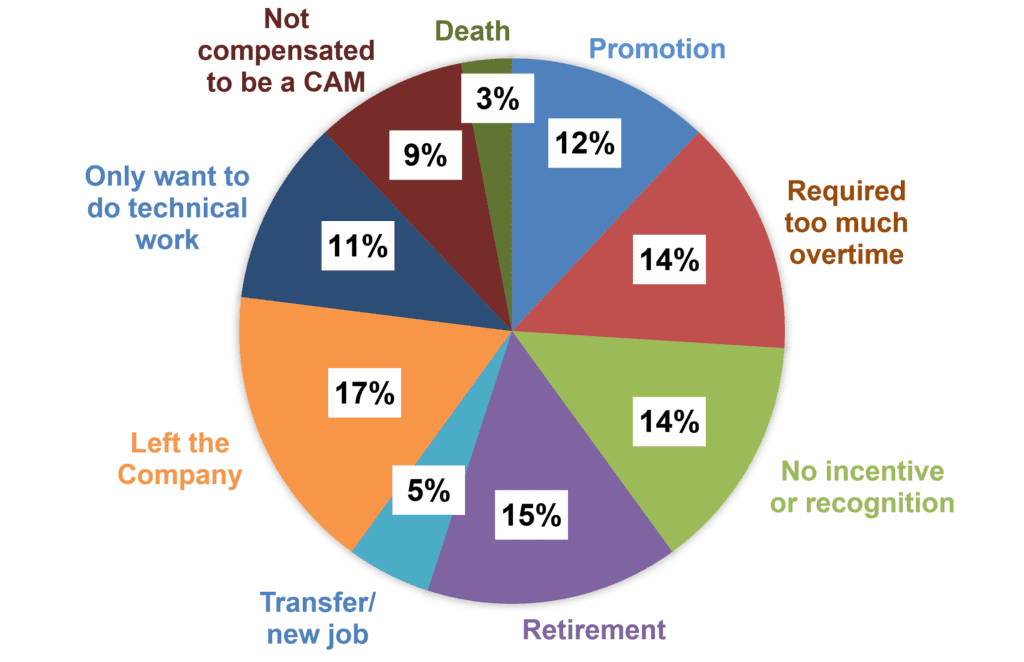
An informal survey H&A earned value consultants recently conducted with corporate business managers and Earned Value Management System (EVMS) directors of A&D and DOE contractors highlighted this challenge of retaining top talent. One contractor surveyed had a 50% annual turnover rate in CAMs that was impacting their ability to sustain their EVMS best practices. The reasons the CAMs gave the business managers or EVMS directors for moving on are summarized in the following pie chart.
While some items are outside the control of a manager or director such as retirement and potentially leaving the company (which may have an underlying root cause related to other reasons cited), a good percentage could be addressed with a formal training and retention program. For example, adding up required too much overtime (14%), no incentive or recognition (14%), only want to do technical work (11%), and not compensated to be a CAM (9%) adds up to 48% of the reasons why they moved on.
Establishing a Training and Retention Program
A strategy some companies have implemented to address this retention challenge is to establish a career path for talented technical, estimating, scheduling, and cost management project personnel with a formal training and retention program that aligns with their professional objectives. A successful approach for retaining and promoting motivated project personnel H&A earned value consultants have seen implemented at some A&D contractors included the following tactics.
Management established a formal training and promotion program for potential CAMs that new employees learn about as part of their on-boarding process. The program is meant to be an incentive for potential employees to come work for the company. These new employees are introduced to their options and the training/promotion process to help them chart their career goals and set expectations. The message to new employees is that the company is committed to helping them determine and achieve their professional goals.
The companies hired a blend of technical engineering, cost estimating, scheduling, and cost management project personnel with the anticipation they would move up through the role of a CAM with expanding responsibilities and higher management levels. This was clearly communicated to the new employees as part of the process to chart their career goals within the company.
They assigned a mentor to help guide them through the training and promotion program. This provided two benefits to the company: a) management was able to quickly identify talented and motivated employees and 2) employees had a direct connection to leadership that could help them align their talents with career paths within the company. It also helps the company to identify those employees that want to excel within their chosen discipline such as systems engineering or scheduling; not everyone will want to follow the path to become a CAM.
They cross trained the personnel in the different disciplines required for a best in class EVMS to increase their skill levels and knowledge base required for an integrated system. This was required training for new employees. For example, the cost estimators or cost management personnel learned about scheduling techniques and the schedulers learned about cost management techniques. Technical personnel learned about schedule and cost techniques. EVM concepts and best practices as well as schedule and cost performance analysis were part of the standard curriculum for everyone.
For those employees that wanted to continue moving up through the CAM role to higher management levels, advanced training was required. Training in other disciplines were woven in such as risk management, resource management, material management, subcontract management, financial analysis, and advanced project performance analysis to broaden their knowledge base. These employees were tested, certified, and earned a bonus upon gaining their certifications that ranged from $5K to $10K.
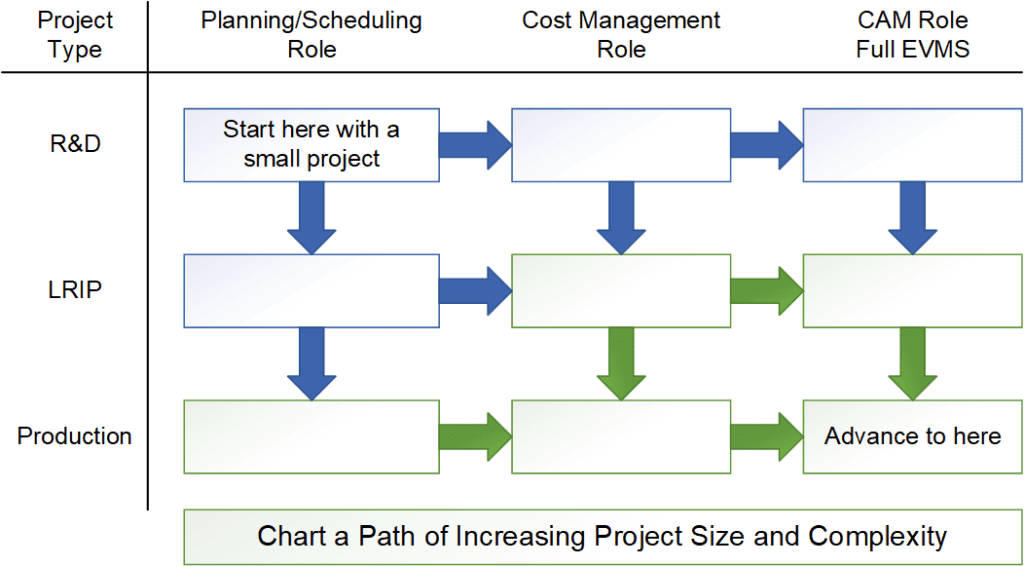
The employee’s mentor helped them to chart a path starting with smaller projects in a planning and scheduling role and then advancing them through different project types and project control roles to larger more complex projects so they could gain hands-on experience in each environment. This approach helped them to broaden their knowledge base across disciplines, improve their skill sets, and learn how to successfully handle increasingly complex project control challenges as well as develop an internal professional network. There were various paths they could follow to progressively gain more experience. The end goal was to become a CAM on a large complex project in preparation for becoming a project manager. This is illustrated in the following image.
Successful CAMs that completed this advancement plan were then moved up to higher management roles such as project managers, business managers, and corporate EVMS directors. For example, one company established a program like this and seven years later, the majority of project managers, business managers, and corporate directors came through this program. The company also offered bonuses for successfully achieving major project milestones or other events such as Integrated Baseline Reviews (IBRs) to keep them focused.
Senior CAMs, project managers, business managers, and corporate directors were the instructors for internal project management and EVM training as well as mentors. This demonstrated to project personnel that excellence in integrated program management was a fundamental component of the company’s business culture.
Essential Components
Common attributes of successful training and retention programs included:
Establishing a program with a defined training and career path to guide and mentor motivated employees whether beginning from a technical, schedule, or cost discipline up through the role of CAMs. The path to become a project manager or high level manager starts with the role of CAM.
Project managers, executive managers and directors conduct the internal project management and EVM training. They are the mentors to junior personnel. They establish the corporate business culture that highlights excellence in project management is a priority. Exceptional project execution results in better financial performance. A commitment to excellence creates a better working environment that reduces the stress level for CAMs and project managers because there is a proven process in place to help ensure achievable project goals have been established.
Motivated employees are rewarded for improving and broadening their skill sets, experience, and knowledge base. They are recognized for their high level of proficiency as well as their role in establishing and maintaining a best in class EVMS regardless of the project they are supporting. Recognition can take many forms that can be tailored to what is important to an employee, whether as bonuses, awards, additional training, or promotions.
Retaining top project management talent requires a plan and strategy corporate management is invested in and actively maintains. It is an inherent component of the corporate culture that demonstrates a commitment to excellence in project management and sustaining a best in class EVMS.
H&A earned value consultants often help corporate business managers and EVM directors chart out training plans for cross-training project personnel and helping them establish internal CAM or project controls certification programs. Licensing H&A training materials or Virtual Learning Lab (VLL) scheduling and EVM online training reduces the time required to develop and maintain training materials. We can do the same for you. Give us a call today at (714) 685-1730.
Originally published March 2023 | Revised May 13, 2026
Quick Summary
EVMS compliance and surveillance reviews continue to identify issues related to poor-quality estimates at completion (EAC), underscoring the need for credible EACs to support effective project management, financial integrity, customer confidence, and funding decisions.
Credible EACs require actively maintained, data-driven estimates to complete (ETCs) that integrate schedule, resource, cost, and risk information along with regular management realism assessments and open communications with all stakeholders.
Organizations can improve EAC credibility by avoiding management imposed targets, keeping schedule and cost systems aligned, routinely reviewing the quality of the ETC data, leveraging evolving tools and analytics, and updating processes to align with the revised EIA-748-E guidelines.
The Defense Contract Management Agency (DCMA) as well as other government entities responsible for Earned Value Management System (EVMS) compliance and surveillance continue to identify issues with the quality of contractor estimates at completion (EAC). Using DCMA statistics, EIA-748-D Guideline 27, Maintain Estimates at Completion, is one of three guidelines1 that represent a third of all EVMS Corrective Action Requests (CARs).
Why Credible EACs Matter
A credible EAC is essential to all stakeholders and a foundation for managing projects successfully. Executive management and project managers must have a complete and accurate understanding of the projected contract or project EAC to ensure financial data is not misrepresented (Sarbanes-Oxley). The customer must have confidence in a contractor’s forecast completion date (FCD) and EAC data to understand whether the remaining work can be completed within the contractual period of performance and target cost, or, if not, how long it will take and how much it will cost.
When the most likely EAC exceeds the negotiated contract cost, the contractor’s profit margins may be at risk. Should the most likely EAC exceed the customer’s funding limit, they will need to secure additional funding, modify the work scope, or slow the pace of the project. No one likes schedule or cost surprises.
What determines whether an EAC is credible?
A credible EAC reflects the cumulative to date actual costs of work performed (ACWP) (costs the contractor has already incurred) plus the current ETC. The ETC must provide a realistic estimate of the time and resources required to complete the remaining authorized work using projected rates. It represents the time phased estimate of spending which translates to the future funds required.
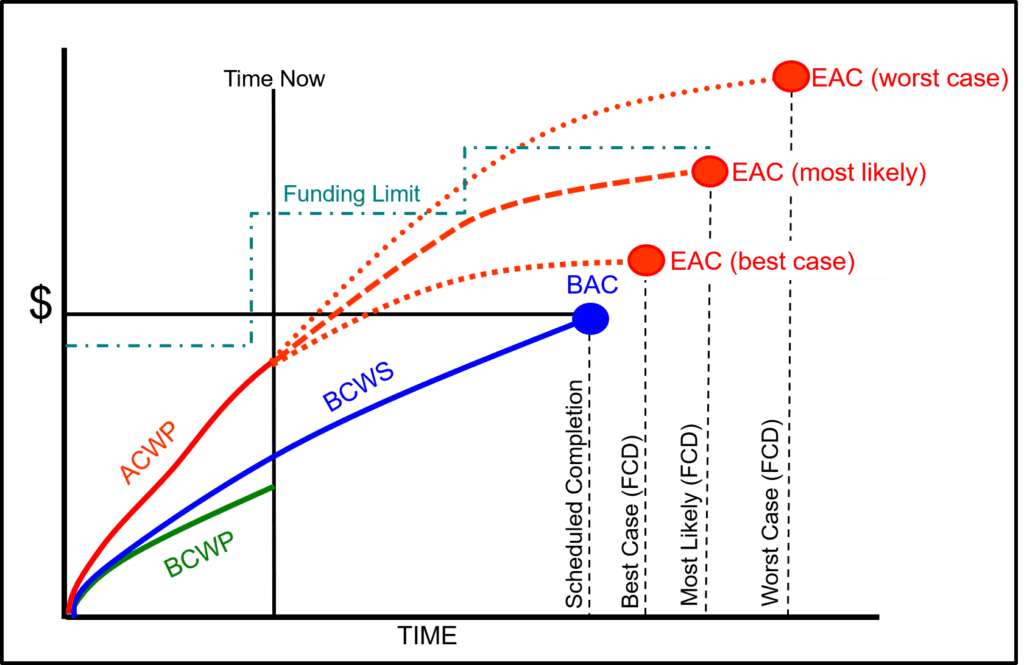
EACs should be based on actual costs and performance to date, the nature and amount of remaining scope, assumptions about and projections of future performance for that scope, risks and opportunities, economic escalation, expected direct and indirect rates, subcontract, and material commitments. As illustrated in Figure 1, project managers should routinely evaluate their project’s ACWP, ETC, and range of EACs along with the funding profile to verify amounts expended and forecasted are within the parameters of available contract funds.
Figure 1: Range of Project EACs with Funding Profile
What project control practices help to ensure EACs are realistic?
Three recommended best practices include:
Actively maintaining the detail ETC data every reporting cycle. This starts with updating the current schedule to include all authorized remaining scope along with the resource loaded activities to reflect performance to date and the latest planning (timing and resource requirements) for work in progress and future work effort. This is the basis for updating the time phased cost estimate for in progress work packages that is added to the cumulative to date actual costs as well as the cost estimate for future work/planning packages. Subcontract forecasted schedules and cost must be included. The current schedule forecast dates and time phased cost estimate must be aligned. Actively maintaining the detail data ensures the current schedule and ETC data reflect the project’s current state. The control account managers (CAMs) can substantiate their ETC with relevant data for analysis and take action to address a significant variance at completion (VAC).
Actively monitoring project FCDs and EACs. Project managers that routinely maintain a range of data driven FCDs and EACs (best case, most likely, and worst case) are better prepared to verify the control account FCDs and EACs are realistic, realized risks have been handled, and emerging risks have been identified, assessed, and addressed. Experienced practitioners use various metrics such as comparing the Cost Performance Index (CPI) to the To Complete Performance Index (TCPI) to test the realism of the EAC. They also include a realism check of the baseline and current integrated master schedule (IMS) to identify any potential disconnects with the cost-based indices discussed in a previous blog, Incorporating IMS Information Directly into IEAC Formulas. Managers should scrub the detail ETCs to assess the quality of the estimates and verify the content of the backup data. A good understanding of the detail ETCs is necessary to produce credible project level EACs with crisp rationale and narratives provided to executive management and the customer.
Maintaining open communications with all levels of management, subcontractors, and the customer. The project manager is the main conduit to manage impacts to their project’s FCD and EAC such as when finance changes direct or indirect rates, there are changes in resource availability or a spike in material prices, or the customer modifies the work scope or funding. As a result, project personnel can quickly handle issues or project changes. Direct and open communications with executive management ensures there is a clear understanding of their project’s FCD and EAC.
What are some things to avoid?
H&A consultants often observe practices that negate the value of maintaining the ETC/EAC and can result in an EVMS corrective action request (CAR). The root cause often points to ad-hoc processes or corporate culture. Examples:
Management provides a target FCD and EAC number the CAMs must match. The ETC/EAC should be “the voice of the CAM”. The CAM is saying “if you give me these resources as scheduled, I can finish the job this way.” Any approach that does not respect the voice of the CAM can cause the ETC/EAC to be unrealistic or at least unsubstantiated. Giving the CAM “the date and number” increases the likelihood the FCD and ETC are unrealistic. There may be a valid reason for this directive as a management what-if exercise or to gain a deeper understanding of the situation. When done as a routine management strategy, it diminishes the value of the ETC data to manage the project’s remaining work and prevent cost overruns. The CAMs should be in a position where they can substantiate their schedule timeline, resource requirements, and cost estimate to complete the remaining work. Project managers should be in a position where they can verify the detail ETC/EAC data to establish a level of confidence in their project level EACs they provide to executive management and the customer.
Project personnel take the path of least resistance. This is often an indication of a lack of direction or an established process. They either do not create the ETC data or maintain it on a routine basis. In some instances, the CAMs manage their ETC data to avoid oversight. An old but valid saying is “the tall grass gets mowed” – the CAM purposely doesn’t raise their ETC to a value that would attract attention. Another troublesome approach is to set a cost management tool option to a static EAC; the CAM may manually update the EAC number quarterly at best. The result? The FCD and ETC data isn’t current; there is zero insight into potential emerging issues. DCMA or the customer can easily identify this when they analyze the time-phased ETC data in the Integrated Program Management Data and Analysis Report (IPMDAR) Contract Performance Dataset (CPD) submittal.
Schedule and cost are created/maintained separately. This often occurs when the schedule and cost tools are not kept in sync for the project’s duration. Significant effort may go into ensuring the data are in alignment to establish the performance measurement baseline (PMB). The IMS resource loaded activities are used as the basis for the time phased budget baseline in the cost tool. However, the ETC data in the current schedule may not exist or be actively maintained. Project personnel only maintain the ETC data in the cost tool and fail to verify it aligns with the current schedule activity forecast dates and resource requirements. It is not part of their routine status and analysis process every month.
Taking Action to Review and Enhance Current Processes
A simple step to start with is to use the IMS Current Execution Index (CEI). This is a useful measure of how well a team can forecast just a single month into the future. If a team cannot achieve a high accomplishment rate against just a one-month forecast, any longer-term ETC is questionable. Start simple and focus on improving the one-month accuracy then move on to longer periods. Build confidence in the team’s ability to see and manage the future.
Another basic step. Build time into the process for managers to scrub ETCs. Maybe it is not possible to scrub every control account ETC every reporting period, but a rotational approach where ETCs are scrubbed as often as possible will improve the ETC and improve the understanding of the ETCs.
Innovate. AI tools are rapidly becoming capable of assuming skilled roles such as project analysts and can yield valuable insight. Tools are already available that can evaluate variances and variance analysis reports (VARs). Poor quality analysis translates to poor quality ETCs. Take action that supports improved analysis.
At a higher level, with the publication of the EIA-748-E Standard for EVMS revised 27 guidelines along with the evolving regulatory environment discussed in a previous blog, Revitalizing Earned Value Management Systems, this is a perfect time to review current EVMS ETC/EAC processes. The EIA-748-E split the EIA-748-D Guideline 27 into two parts: EIA -748-E Guideline 20 focuses on the control account level EACs and Guideline 23 focuses on the project level EACs. The DoD EVMS Interpretation Guide (EVMSIG) for Revision E has been updated accordingly.
We recommend reviewing approved EVM System Descriptions to ensure existing content supports the EIA-748-E Guideline revised text as well as remapping content to the EIA-748-E Guidelines and applicable government guides such as the DoD’s updated EVMSIG. Take the time to determine whether the documented processes make sense. If project personnel are ignoring the current process, it may be an indication it needs a revisit; it may need to be simplified or redone.
Consider reviewing the schedule data quality assessment process. Are project schedules providing an accurate forecast of the time required to complete the remaining work effort? This includes assessing whether task duration estimates are realistic as discussed in another blog, Improving IMS Task Duration Estimates. The IMS is the first line of defense to identify the potential that a cost overrun issue is likely to occur.
Lastly, open communication is essential to ensure technical, schedule, or cost realized risks are visible to all stakeholders. What is certain in any project plan is that things will not go as planned. Success depends upon quickly identifying the root cause of an issue and correcting course to reduce or eliminate the impact.
Reminder of the Objective of the ETC/EAC
The ETC is the detailed step-by-step plan the CAM provides to show how the remaining work will be accomplished. The goal of maintaining a credible ETC and EAC is to verify an executable plan is being regularly updated to accomplish the remaining scope of work within the contract’s schedule, cost, and funding targets for internal management visibility and control. The customer must also have confidence in the contractor’s ability to deliver and meet the remaining contract objectives.
The best way to prevent an ETC/EAC process CAR is to ensure you have a useful established process personnel follow, and they know how to use the schedule and cost tools to consistently maintain quality schedule as well ETC and EAC data. H&A scheduling and earned value consultants have worked with numerous clients to design or enhance their ETC/EAC process. H&A also offers EVMS training workshops that include content on how to develop a realistic EAC. Regular EVMS training always helps to reinforce best practices. Call us today at (714) 685-1730 to get started.
In Part 2 we talked about the over-application of EOCs at or below the Work Package level and how a CAR assuming that a charge against an Element Of Cost (EOC) equals a charge against a “zero-budgeted WP” was inaccurate.
Use a New EOC
Both of the examples from part 2 were over-applications of the EOC requirement. The point here was that the work (it was to design a circuit card), was planned as labor and was also accomplished (earned) in the month it was planned; so the value would be “earned” as planned. In that period, however, it happened that the planned resource was not available, so the work was actually accomplished using a different EOC such as a subcontractor engineer. The contractor’s system properly showed that the design had been completed and the value earned and that the ACWP for that completion was also in the system (i.e. consistent with the BCWP). However, it just happened to be the Subcontract EOC instead of the Labor EOC originally planned, and the CAM addressed the cost difference in the VAR for the Control Account. The team’s comments on the CARs were that the CAM should have replanned the effort using the new EOC instead of the original one. The problem with this is that in many cases the CAM does not know the original resource is not going to be available until the day it happens. There would (1) be no time to process the change and (2) the change would occur in the “freeze period” (actually in the current month), and (3) this could result in unnecessarily large numbers of Change Requests since these types of events commonly occur in the industry.
Noted instances:
Work planned and earned as internal labor (Labor EOC) had to be performed by contract support (subcontract EOC) in that period because of the non-availability of the planned resource.
[Some Contractors consider each labor grade a separate EOC within labor] Work planned and earned for an Engineer 2. However, the period the work was performed used an Engineer 3 (higher cost).
The plan was to build sub-assemblies in-house (Labor EOC), but a machine breakdown necessitated having a vendor provide substitute off-the-shelf assemblies (Material EOC) that month.
In each of these cases, the “EOC ACWP substitution” was temporary, and the work resumed the next period as planned, using the originally planned Element of Cost. The key here is that in each case, the work was performed, and so it was earned; as it should have been. The only difference was that a different EOC was used to accomplish the work – a simple Cost Variance. While it is certainly true that each WP (and PP) should be planned and WPs earned using a single EOC, the misinterpretation here was that every EOC then is a Work package and they are not. In other words, temporarily using a different Engineer category than planned, or using contract support instead of internal labor, or substituting a purchased material item instead of fabricating internally, etc. simply represents a Cost Variances, and should not be cited as a violation of the EVMS Guidelines.
The “consistency” required by the Guideline and the sub-question is that the EOC actually used was expended in the same period in which the work was completed and the Earned Value claimed (i.e. consistent with the BCWP). The variance analysis would show BCWS, BCWP, and ACWP at the CA level with the EOC details at lower levels.
Now for the big “HOWEVER”!
If the switch in use of the alternate EOC is short term, then the differences should be addressed as a Cost Variance (which could be higher or lower than with the planned EOC); HOWEVER, if the change is expected to be permanent or long term, then the CAM should replan the remainder of the work package using the new EOC, and the EAC should be updated, as well, to reflect the new anticipated total cost using that revised EOC.
Note: Some contractors have what is called a “gray badge” environment, whereby a subcontractor charges their labor directly into the Prime contractor’s labor system. Under this arrangement, for this subcontractor, there would be no difference in EOC if the subcontractor performed the work instead of the prime contractor.
Labor, Materials, Subcontracts, Other Direct Costs, and their Indirect Costs (Overhead including General and Administrative —G&A) are the typical building blocks for any project: personal projects and projects we manage for the customers we support. These items are also what the Earned Value Management System (EVMS) Guidelines call elements of cost (or EOCs). So, when the Guidelines call for us to plan and manage by EOC, it really should not cause us any undue anxiety – it is just the natural way to manage any project.
Example: Outdoor Backyard Patio
Let’s use a simple home project example of building an outdoor backyard patio: What do you have to do to determine how much it will cost for this Backyard Patio Project (BPP if you like acronyms)? Generally, you look at such things as:
How much concrete; lumber for decking; nails, screws, bolts, washers, and other hardware, etc.; and weather-coating and paints/stains you will need (Material Element of Cost – EOC).
Work you cannot do by yourself: electricity for lights and power, and natural gas for the Barbecue/fireplace (Subcontract EOC).
Work you will do yourself (Labor EOC).
Costs unique to this project’s completion, such as: Home Owners Association permits, building code permits, local excavation application fee, etc. (Other Direct Cost EOC).
Costs incurred that do not necessarily go into the final product, such as: cleaning supplies, brooms, solvents, turpentine, weather tarpaulins, lighting and electricity, etc. (Indirect Costs/Overheads).
Unfortunately, when operating under the EVM requirement, often managers tend to overthink, and sometimes over apply the management of EOCs. Let’s look at the overthinking part first.
Overthinking EOCs
Guideline 9 of the EIA Standard 748 (Revision D) for EVM Systems requires:
Establish budgets for authorized work with identification of significant cost elements (labor, material, etc.) as needed for internal management and for control of subcontractors.
Some might propose: “I’ll have one Work Package for the Control Account with all the EOCs in it, and I’ll be okay.” That might meet the intent of that first part of the guideline, but would probably fail the requirement that says “as needed for internal management and control of subcontractors.” For example, what EV technique would you use for a “work package” that had labor, material, and subcontract work in it? The labor occurs as the work is performed, the material might be earned at the point of receipt on the dock, and the subcontract might earn value with the receipt of an Integrated Program Management Data and Analysis Report (IPMDAR) dataset at the end of a month. Since the Control Account (CA) has one total dollar budget, the “identification of significant cost elements” has to occur at the Work Package (WP) and Planning Package (PP) level within the CA, which requires each WP and PP to be identified as one of the EOCs mentioned above.
For Instance
In our example, if we lumped concrete and lumber into one “Material WP” and we incurred a serious overrun in material, how would we identify what caused the overrun: the concrete pour or the lumber portion? These are different categories of material that would “earn value” (be accomplished) in different ways and at different times. In order to determine the “guilty party” in the overrun, we should also have separate WPs for the different significant material categories. Some might call these major, or high value, or critical material items, which should be tracked separately.
On the other hand, for the lower-value materials, it may not be significant enough to management to know that a variance might have been caused by a 1-cent washer or a pint of deck stain. Consequently, a grouping of these low-value material items may be all that is required for visibility. Conversely, Management might actually want to break out categories such as, separating the paints/stains, and weather-coating from the nuts, bolts, washers and other hardware, since they are different categories of low-value material that could also earn value differently.
Indirect Cost Rates Must be Applied Properly
For Indirect Costs, some contractors put the burden of planning and managing these overhead costs on the CAMs, while others apply the indirect rates at a summary level of the Work Breakdown Structure (WBS) or organizational structure. Regardless of how a particular contractor does it, the indirect cost rates must be applied properly to the various direct elements of cost:
Material handling charges applied to material items
Indirect Labor rates applied to the direct labor hours
Subcontract overhead applied to the subcontract direct costs
ODC overheads charged to the ODCs identified.
Applying and managing overheads at the CA level would entail hundreds of applications across the number of Control Accounts on a project, but applying these at a summary level would require only a handful of Overhead lines in reports. Doing so would significantly reduce the number of possible errors in application – which is why many contractors do not require CAMs to “manage” overheads in their Control Accounts. [Our BPP example does not have the above types of Indirect Costs that are related to specific Direct Costs, but it does have its own specific Overheads related to the labor to build the Patio.]
A question commonly asked in the industry is “how companies are incentivizing their employees to become Control Account Managers (CAMs)”. Before answering this question, it is important to fully understand what the CAM’s roles and responsibilities are. In addition, it is important to understand the what authority and accountability a CAM has within his/her organization.
CAM Responsibilities
The CAM is the single point of contact for management of the Control Account. Consequently, the CAM is responsible for managing the cost, schedule and technical performance of the Control Account. Below is a list of specific CAM responsibilities that are common throughout the industry:
Establish and maintain Control Account budgets and schedules.
Define the tasks and the sequencing of the schedule for optimizing the accomplishment of the work scope.
Assure the scheduled activities for the Control Account have a realistic duration and performance logic.
Maintain the appropriate portions of the WBS Dictionary and approve the Control Account Authorization (CAA) and authorized changes to the CAA.
Proactively manage the personnel performing the Control Account detailed scope of work.
Identify, negotiate and implement required vertical and horizontal interfaces.
Manage Customer Expectation Agreements (CEA) and Memorandums of Understanding (MOU) with other organizations and programs.
Review and approve all resources and cost type charging to the Control Account and assure its accuracy.
Monitor and assess preponderance of Control Account and Work Directive.
Prepare Control Account Variance Analysis Reports that clearly address cause, impact and corrective action.
Develop, implement and manage corrective actions, as applicable.
Maintain an awareness of the Subcontract Data Requirement List (SDRL) items and other applicable contract deliverables.
Prepare Estimates to Completion for remaining Control Account work scope.
Provide forecast dates for accomplishing activities and milestones in the Control Account Schedule.
Evaluate applicable Critical Path tasks within the Control Account.
Manage the integration and monitor the development of any critical technologies.
Inform management of significant problems concerning Control Account performance.
Identify potential technical and programmatic risks and make effective use of the risk management tool.
Employ the baseline change control process for any revisions to the Control Account’s baseline scope, schedule and budget. Submit Budget Change Notices (BCN) as necessary.
Proactively manage all subcontractor effort that affects Control Account performance.
Lead or participate in Make/Buy decisions.
Evaluate alternatives and develop facility utilization plans as applicable.
Status all work scheduled within the Control Account.
Participate in applicable IPT meetings to assure technical integration.
Update the CAM Notebook to maintain currency and accuracy.
Review and Approve
In addition, the CAM has the authority to review and approve all work assignments, documents and commitments involving his/her Control Account. This results in the CAM being held fully accountable to the Program Manager for overall Control Account performance. Below are some specific items a CAM would have authority over. In addition, a list of accountable actions is provided.
Approve the Control Account Authorization documents.
Co-approve the Make/Buy Plan for any material used in the performance of the Control Account scope of work.
Approve Control Account Budget Change Notices and Requests.
Authorize and coordinate work performed by functional departments on Work Directives within the Control Account.
Determine the work schedule and prioritize work within each Work Directives issued for the Control Account.
Approve hours charged to the Work Directives supporting the Control Account.
Approve material and other direct costs charged to the Work Directives supporting the Control Account.
Identify potential technical, schedule and cost risks and enter them into the Risk Management Process.
Accountable actions by the CAM
Complete the Control Account scope of work within the schedule period authorized.
Complete the Control Account scope of work within the resources authorized.
Achieve the technical performance goals for the defined scope of work.
Achieve the technical quality.
Assure that the reported Earned Value performance is based on quantified back-up data including justification of variances, identified impacts and corrective action plans.
Mitigate all technical, schedule and cost risks associated with the Control Account.
Encouraging CAMs
Appropriate incentives for high performing individuals to become CAMs is a common question across the industry. Many believe they were hired to do the technical aspects of the job and do not want the responsibility of cost and schedule. You hear comments like “this is not what I went to school to learn.” Below are a few suggested avenues an organization can follow to better highlight the importance of the CAM’s role;
Companies will reward individuals with a ~$5k bonus for passing all the requirements in becoming a CAM. In many cases, this encourages individuals to better understand the cost and schedule aspects of the job in order to become an effective and successful CAM. They will be required to take an instructor led class of 3 days for basics of Scheduling, 3-day basics of EVMS, then 3-day Advanced course where both cost and schedule are covered. Then and only then can a title can change from Control Account Leader (CAL) to Control Account Manager (CAM).
Increased Upper Management support and emphasis on the CAM’s role motivates individuals in becoming a CAM. In one example company, the Vice President of Programs required potential CAMs to prepare a presentation proving what they had learned during the CAM Certification/Training process. Having upper management buy-in on the importance of the CAM’s role is crucial.
Organizations will use the CAM position as a stepping stone/pre-requisite toward becoming a Program Manager (PM). This can be an effective technique.
Assurance that the CAMs will have the appropriate Cost and Schedule support staff assisting them as required. CAMs cannot be expected to be the expert in the Technical, Cost and Schedule disciplines on their own. Qualified Cost/Schedule support is essential to properly managing the CAM’s role.
Room for Growth
Any or combination of the above examples can increase the desire of individuals into becoming CAMs. Management positions are not for everyone. Often individuals who are otherwise highly proficient in their existing positions fail as managers. The CAM role is no different. It important for organizations to fully define the roles and responsibilities of the CAM as well as the incentives and goals used. By doing so, organizations will be better equipped in placing the right individuals into CAM positions for success.