EVMS General Topics

Earned Value Management: How Much Is Enough?

, , , , , ,

How Much EVMS Is Enough

I took the scenic route to selecting the theme of this blog. First, it was suggested that I write a blog on the benefits and costs of the earned value process as it applies to program management. Next it was suggested that I describe the harm of not using any of the elements of the earned value process.

In the case of the benefits and costs of the earned value management process, it would be difficult to improve upon Dr. Christensen’s 1998 paper on this heading or to attempt to improve other papers and studies done by Wayne Abba, Gary Humphreys, Gary Christle, Coopers & Lybrand and others. So I will not make citations to these past studies. Rather I will leave them undisturbed, as the monuments they have become.

This blog will summarize my observations of how companies have chosen “how much EVM is enough” for them and share my observations of the results of these decisions. Each company has selected an EVM implementation strategy and each company’s strategy falls along a bounded continuum.

I will describe this continuum of company EVM strategies with a left hand and a right hand goal post, and the space between as a cross bar. The “left hand goal post” represents companies that elect to be very poor at EVM or to not use EVM at all. The “right hand goal post” represents companies that have committed to being “best-in-class” practitioners of the EVM process and are the polar opposite of the companies at the left hand goal post. There are few companies at either the left or right hand goal posts. The “cross bar” represents the vast majority of companies that have selected an EVM strategy somewhere between the left and right goal posts.

Two Goal Posts And A Cross Bar; Recalcitrant, Merely Compliant, Efficiently Expert

There are as many strategies to earned value management as there are companies using EVM to manage their programs and projects.

Left Goal Post; The Recalcitrant

I have firsthand experience with a company, that at the time I initially joined them and had decided to ignore earned value management even though it was a requirement in several of its contracts. After many painful years of attempting to maintain this recalcitrant EVM strategy, this company decided that a better strategy would be to become “efficiently expert” at EVM.

Cross Bar; Merely Compliant at EVM

It has been my experience that most companies desire to “become EVM compliant,” which generally means being compliant to the 32 guidelines and not failing those guidelines so as to be de-certified. This is the vast middle ground between the two goal posts. I will now share five observations regarding companies in the “cross bar” majority.

Observation #1: Compliance As A Goal; Golf and EVM

Compliance should be a “given,” or a “pre-condition,” not a “goal.” Remaining merely compliant implies a status quo or static posture.

I will use the game of golf as an analogy. Golf is a game of honor and compliance to well established rules. All PGA professional tour golfers “comply” with the rules that govern golf. Although all PGA tour pro golfers comply with these rules, their performance on tour differs dramatically.

Fifty-three percent of all PGA golf pros, past and present, have no tour wins. That means only 47% of all PGA tour golf pros have won at least a single PGA tour. There are seven players in the history of the PGA that have fifty or more tour wins. If the bar is lowered to forty or more wins, only three players are added to the list. If the bar is lowered yet again to thirty or more tour wins, only eight more players are added to the list. Only 18 golfers have won 30 or more PGA tournaments.

Professional golfers do not confuse compliance with performance, nor do these professionals assume that “being compliant” will improve their performance.

Observation #2: “The Tyranny of The Status Quo”

With apologies to Milton Friedman and his book of the same name, companies that attempt to maintain mere guideline compliance will do no better than the status quo, and more often than not, regress toward non-compliance. Maintaining status quo is a myth – you either improve or regress.

All professionals, companies included, must compete in their markets and selected fields. To succeed in this competition requires constant improvement in areas critical to success. A company, organization, or individual without the means or the desire to improve will eventually fail and perhaps perish.

Observation #3: Blaming The Scoreboard

As a program manager, I considered EVM as my scoreboard. I reacted to the EVM data – the scoreboard – and made decisions based on that data (GL #26).

I recall the 2014 Super Bowl’s final score: Patriots 28, Seahawks 24. Did the scoreboard cause the Seahawks to lose the game or did a poor decision by their coach cause the loss? Imagine a coach that cannot see the scoreboard. That coach does not know the score or how much time remains. That coach cannot react to the realities of the game.

Observation #4: EVM Causes Poor Program Performance

I have witnessed several company leaders assert that the use of EVM on a poorly performing program is the cause of that program’s poor cost and schedule performance. A correlation between two variables, or a sequence of two variables (use of EVM and poor performance), does not imply that one caused the other. This is the logical fallacy known as “X happened, then Y happened, therefore X caused Y.” Night follows day, but day does not cause night. Use of EVM does not cause poor program performance. Not reacting to EVM data and promptly taking corrective action with your program’s cost and schedule performance often leads to poor outcomes.

Observation #5: It Takes More Energy To Be Poor At EVM Than To Be Expert

Returning to the earlier golf analogy, professional golfers make very difficult shots appear easy. I played in one pro/am tournament years ago. The pro I was teamed with took me to the range hours before our tee time. He asked me how many balls I hit before each round. I told him sometimes none and sometimes 50. He hit 1,000 balls before our round. When we finished our round, he was ready for another 18 holes. I was not. Both of us “complied” with the rules of golf. His score was significantly lower than mine. His game was effortless and produced a below par score. My game was labored and produced a poor result.

And so it is with EVM or any other process. The better you are at a skill, the easier it becomes. Experts consume far fewer calories at their craft than ambivalent amateurs.

Right Goal Post; Efficiently Expert At EVM

The polar opposite of a recalcitrant strategy to EVM is a strategy to become “efficiently expert.” As I mentioned earlier, I joined a company that attempted to sustain a recalcitrant EVM strategy. Their recalcitrant EVM strategy led to de-certification, large dollar withholdings, and significant damage to their corporate reputation.

After the most ardent EVM recalcitrants in this company “sought employment elsewhere,” a new strategy was adopted. This company embraced a strategy to become “best-in-class” as expert practitioners of EVM. This company’s goal was EVM perfection. EVM perfection is an impossible ambition, but wiser than “mere compliance.” And as with the PGA tour golf pro, EVM became nearly effortless.

Which EVM strategy will your company choose?


Robert “Too Tall” Kenney
H&A Associate

Earned Value Management: How Much Is Enough? Read Post »
Common Problems Found in EVM Systems and Recommended Corrective Actions – Part 3

Part 3: IMS Health Problems; Data Item Non-Compliance; Planning Package Misuse

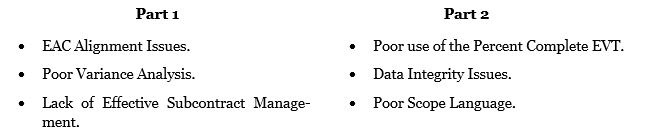
This is the third part of a five part series regarding common findings discovered in Earned Value Management Systems (EVMS) reviews and the recommended corrective actions to help mitigate those findings.  The previous two articles discussed:

Part 3: IMS Health Problems; Data Item Non-Compliance; Planning Package Misuse

The topics anticipated for parts four and five are:

Part 4: Misalignment between BCWP and ACWP; Freeze Period Violations; Failed Data Traces.

Part 5: Inappropriate use of PERT and LOE; Misuse of Management Reserve; Administrative CAMs.

1.  IMS Health Problems 

Several years ago the Defense Contract Management Agency (DCMA) issued the 14-Point Assessment Metrics. Twelve of the metrics are related to the “health” of the Integrated Master Schedule (IMS) while the remaining two (critical path length index and baseline execution index) are “tripwire” metrics for schedule performance.  Of the 12 health metrics, H&A has found that most discrepancy reports (DRs) are associated with missing logic, high total float, and high duration.

Missing Logic:  The DCMA uses logic checks to identify any incomplete tasks that are missing a successor or predecessor, or both.  As a rule of thumb, all activities should be tied to at least one predecessor and one successor with the exception of the first and last activities (respectively) in the project.  By the DCMA’s standards, there is an allowance of 5% for activities not having these types of relationships; but some believe that may be too loose.  In the Planning and Scheduling Excellence Guide or PASEG (National Defense Industrial Association, June 2012, version 2.0) states that all discrete tasks (excluding receipts/deliveries, LOE and summary tasks) should have at least one predecessor and one successor as even one missing logical tie could adversely affect the program’s ability to successfully execute the contract.

High Total Float:  Total float (or “total slack” for Microsoft Project users) is the amount of time an activity can be delayed or expanded before the finish date of the project is affected.  In the DCMA Program Analysis Pamphlet (DCMA-EA PAM 200.1, April 2012), any incomplete tasks with total float greater than 44 working days are considered as having high total float;  an allowance of 5% is also given before this metric trips a red flag.  The primary drivers for inappropriate high total float are missing successor linkages or planning well in advance of need.  For this metric, however, there are many conditions that may drive a high total float value that are perfectly legitimate.  This is especially true for longer projects and production projects that often receive materials well advance of need.

High Duration:  The DCMA Program Analysis Pamphlet classifies incomplete activities with a baseline duration greater than 44 working days as having “high duration”, and again have applied a 5% threshold to the metric.  The fear of very long tasks is that they may not provide enough precision for measurement of accomplishment and will introduce subjectivity into the statusing process.  As with total float, there may be conditions that drive high duration activities that are justifiable.  This is often the case when activities are representative of schedules outside of the IMS, such as at subcontractors or manufacturing planning systems.

Most Common Corrective Action Plans

The IMS is a critical management tool, and the purpose of the health metrics is to ensure that it provides an accurate plan and reliable forecasting for program management and execution.  The basic approach to resolving DRs written for IMS health issues is to first take all the necessary steps to improve the real health of the schedule using the metrics as indicators.  This includes a thorough review of the linkages, relationships, and task durations on an ongoing basis.  Organizations should establish a health check “rhythm”, to be used to review the IMS prior to customer submittal.  This process should also require the CAMs and their scheduling support staff to justify any conditions that may drive tripping a metric.

The contractor should work with its customer to gain a mutual understanding of the conditions that may legitimately result in high total float and high duration activities.  Contractors should try to avoid taking illogical actions, such as adding unnecessary linkages or arbitrarily breaking tasks into small durations simply to meet the metric requirements.  The IMS health metrics are simply indicators of potential issues.  If the nature of the program were one where relatively higher total float values or high durations are to be expected, the appropriate thresholds for tripping a metric may be higher than the standard 44 days.  In these cases, it is worth having a discussion with the customer to establish  new metric thresholds.

2. Data Item Noncompliance

The reports that are generated from an EVMS or IMS, and delivered to the customer, are usually placed on the contract by the incorporation of a Data Item Description (DID) and included in the Contract Data Requirements List (CDRL).  As of June, 2012, both earned value and schedule reporting are included in the Integrated Program Management Report (IPMR), DI-MGMT-81861.  It is important to generate the system reports in accordance with the appropriate DID as the requirements have changed with progressive releases.

Prior to the IPMR DID, IMS reporting was required per DI-MGMT-81650.  For EVM reporting, the previous DID was DI-MGMT-81466A, Contract Performance Report (for contracts established between March, 2005 and June, 2012), and before that was DI-MGMT-81466 or the Cost Performance Report.  The release of the Contract Performance Report DID in March 2005 also eliminated the use of the Cost/Schedule Status Report (C/SSR, DI-MGMT-81467) for new contracts.  There are, however, active contracts which use any one of the above DIDs as the requirements document for earned value and schedule reporting, and compliance of the submitted reports is evaluated against the DID that is required on each contract.

Data Item Descriptions are not just guidelines for reporting, they stipulate the contractual requirements for the documents. There are 203 uses of the word “shall” in the current IPMR DID, and some of these “shall statements” refer to a list of many requirements.  Any planned deviation, or tailoring, from the DID must be approved by the Procuring Authority and documented in the CDRL (DD 1423-1 on DoD contracts).  Section 3.0 of the “IPMR Implementation Guide” (OUSD AT&L PARCA, January 24, 2013) provides tailoring guidance for the IPMR.

Software programs used to generate the IPMR formats have reduced the amount of data specific errors in the reports; however, there are many requirements in the IPMR that are not related to data reporting.  In the requirements for the Format 5 (Explanations and Problem Analyses), for example, there are nine discussion requirements in addition to the required explanations for cost and schedule variances that exceed the variance thresholds.  The narrative portions of the IPMR cannot be generated by a software tool.

A contributing factor in the delivery of poor data items is when the customer encourages noncompliance or does not provide feedback on submitted reports.  It is easy to fall into apathy regarding compliance to the DID when there is no motivation to do so.  This situation, however, does little to convince other reviewers, such as the DCMA, that noncompliance is allowable.

Most Common Corrective Action Plans

When DID noncompliance is found and communicated to the contractor, the best immediate approach is correction and resubmittal of the document.  Noncompliance is most likely a discipline issue which requires a structured approach to developing the report, training the personnel who are responsible, and a thorough review prior to submittal.  Many organizations develop checklists that are used to ensure that all the requirements have been met prior to submittal.  There are also training materials available which can provide cell-by-cell instructions to make the proper entries into these reports (H&A has a DVD titled “Contract Performance and Funds Status Reports (CPR/CFSR) Completion and Reconciliation”).  It may be worthwhile to develop a “buddy system” with another program or another part of the company to exchange outside review and evaluation of data items.  This type of accountability can be mutually beneficial.

3. Planning Package Mismanagement

A planning package is far-term effort in a control account that cannot yet be subdivided into detailed work packages.  Planning packages share similar attributes as work packages, such as a time phased budget, a scope of work, start and finish dates, and must have enough detail in the IMS to support the development of a critical path.  There can be no accomplishment or actual costs recorded against the scope and budget that is defined in a planning package.  When enough information is available to detail plan the planning packages, they are converted to work packages.  This is done through a process called “Rolling Wave Planning”, and it is a good practice to have the detailed information available for at least six months in advance.  Advanced detailed planning is an effective approach to avoid unpleasant surprises, such as lack of availability of the necessary resources or the necessity to begin a hiring exercise.  In addition, near term lack of detail in the Integrated Master Schedule may drive improper or incomplete logic ties, which will impact total float and critical path analyses.

Company EVMS System Description Documents (SDDs) should provide guidance for rolling wave planning, including rules for any baseline adjustment in the current or near term periods.  It is important that planning packages are not allowed to exist in the current or past periods.  It is also improper for any actual costs (ACWP) or performance (BCWP) to be recorded against a planning package.  Most earned value engine software tools prohibit this, but some contractors have been known to override that prohibition in the toolset.  In addition to ACWP and BCWP, there should also be no cumulative BCWS in the current period for any planning package.  Cumulative BCWS is the most noticeable evidence that a planning package was not converted to a work package in a timely manner.

Most Common Corrective Action Plans

The most common corrective action is to conduct a monthly analysis of the EVM data to identify planning packages that are nearing the planning period.  While it is the responsibility of the control account manager (CAMs) to convert planning packages to work packages, Project Controls can easily provide the CAMs with a list of planning packages needing conversion.  If there is no guidance or process written for rolling wave planning, these should be developed to provide instructions to the CAMs and the support staff.  It is also critical that organizations maintain the restrictions in the earned value engines to prohibit the accrual of earned value or actual costs for planning packages.

Please contact Humphreys & Associates if you have any questions on this article.

Common Problems Found in EVM Systems and Recommended Corrective Actions – Part 3 Read Post »

Keeping the EVM Love Alive In Your Organization

,

Keeping the EVM loveAdmittedly, operating an Earned Value Management System (EVMS) in an organization can sometimes be like getting your kids to the dentist.  They know they have to do it, and they will even concede that it may be good for them, but it does not mean they have to like it.

Earned Value provides a framework for integrating the cost, schedule, and technical scope of your project, and is an exceptionally valuable tool for management and project status.  There are, however, a few strategies that can be employed in order to maintain a healthy system by motivating those who operate within the system to do so with a sense of ownership.

Keeping the EVM love alive can follow the simple formula of Push, Pull and Inform.

1)   Push:  Senior Management Must Use the Data and Demand Quality

Having those up the food chain demanding accurate and timely information can be a powerful “push” that maintains interest and focuses efforts on system health and quality.  Organizations where EVM is nothing more than a reporting requirement and is not used for decision making or conveyance of project status, will have a difficult time maintaining a healthy system.  Sometimes negative attitudes towards Earned Value can even start with the customer and flow down to the contractor.

The alternative is in companies in which it is apparent that EVM is deeply embedded in the projects’ culture.  In a multitude of forums, the language of Earned Value is used to describe the status and issues of the project.  In these companies you probably will not see only the obligatory EVM charts in project reviews, but instead see the concepts and outputs of the system used throughout project management.  If poor variance analyses, inaccurate Estimates at Completions (EAC), incomplete baselines, or lack of corrective actions are challenged by the entire chain of management, then chances are those problems will stop being problems and the organizations can begin relying on the information to manage effectively.

2)    Pull:  Keep the System Useful to the Users

A great deal of resources may be invested in an EVMS, and in organizations with a healthy and useful system the return on this investment can be substantial.   Organizations that employ toolsets with timely and accessible reporting of project information help combat the belief that EVM is just a one-way reporting process.  A common interface for data is an “EVM Cockpit”, or some other tool set or reports that make the information easy to access for day-to-day management purposes.  The flip side of this are systems that make data accessibility difficult, or the problems of the system cause the data to be unreliable for prompt decision making purposes.  For example, one of the more important processes in an EVMS is variance analysis; however, when a great deal of time and effort is spent explaining variances that are not related to project performance, it becomes a significant drain on the attitude towards the system.

It is also important that the critical processes of the system are easy to use and understand.  These processes include project baselining, updates to the Estimate to Complete (ETC), statusing the Integrated Master Schedule (IMS), incorporation of changes, preparing variance analyses, and tracking of corrective actions.  Decisions regarding the architecture of the toolsets supporting these processes can significantly impact the attitudes of system users.  In addition, developing tool sets that eliminate the redundancy of data inputs between the cost and scheduling systems can dramatically improve the quality of the Earned Value data.

3)   Inform:  Regular Communication and Continuous Education to the Project Teams are Critical

Like any important management system in an organization, it is important to continually inform and support those who operate within the EVM system.  There is an endless source of special topics and project notifications that can provide useful information to project teams, which will help maintain EVM knowledge and a healthy system.  Some topics, such as preparing quality variance analysis, thorough corrective actions, and valid ETCs, need routine refreshment.

Below are a few suggestions on ways to communicate within the organization:

  • Monthly Internal Newsletter: An excellent mechanism to convey important updates to EV processes or changes that pertain to the business and the industry. This gives employees a chance to keep up with the latest news and developments.
  • EV Blog:  By blogging regularly, an organization can develop themes that are specific to business issues the organization is experiencing. If there are many of the same questions repeated again and again, the blog can be used to answer those questions. This way, people can just refer to the blog if they have questions that are common.
  • Lunch & Learn Sessions: These sessions are an excellent way for all participants to gain further knowledge on a specific topic and ask questions in real time.  This becomes more advantageous as all participants benefit from the group discussion.
  • Quarterly Webinar: This is particularly beneficial for organizations that may have multiple facilities located throughout the country. Specific subjects would be applicable to all sites. All participants, regardless of location, can attend and benefit.
  • Annual Quiz: This is a great way to gauge how well employees are grasping and using EVM. Questions would be centered on topics relating to events that occurred during the year. The quiz could be recurring and mandatory in the same manner as ethics and sexual harassment training.

For more information about keeping the EVM love alive in your organization give us a call at Humphreys & Associates, Inc. We are happy to answer questions.

Keeping the EVM Love Alive In Your Organization Read Post »

The Benefits of Using Nine EVMS Process Groups

The benefit to a contractor initially developing its management system and the documentation of that management system in a System Description Document (SDD) using the Nine Process Groups is to clearly and completely structure its SDD in a natural grouping of related topics.

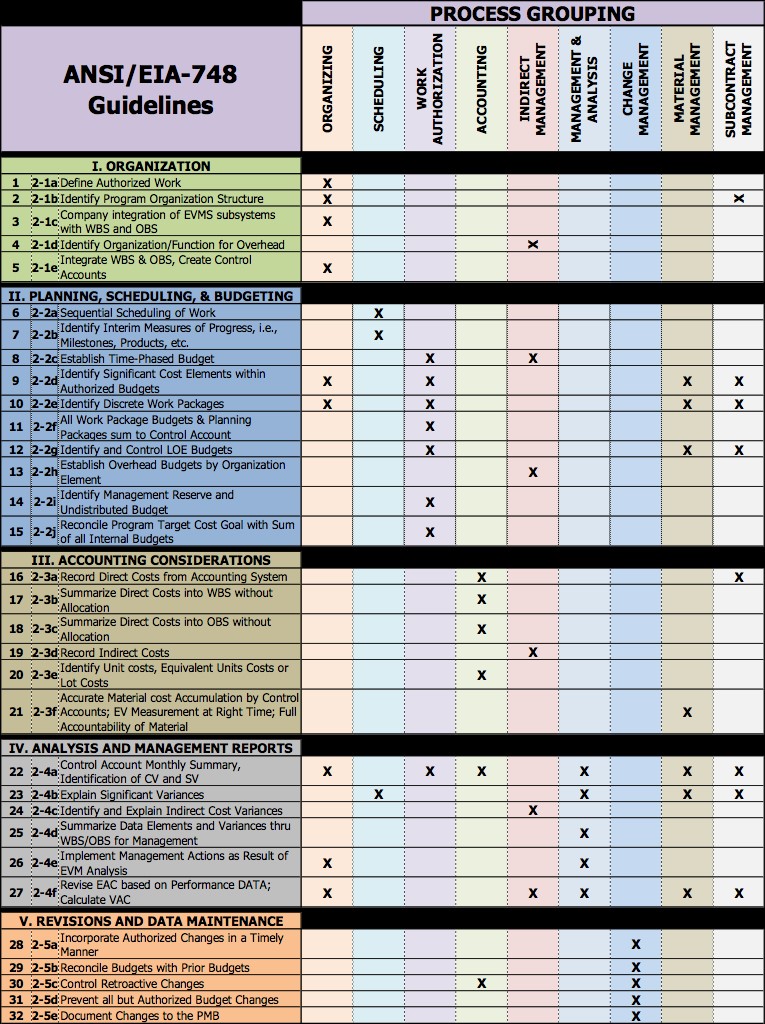
Below are the Nine Process Groups mapped to the EIA-748 Guidelines:

Nine Process Groups mapped to the EIA-748 Guidelines by Humphreys & Associates, Inc.

Guideline Areas

Process Groupings

  • Organization
  • Planning, Scheduling & Budgeting
  • Accounting Considerations
  • Analysis & Management Reports
  • Revisions & Maintenance
  1. Organizing
  2. Scheduling
  3. Work Authorization
  4. Accounting
  5. Indirect Management
  6. Management & Analysis
  7. Change Management
  8. Material Management
  9. Subcontract Management

Why not use the five EVMS sections (guideline groupings) for organizing an SDD?  The 32 guidelines were chronologically organized into these five sections rather than by process.  When a program is started, the focus is to “Organize”.  This includes activities such as:

  • Organizing the staffing  and work (OBS and WBS)
  • Integrating the management control systems and the company’s processes
  • Integrating the WBS with the OBS to establish control accounts
  • Identifying the organization that is responsible for managing the overhead costs

These are all activities that occur prior to the next phase “Planning, Scheduling, and Budgeting”.  This type of grouping is also an excellent method for teaching the basic concepts of EVMS.  An Earned Value course organized in this manner has a natural flow, because each one of the five guideline areas builds upon the concepts of the one before.

An SDD, however, should describe an already established system rather than a concept, and the best framework in which to understand that system is not with a chronological orientation.  Using the five EVMS areas approach often results in a document that is muddled, with disjointed flows of information.  For example the topic of Indirect Cost Management is covered in six different guidelines across four different guideline areas.  Similarly, Subcontract Management is represented in eight guidelines across four guideline areas.  An SDD using the structure of the five EVMS areas would need repeated coverage of these topics throughout.  Many companies also have organizational disciplines represented by several of the nine process groupings, e.g., Subcontract Management, Material Management, Indirect Management, and Accounting are often organizations within the company.  Their associated processes represent the flow of the organization as well as the earned value management system.  The clearest method for designing, reviewing and documenting an earned value management “system” is to structure the system using the nine process groups.  The nine process grouping also follows the DCMA EVMS Cross Reference Checklist and its Management System Characteristics (MSCs) to accommodate contractor system structuring.

Additional chapters or section such as pre-contract award/proposal process, risk and opportunity, and system surveillance could be included in the system description, as they also involve earned value management.

In summary, while either approach could be used to construct the Earned Value Management System, the nine process group structure has proven to be the best architecture for an EVMS document.

For additional information about EVM education, EVMS Consulting or the Nine EVMS Process Groups, feel free to contact Humphreys & Associates.

The Benefits of Using Nine EVMS Process Groups Read Post »

EVM Systems – The 16 Foundational Guidelines

The Earned Value Management System (EVMS) – Standard Surveillance Instruction (SSI) (latest revision February 2012) defines the Defense Contract Management Agency (DCMA) standardized methodology to conduct contractor surveillance on EVM Systems. This includes assessment of contractor processes and procedures to ensure the 32 EIA-748 Guidelines are being followed when contractually required.

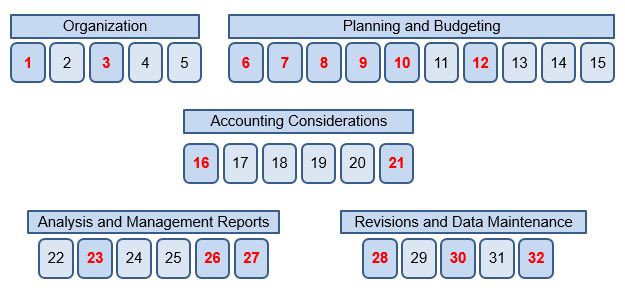
Of the 32 Guidelines, sixteen are considered high-risk or foundational for EVM Systems.  This means that if the requirements of those Guidelines are not met, considered noncompliant, the Earned Value Management System may not produce accurate, reliable and auditable data such that it provides the customer with the information necessary to reliably manage a program.

The 16 Foundational Guidelines are highlighted below in red.

EVM Systems - 16 Foundational Guidelines

Each year, the DCMA prepares a surveillance schedule which includes the five EVMS Areas and associated Guidelines to be reviewed and the programs/contracts involved.  Of the 32 Guidelines, the 16 high-risk Guidelines are evaluated every year and all 32 Guidelines evaluated within a 3 year period.  By concentrating on these 16 high-risk Guidelines, resources for both the Government and the contractor can be used more efficiently.  Concerns with non-high risk Guideline(s) could be surfaced during reviews and these can then be scheduled for additional surveillance.  Generally, a minimum of four surveillance events are planned covering the five EVMS Areas in a given year.

If guideline noncompliance were found in any of the high risk guidelines, this signifies that there are shortcomings in the system and the information produced from that system is not reliable for management purposes.

Although the Standard Surveillance Instruction requirements are that those Guidelines that are not foundational be reviewed by the DCMA at least every three years, it is still incumbent on the contractor to ensure that those Guidelines remain compliant.

The 16 foundational guidelines are:

ORGANIZATION

Guideline 1: Define the authorized work elements for the program.

Guideline 3: Provide for the integration of the company’s planning, scheduling, budgeting, work authorization and cost accumulation processes with each other, and as appropriate, the program Work Breakdown Structure (WBS) and the program organizational.

PLANNING AND BUDGETING

Guideline 6: Schedule the authorized work in a manner, which describes the sequence of work and identifies significant task interdependencies required to meet the requirements of the program.

Guideline 7: Identify physical products, milestones, technical performance goals, or other indicators that will be used to measure progress.

Guideline 8: Establish and maintain a time-phased budget baseline, at the Control Account level, against which program performance can be measured.

Guideline 9: Establish budgets for authorized work with identification of significant cost elements (labor, material, etc.) as needed for internal management and for control of subcontractors.

Guideline 10: To the extent it is practical to identify the authorized work in discrete work packages, establish budgets for this work in terms of dollars, hours, or other measurable units.

Guideline 12: Identify and control level of effort activity by time-phased budgets established for this purpose.  Only that effort which is immeasurable or for which measurement is impractical may be classified as level of effort. 

ACCOUNTING CONSIDERATIONS

Guideline 16: Record direct costs in a manner consistent with the budgets in a formal system controlled by the general books of account.

 Guideline 21: For EVMS, the material accounting system will provide for:

      1. Accurate cost accumulation and assignment of costs to Control Accounts in a manner consistent with the budgets using recognized, acceptable, costing techniques.
      2. Cost performance measurement at the point in time most suitable for the category of material involved, but no earlier than the time of progress payments or actual receipt of material.
      3. Full accountability of all material purchased for the program including the residual inventory.

ANALYSIS AND MANAGEMENT REPORTS

Guideline 23: Identify, at least monthly, the significant differences between both planned and actual schedule performance and planned and actual cost performance, and provide the reasons for the variances in detail needed by program management.

Guideline 26: Implement managerial actions taken as a result of earned value information.

Guideline 27: Develop revised estimates of cost at completion based on performance to date, commitment values for material, and estimate of future conditions. Compare this information with the performance measurement baseline to identify variances at completion important to company management and any applicable customer reporting requirements including statements of funding requirements.

REVISIONS AND DATA MAINTENANCE

Guideline 28: Incorporate authorized changes in a timely manner, recording the effects of such changes in budgets and schedules.  In the directed effort prior to negotiation of a change, base such revisions on the amount estimated and budgeted to the program organizations.

Guideline 30: Control retroactive changes to records pertaining to work performed that would change previously report amounts for actual costs, earned value, or budgets.

Guideline 32: Document changes to the performance measurement baseline.

For more information on these guidelines or to inquire about EVMS implementation and remediation, contact Humphreys & Associates.

EVM Systems – The 16 Foundational Guidelines Read Post »

Scroll to Top