EVMS General Topics

Earned Value Management for Biotech and Pharma – Part 2 Accounting

By Ric Brock – Engagement Director, Humphreys & Associates

As a follow up to our article on the Earned Value Management for Biotech and Pharma Industries, this is a quick look at how Biotech and Pharma companies collect and manage costs compared to accounting requirements on federal acquisitions.

The Operating Model for the Biotech and Pharma Industry

The basis of the Biotech and Pharmaceutical operating model is to discover/invent a compound or device to meet a need, validate its safety and efficacy, ensure proper patent protection, market it as quickly as possible, and maximize commercialization while there is still patent protection.  In short, it is about speed to market and maximizing the commercial life cycle.

Operating costs are collected and managed from a process costing basis.  Internal costs are usually not collected by a cost objective, as they are not managed to that level of detail.  Most internal labor is collected by department total headcount and labor dollars.  Project or activity based timekeeping is not practiced; i.e. time cards are not used.  External costs (materials, contract services, subcontractors, etc.) are collected within the purchasing system and can be tied to specific activities and traced to the originating departments.  Most companies do have the ability to set up and track job costs within their capital management system.

Federal Acquisition Regulations (FAR), Cost Accounting Standards (CAS), and Timekeeping

The ability to plan and collect actual costs in a consistent and systematic manner by contract/project is a key to the Earned Value Management System requirement.  The costing of items and services purchased by the US Government on a non-firm fixed price basis are covered in the Federal Acquisition Regulations (FAR) and the Cost Accounting Standards (CAS).  The ability to collect costs in a consistent and timely manner is an EVMS prerequisite.

Federal Acquisition Regulations

Federal Acquisition Regulations (FAR) are a set of regulations governing the US Government processes of purchasing goods and services.  Among the guiding principles are to have an acquisition system that satisfies the customer’s needs in terms of cost, quality, and timeliness; to conduct business with integrity, fairness, and openness; and to fulfill other public policy objectives.

Part 52 of the FAR contains standard contract clauses and solicitation provisions. Many clauses incorporate parts of the FAR into government contracts by reference, thereby imposing FAR rules on contractors.

Part 30 of the FAR describes policies and procedures for applying the Cost Accounting Standards Board (CASB) rules and regulations [48 CFR Chapter 99 (FAR Appendix)] to negotiated contracts and subcontracts. This part does not apply to sealed bid contracts or to any contract with a small business concern [see 48 CFR 9903.201-1(b) (FAR Appendix) for these and other exemptions].  Part 30 also identifies the standard contract clauses and solicitation provisions contained in FAR Part 52 that are to be incorporated when applying the CASB rules and regulations to a contract or subcontract.

When a government agency issues a contract or request for proposal, it will specify a list of FAR clauses that will apply.  In order to be awarded the contract, a bidder must either comply with the clauses, demonstrate that it will be able to comply at time of award, and/or claim an exemption from them.  A bidder must also ensure that it understands the contractual commitments, as complying with some FAR clauses may require changes to operating processes.

Cost Accounting Standards

Cost Accounting Standards (CAS) are a set of 19 standards and rules (CAS 401 – 420) that the US Government uses in determining the costs on negotiated procurements.

A company may be subject to full CAS coverage (required to follow all 19 standards), modified CAS coverage (required to follow only Standards 401, 402, 405, and 406), or be exempt from coverage.

Full coverage applies only when a company receives either one CAS-covered contract of $50 million or more, or a number of smaller CAS covered contracts totaling $50 million. In addition to complying with the standards, the company must also file a CAS Disclosure Statement (CASB DS-1) which clearly describes the company’s accounting practices (such as what costs are treated as direct contract charges and what costs are treated as part of an overhead expense). There are two versions of the CAS Disclosure Statement: DS-1 applies to commercial companies while DS-2 applies to educational institutions.

Modified coverage applies when a company receives a single contract of $7.5 million or more. 

Timekeeping

Despite the significant role timekeeping plays in government contracting, the FAR provides little direction on timekeeping.  This lack of guidance has been left to government audit agencies (such as the Defense Contract Audit Agency (DCAA) to establish audit standards.  The DCAA uses its Contract Audit Manual (CAM) to provide audit guidance to its auditors.  The CAM provides guidance on auditing timekeeping procedures in section 5-909.  The audit manual states that timekeeping procedures should be able to “assure that labor hours are accurately recorded and that any corrections to timekeeping records are documented…”.

This timekeeping system should feed a labor distribution system that maintains labor hours and dollars by employee, by project/contract, and type of effort account.  This labor distribution should be reconciled to the general ledger labor accounts at least monthly.

Timekeeping is critical.  Unlike other contract costs, labor charges are not supported by external documentation.  The move by a Biotech/Pharma company to a formal timekeeping system may require extensive cultural change.

Summary

As Biotech and Pharmaceutical companies move to FAR contracting, it will require a transition to a project/job costing basis from a process costing basis.  This change may appear straight forward, but any process change requires sound change management.

All aspects of EVMS are critical to ensure the utility of an effective program management tool.  In this blog we provided a summary level look at cost accounting data.  The ability to collect valid, timely, and auditable cost is the foundation for the Actual Cost of Work Performed (ACWP).  Without knowing what we accomplished and what we spent to get to where we are, it is very hard to predict where we are going: the Estimate to Complete (ETC).   As a company designs and develops its EVMS, it must make sure actual cost collection and management is also addressed within the FAR and CAS requirements.

For questions or inquires on how to implement Earn Value project management in the biotechnology or pharmaceutical industries, contact one of the experts at Humphreys & Associates.

Ric Brock - Engagement Director, Humphreys & AssociatesMr. Brock has over 30 years of experience in program and project management, operations, and quality assurance in government and commercial environments.  He has extensive experience working with all levels of an organization, from top management to performing personnel. Ric has extensive experience supporting Pharmaceutical companies in life cycle management, filing new drug applications, and launching new drugs.  He has a wealth of experience with EVM systems across a variety of industries from defense to commercial including biotech/pharma. You can find Ric on LinkedIn


Earned Value Management for Biotech and Pharma – Part 2 Accounting Read Post »
EVM Lite – Part 2: Tailoring approaches to EV Lite

So, what if there is no EVMS contract requirement, but a company wants to use the EVM principles to measure performance on important work?

Approaches for tailoring EVM Lite (also called EV Lite):

  • First, the levels of the Work Breakdown Structure (WBS) could be limited to minimal extension.  With fewer lowest level WBS elements, fewer control accounts are created which results in a reduction in the overall administrative costs of the system.
  • Similarly, responsibility can be assigned to managers higher in the Organization Breakdown Structure (OBS), or Integrated Product Teams can be used to combine functions.  By having fewer lowest level OBS elements, fewer control accounts will be created.  Most contractors are well aware of these implementation tactics and actively engage in them.
  • Other approaches include the Project Schedule – more distance between the milestones and use of the Percent Complete Technique, providing the validity of the Earned Value (EV) data is unaffected.  Also, the Variance Analysis Report Thresholds could be tailored to specific risk areas and made less stringent.  The Change Control Process could be tailored to a more streamlined transfer of work and budget involving Stop Work Orders.
  • With respect to reporting, The Integrated Program Management Report (IPMR) or Contract Performance Report (CPR), Format 2, Organizational Categories, and Format 4, Staffing, could be eliminated.
  • In some cases, Format 3, Baseline is eliminated.  Note: The new IPMR Guidance does not allow tailoring of the Contract Data Requirements Item List (CDRL) to removed reports on contracts that exceed $50 million.  None of the bulleted “EVM Lite” items above are even in the realm of the acceptable items for EVMS tailoring.  If a company has an EVMS contract requirement, EVM Lite will not receive a favorable reaction from the DCMA.

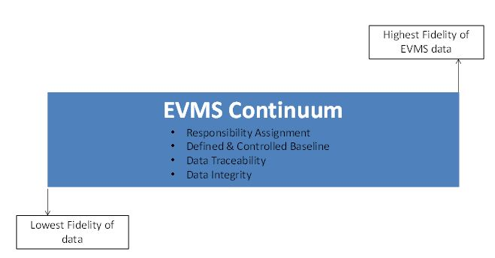
Some companies use EVM for critical internal Research and Development projects or fixed priced work.  Companies need to ask the question “Where do we want to fit in the EVMS Continuum?”  Consider the graphic below:

EVM Lite: Part 2 -EVMS Continuum by Humphreys & Associates

The right hand side of the continuum represents implementation of EVMS to the maximum, and represents the highest cost to operate and maintain an EVMS.  The left hand side represents something that looks like EVMS because it contains Earned Value, but none of the discipline necessary to ensure the integrity and traceability of the EVMS data.  Most people that talk about EVM Lite want to be closer to the left hand side of the continuum.

Any alternative approaches must consider the trade-off between the steps necessary to maintain good baseline control and system discipline versus implementation/ maintenance costs.  If the performance measurement baseline is not adequately controlled, a good basis for measurement does not exist.  If the earned value is not reliable and other data integrity issues exist, status reporting is suspect and the data cannot be used with confidence to forecast expected outcomes.

Humphreys & Associates can help a company’s team sort out which methods would work best for its project.  H&A EVM experts can help determine which requirements can be relaxed, which ones need to be implemented and still maintain the fundamental EVM principles within each subsystem.

EVM Lite – Part 2: Tailoring approaches to EV Lite Read Post »

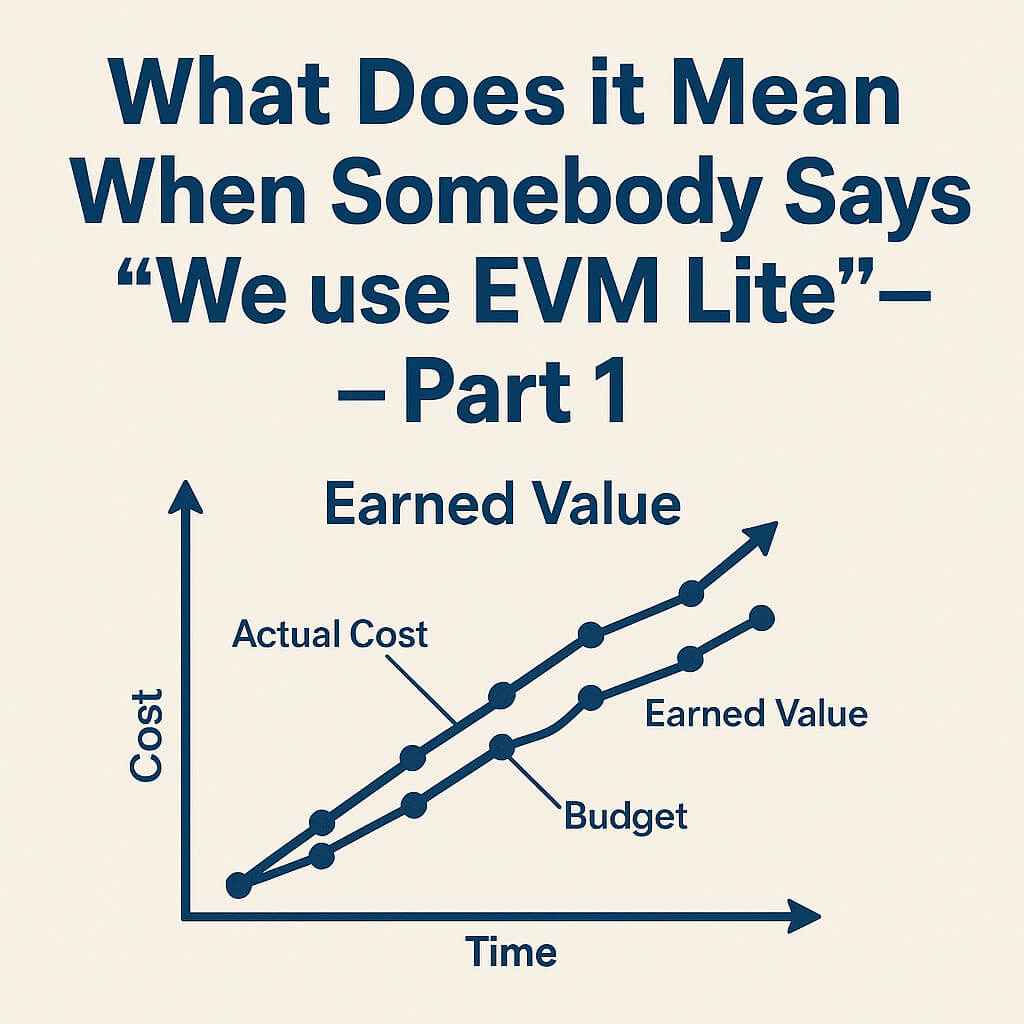
What Does it Mean When Somebody Says “We use EVM Lite” – Part 1

Here is why Humphreys & Associates takes an interest in the EVM Lite approach to Earned Value Management.

Earned Value Management (EVM) “lite” or EV Lite is a hot topic because people recognize that budgets versus actual costs are not meaningful enough for assessing true project technical/schedule/cost status. An awareness exists that there is a significant advantage to using Earned Value (EV) measurement to manage projects.

The EVM Lite approach is common for Independent Research and Development and Firm Fixed Price (FFP) projects. Therefore, it is important to understand what this term means.

EVM Lite is a title that could mean a combination of any of the following:

  • Relaxation of the level of detail (fewer control accounts of larger size, fewer work packages of larger size with less milestones/technical achievement points and  more dependence on subjective earned value techniques )
  • Less rigor in approvals for Work Authorization Documents (WAD) and Budget Change Requests (BCR)
  • Less rigor in Rolling Wave Planning and enforcement of the freeze period
  • Less rigor in the variance analysis process, including looser variance thresholds
  • Compliance with only the 16 “critical” American National Standards Institute, EIA-748 Guidelines
  • Earned Value Management System (EVMS) not subject to third party verification
  • Less detail in the EVM System Description (fewer examples, no “live” data examples)
  • EVMS Cross Reference Checklist only at the Guideline level

EVM Lite implies an EVMS with relaxed requirements or a less rigorous approach that still meets the spirit and intent of the EIA-748 Guidelines. But it is important to note that none of the descriptions of EVM Lite above would pass muster in a DCMA review to determine whether a contractor’s EVMS complies with the EIA-748 Guidelines and cannot be used in that event.

If a contract mandates the use of an EVMS then EVM Lite is not an option. It is important to us our customers know this. However, if your contract does not mandate the use of EVM, then EVM Lite might be a viable option to pursue if management desires insight into their programs.

Part 2 – Tailoring Approaches to EVM Lite 

What Does it Mean When Somebody Says “We use EVM Lite” – Part 1 Read Post »

Aligning ACWP with BCWP for Proper EVM | Earned Value Management

, , , ,

Last Updated May 22, 2025

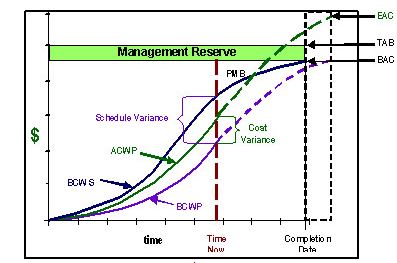
ACWP and BCWP by DAU

What is estimated Actual Cost of Work Performed (ACWP)?

Estimated ACWP is an adjustment to the actual cost data imported into the EVM cost tool as the Actual Cost of Work Performed (ACWP) to align ACWP with Budgeted Cost for Work Performed (BCWP).  Estimated ACWP is synonymous with “estimated actuals.”

Why is Estimated ACWP necessary?

Without Estimated ACWP, timing mismatches between ACWP and (BCWP) cause false cost variances to be calculated in the EVM cost tool as well as from the data in the Integrated Program Management Data Analysis Report (IPMDAR) Contract Performance Dataset (CPD).  Typically these variances are favorable and can mask other unfavorable variances.  Additionally, if these variances exceed reporting thresholds, the explanations clutter the IPMDAR Narrative Report with variance explanations that discuss timing problems of the accounting system rather than actual performance issues.

When should Estimated ACWP be used?

Estimated ACWP is most typically required for material costs.  For example, when BCWP is claimed upon receipt of the material, the payment for accrued costs in the accounting system typically occurs one or more months following material receipt, which creates the timing mismatch between BCWP and ACWP in the EVM cost tool.  Other cost element types that may require Estimated ACWP include subcontracts and Other Direct Costs (ODC).  Examples of ODCs that may require Estimated ACWP include staff augmentation, purchased labor, and travel.

How does Estimated ACWP function?

Receipt-type material:

  1. First, a determination must be made whether Estimated ACWP is necessary.  For some categories of material, when a material item is received, the BCWP is claimed in the EVM cost tool.  If actual costs for the materials do not enter the accounting system in the same period that the BCWP was claimed, Estimated ACWP is necessary to ensure ACWP occurs when BCWP occurs.
  2. Second, the Estimated ACWP adjustment is entered into the EVM cost tool as a current period transaction.  The amount of the Estimated ACWP is based on the best information available for the material item (often accrued costs in the accounting system) using the invoice, purchase order, or receiving report.
  3. Third, the Estimated ACWP adjustment transaction is reversed in the EVM cost tool when the actual costs are recorded in the accounting system; this could be the following reporting period or later.  If actual costs were to come in that month and the transactions were not reversed, the ACWP would be double-counted when the actual cost data from the accounting system is imported into the EVM cost tool. Also, the Estimated ACWP transaction should be recorded in a log to maintain traceability. 

Production-type (inventory) material:

For production type materials, or materials that are common to many control accounts or even contracts, that go into inventory, earned value is claimed upon issuance from inventory, sometimes several months after receipt of the material and after the incurrence of actual costs in the accounting system.  In this case, the opposite condition would exist.  The accounting actuals occur before earned value is claimed for material. The EVM rules in the EIA-748 Standard for EVMS Revision D Guideline 21 or Revision E Guideline 14 (and common sense) state that ACWP is not to occur until BCWP takes place.  Therefore, the accounting actual costs have to be “suppressed” from entering the EVM cost tool until material earned value is claimed. Since some companies say they cannot suppress actual costs, they let the actual costs enter the system, but make an off-setting “Negative Estimated ACWP” entry in the EVM cost tool until the material is issued and BCWP can be claimed for the material.

Do you need to implement an Estimated ACWP process in your Earned Value Management System?  Humphreys & Associates has the earned value experts to assess your material management processes and to help you implement the appropriate procedures. Contact us today.

Aligning ACWP with BCWP for Proper EVM | Earned Value Management Read Post »

Part 2 – Weekly Earned Value: More trouble than it’s worth?

Part 2 – Continues with the benefits and implementation of weekly Earned Value Management. Here is the link to Part 1

Part 2 - Weekly Earned ValueIn the past, accounting systems were not able to update actual on a weekly basis. The legacy systems could accrue actual every two weeks or at month end. Now, most labor timekeeping systems are linked to a cost system that updates daily. With this daily labor cost input capability in place, weekly Earned Value (EV) provides real time information on what has been spent for the work accomplished.  Newer software tools are more accommodating with regards to material and subcontractor cost accruals.

It is now easier to input estimated actual for invoices to accommodate the lag between an acquisition commitment and the actual billing for services or material.   On a single project with multiple subcontractors using different software, the weekly accounting of data can become complicated.  The prime contractor may end up manually inputting data from the subcontractors each week. The ideal situation is for all subcontractors to use the same software or data exchange format in order to have a seamless transition of data to the prime contractor. This ensures accurate and timely submittal of data on a weekly basis.

Weekly earned value takes some initial effort to establish. Management must be committed to a proactive stance. The biggest challenge is changing the culture of the program team. This requires a new paradigm of effective weekly management of the program and proper use of the available software tools. Earned Value Management (EVM) is an effective way of managing work whether done weekly or monthly and can be more efficient than month-end reporting.

The major hurdles in implementing weekly EV include:

  • Gaining user and management acceptance
  • Getting everyone, including subcontractors, integrated with compatible schedule, cost, contract and internal change tracking software
  • Processing schedule changes in a timely manner

Many companies already have many of the software tools to make the transition from a monthly basis to a weekly basis. Weekly earned value drives more effective automation which can potentially decrease overhead, a important factor over large or multiple projects. It provides quality, real time performance data for decision analysis and corrective actions.  Weekly EV also reduces the chances of being surprised with major cost or schedule variances by improving the overall early warning features of the system.   More time is available for management to respond to variances and develop corrective action plans. For many companies this is a business best practice and their customers are taking note.

Good business practices dictate that programs have schedule, cost, and change information available on an ongoing basis. Weekly EV insures this process. Implementing a weekly Earned Value Management System is proving to be well worth the time and effort.

For more information about implementing weekly earned value, contact Humphreys & Associates. We have many years of experience in efficient Earned Value Management processes

Part 2 – Weekly Earned Value: More trouble than it’s worth? Read Post »

Part 1 – Weekly Earned Value: Is It More Trouble Than it’s Worth?

Part 1 - Weekly Earned ValueThe notion of implementing weekly Earned Value (EV) causes most Program Managers to cringe. Many companies, however, are now using weekly EV as an internal management process. The business driver for this decision is the benefits that contribute to the overall success of the program.

The discipline of performing weekly EV ensures a more thorough report to the customer at month-end.  Many areas of the Joint Strike Fighter (JSF) program are successfully using weekly Earned Value. The V-22, the F/A-18E/F, and the IRS PRIME programs have used weekly EV as a standard business practice.

 Why does weekly EV have an appeal? Is weekly just as good as monthly? Do the benefits outweigh the initial costs of implementation?  Analyzing weekly EV data is far superior to looking at a performance report on a monthly basis.  This can best be described as a “proactive” approach to program management rather than a “reactive” mode.  There are new processes and cultural impediments involved when implementing weekly EV, but the benefits outweigh the costs.

 In order for weekly EV to be successful: 

  • Planning must be sufficiently detailed to objectively provide status on a weekly basis;
  • The budget must be time phased on a weekly basis
  • Accruals of labor and material costs must be done every week.

These three processes, combined with trained and proactive personnel, form the ground work for successful weekly Earned Value Management (EVM).  Weekly EV will provide continuous visibility of program performance with real time status.

A successful Earned Value Management System (EVMS) begins with a well-designed schedule.  Without an accurate and valid schedule in place, the EVMS is virtually useless. The schedule must be time phased and resource loaded consistent with the work to be accomplished.  A proper scheduling tool that can be integrated with the appropriate cost software is essential.

The EVMS scheduling tool must have:

  • The ability to record and display status
  • Convert the status to a percent complete
  • Show milestone completions
  • Accurately compare that status to costs on a weekly basis

 The program’s organizations must be trained in providing schedule status on a weekly basis.

For companies without this existing infrastructure, acquiring a new scheduling will incur some initial costs.  Many companies have an adequate scheduling tool deployed, have the schedule status updated weekly and weekly performance assessments.   High-risk programs, such as R&D efforts, have work scheduled weekly to maintain tight control over schedule and cost. This makes integration of the schedule into a weekly EVMS nearly painless.

This is the first of a two parts on “Earned Value – Is it Worth It? presented by Humphreys & Associates, Inc. 

Part 1 – Weekly Earned Value: Is It More Trouble Than it’s Worth? Read Post »

Scroll to Top