
Earned Value Consulting

Earned Value Consulting is support services that an expert in Earned Value Management (EVM) provides to an organization to help them implement an Earned Value Management System (EVMS). EVM consulting services may be offered by organizations that have certified Earned Value professionals on staff, or by service providers who have been trained in EVM and can offer advisory or implementation services.

For a full description of what Earned Value Consulting is and who it is for, see our Knowledge Base article: https://www.humphreys-assoc.com/evms/earned-value-consulting-ta-a-252.html

EVM Consulting – Modeling & Simulation

, , , , , , , , ,

Fighter Jet Air Plain Flying in Front of Moon

Forewarned is Forearmed

Forewarned is forearmed. John Farmer, of New Hampshire, said that in a letter in 1685. But that advice is most likely biblical and very much older. No matter the source of the thought, we should take it as divine guidance if we are project managers. Maybe we should have it cut into a stone tablet, so we can share it with our team members.

Most of our work as project managers is spent in the “controlling” phase which is made up of the three steps “measure, analyze, act.” Our EVMS and IMS exist to be able to support this management function. The measuring part is done very well in our EVMS and our IMS; we know where we are and how we got there. The analyzing is equally well handled in the IMS and EVMS. Only the management task of acting is not well supported. Generally, we lack decision making support and tools.
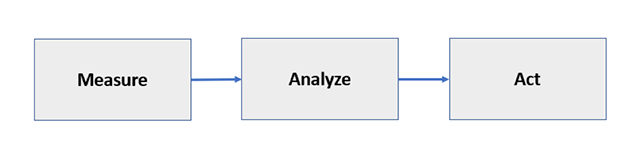
EVM Consulting - Measure, Analyze, Act

Deterministic Path

No matter how well constructed and how healthy our IMS is, it has a deterministic path forward. The logic links between the activities are there because we expect them to be fulfilled. Indeed, if activity “B” is a finish-to-start successor to activity “A” we fully expect that at some point activity “A” will finish and will provide its output to activity “B”. That is a single path forward and it is a deterministic path. It is also a somewhat simplistic model.
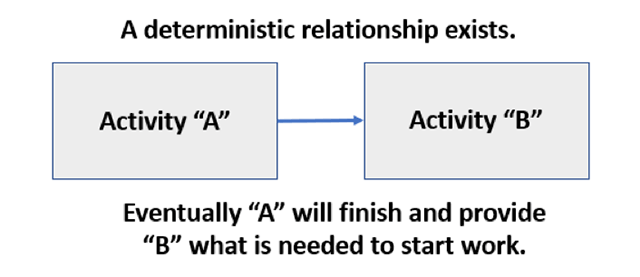
EVM Consulting - Deterministic Relationships in EVMS

Multiple Outcomes

Our management system asks us to perform root cause analysis followed by corrective action. But what if there is more than one corrective action to be taken. And worse; what if the corrective actions can have multiple outcomes with each enjoying its own probability. That means multiple choices and multiple outcomes. How would we show that in our plan? How would we analyze the multiple possible futures that such a situation presents?

Happily, there are ways to model a future without a set path. And once we have the future model, there are also ways to simulate the outcomes to give the probabilities we need to decide which actions to take. We are talking about probabilistic branching, and we are saying that we can build a probabilistic map of the future to use in making decisions; especially making decisions on corrective actions.

Take a simple example of running a test on the project. The expectation is that eventually we will pass the test. We will keep trying until we do. In the IMS deterministic model the test portion of the IMS might look like this:
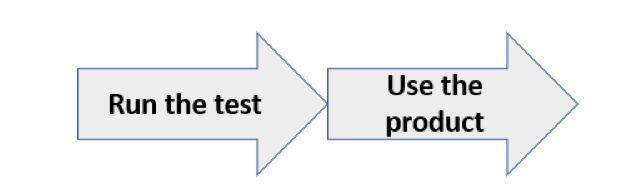
EVM Consulting - Run the Test then Use the Product

Simulation

We can simulate this situation with different expected durations for the test. That is helpful information, but it does not explain or even capture what is going on in those different durations. It looks like we are just taking longer to do the testing but is that really what is happening? What is going on here? We certainly don’t show that.

In the real world, this simple model might have three potential outcomes. There might be three paths we can take to get to the point where we use the product. Each path has a time and money cost. We might run the test and find that we passed. Or we might have to stop the test for issues on the item or the test setup. We might even fail the test and must correct something about the product to improve our chances of passing a rerun. Eventually we will get to a usable product. But what do we put in our estimate and our plan? What do we tell the resources we need? What do we tell the boss? The customer?
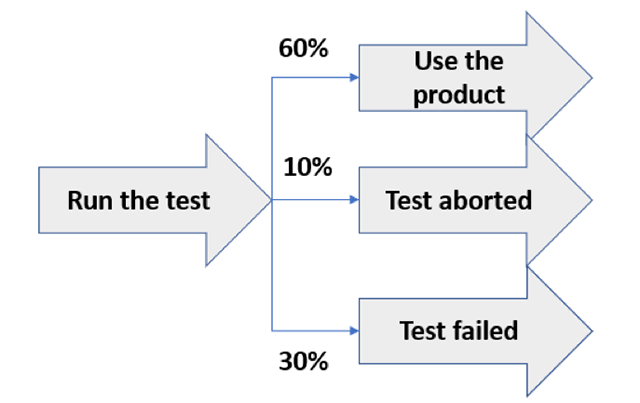
EVM Consulting - Real World Testing

Full Future Model

We now have a much better understanding of the future and can explain the situation. We also can simulate the situation to find out the most likely time and cost outcomes, so we can explain the future without any histrionics or arm waving.
If the issue is important enough we can build out the full future model and simulate it.
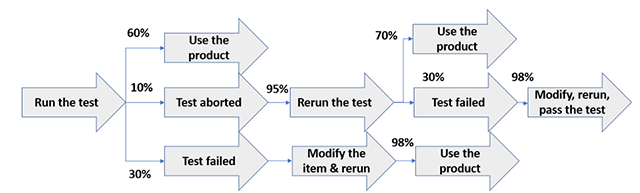
EVM Consulting - Full Future Model and Simulation

No matter how far we pursue the model of the future, having a valid model and being able to stand on solid ground are very valuable to us as project managers.

This is not to say that we should model out complex situations as a routine in the IMS. That would be impossible, or at least prohibitively costly. We are saying that when situations arise, we need to be able to use the IMS to help us make decisions.

This type of probabilistic modeling of the future is particularly useful in defining major decision points in our plan. When we reach a decision point the IMS may have multiple branches as successors but that implies we take every branch and that is not valid. Modeling each branch and its probabilities is valid. In the example below, where the milestone represents a decision point, we have shown three possible paths to take. If each were modeled out into the future with time and cost data, we should have the information we need to choose the path we wish to pursue. Without processes and tools like this, we would be flying blind.

Future Blog Posts

This discussion will be continued in future blogs to develop a better foundational understanding of the process and power of probabilistic modeling in our EVMS.
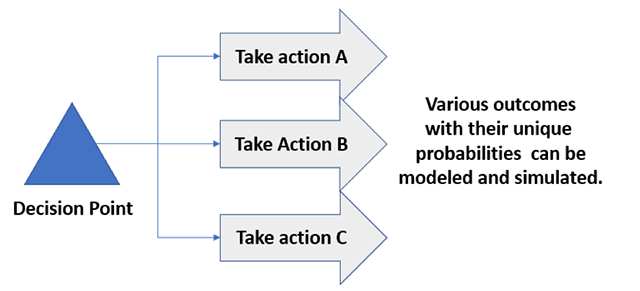
EVM Consulting - Decision Point

Good information sets the stage for good decisions. The IMS and the EVMS have sufficient information to help us model the pathways ahead of our critical decisions. We just need to learn to take advantage of what we have available to us.

Find out how an experienced Humphreys & Associates EVM Consultant can help you create a full future model and simulation of your most vital EVMS Systems. Contact Humphreys & Associates at (714) 685-1730 or email us.

EVM Consulting – Modeling & Simulation Read Post »

Project Management: Earned Value Consulting; Could You Use Some?

, , , , ,

Failed Projects

A recent article discussed the results of a survey on the reasons that projects failed. The definition of failure was that the project was abandoned. Abandonment does not occur frequently in the world of government projects; especially defense projects where there should be strong “must have” needs driving the project. These projects tend to persist until completed even though the outcomes are not satisfactory. But there is a lot to learn from the list of reasons for failure.

Of the sixteen reasons listed, the top four had to do with changes to the environment that had given rise to the project. For example, changes in the company priorities was the most often cited reason for abandonment. In that same vein were issues with changing objectives and inaccurate definition of requirements. These types of failures are not topics for this blog since they do not immediately involve execution of the project.

Execution Problems

Lower on the list of those environment related reasons for failure were the ones more related to execution problems. These are of significant interest to a project management using an earned value consulting company such as Humphreys & Associates (H&A). These reasons related more to issues of poor project management that could have been corrected. In this area were reasons like “poor change management,” “inaccurate cost estimates,” “inaccurate time estimates,” and “inexperienced project management.”

The answers given in a survey situation depend very much on the mindset of the person responding. Is the reason really “inaccurate cost estimates” or should it have been “failure to execute to the estimate”? How many times have you seen a problem in execution “swept under the carpet” as being an inaccurate estimate or plan? One of these two answers points to the estimating system and process while the other points to project management. The estimates were generated; and, at some point, they were deemed to be sufficiently detailed to launch the project. If a scrubbed and blessed estimate is “inaccurate” that would still be a failure of project management. If the problem were really a failure to execute, then how easy would it be to blame the problem on poor estimates? This blog will discuss the cited failures as if they were execution failures.

Earned Value Management (EVM) Consultant Specialists

There are situations in life where the need for specialized advice is common and well accepted by us all. When your doctor is unsure of the medical issues, the doctor will send you to a specialist. The reason is obvious. The specialist has learned so much more about a specific problem and has so much experience diagnosing and treating the problem that it would be foolish not to secure the services of that specialist. In fact, it might be malpractice. A project management consultant can be thought of much like a medical specialist.

There are similar situations in business where the need for specialized knowledge is critical. Large companies tend to have in-house legal departments to cover the day-to-day legal issues and tasks that are central to their businesses. However, the need to go to outside counsel for large or unusual issues is accepted. Companies do not hesitate to engage the services of outside law firms to help them through troubled times. Project management consultants are like outside counsel.

What if there were a project management or earned value management situation you have never encountered before? A good example would be the times that H&A has been called in to help clients navigate the unhappy circumstances of needing to go over-target. Going through the over-target-baseline (OTB) or over-target-schedule (OTS) process is not a common experience. It is a tense time when careers can be on the line and the company reputation might also be at risk. It takes specialized knowledge to get it right. In some cases, it even takes the objective view of an outsider to help make the right decisions.

Specialized Knowledge

Another example of specialized knowledge being crucial is when the customer has deemed some issue on the project to be deficient. In some situations, a customer’s Corrective Action Request (CAR) can result in cost penalties and damaged reputations; possibly even worse consequences could result. Engaging the services of an EVM consultant with experience in identifying problems, building Corrective Action Plans (CAP)s, and leading or helping implementing the corrective actions is often a valuable and necessary action. Ask yourself how smart it would be to assume that those who were involved in causing the issue would be capable of creating a satisfactory solution.

These scenarios are aligned with the idea of project management consulting being something you only need in a crisis. There are other non-crisis needs for specialized support. Often H&A is engaged simply to help a client prepare a proposal. A proposal situation puts heavy demands on the company staffing levels and can require areas of specialized knowledge not available in the company. What if the company has never created a fully compliant Integrated Master Schedule (IMS) and they could use help the first time? What if there are not enough trained and experienced schedulers to work on the proposal? What if the company does not have a documented project management system?

Make or Break Opportunities

Projects can be huge and risky. They can be make-or-break opportunities to a company. Where so much can depend on good project management, smart companies recognize the need for an outside opinion and outside talent. Just like the internal legal department, the internal project management group sometimes needs to call on outside subject matter experts. While it might be obvious, let’s look at some reasons why this is true.

There are more ordinary everyday reasons to engage a project management consultant. Perhaps an organization just managed to win a new project bigger than any they have won before. In this case, they may not be ready to handle the project in terms of experience, systems, and even just talented headcount. A project management consulting company such as H&A can bring solutions to your earned value woes. It can also provide temporary training staff to get things going until the client is ready to take over.

Poor Communication

Let’s get back to the survey of reasons that projects failed. Are there issues on the list where project management consulting could have made a difference? Imagine an improved project management process and staff after a period of consulting to support creating or improving systems and training personnel?

The fifth most frequent reason for failure is “poor communication.” A good project management system with trained personnel is all about communication. Communication of plans, communication of progress, communication of issues, and communication of corrective actions are all actions required in a project management system. Quite often the problem of “poor change management,” cited as the sixth most common reason for failure, is reduced or eliminated after using the consulting services of a specialist?

What about the twelfth cited problem of “inadequate resource forecasting”? Would a well built and maintained resource-loaded Integrated Master Schedule (IMS) go a long way in providing forecasts of resource needs and the impacts of not having the resources? In fact, a proper IMS would help with several of the cited reasons for failure, such as inaccurate duration estimates. In fact, the application of a process, such as Schedule Risk Analysis (SRA), with the help of an experienced consultant can identify such issues in advance while there is still time to take action.

Earned Value Training

Disregarding the threat of failure as a motivator, the need for constant improvement should be enough reason to consider a project management consultant. We can all laugh at the time-worn clichés of “not-invented-here” or “we’ve never done it that way;” however, these are clichés for a reason. There is resistance to outside help and there is resistance to change. But outside help can be a great logjam breaker. An experienced and knowledgeable consultant can be your voice when you need someone who has, to use another cliché, “been there and done that.”

In fact, our consultants can laugh when they say they have “been there” and they have more than a T-shirt to prove it.

Project Management: Earned Value Consulting; Could You Use Some? Read Post »

Scroll to Top