EIA-748

NDIA and Earned Value Management – Humphreys & Associates Marks 35+ Years of Participation

, , , , ,

NDIA and Earned Value ManagementThe National Defense Industrial Association (NDIA), Integrated Program Management Division (IPMD) plays a central role in defining earned value management within the defense contracting community. Earned value management, or EVM, is a project management methodology that measures the technical, cost and scheduling performance of projects and/or programs. EVM systems (EVMS) are widely used and in some cases required by federal government agencies on large and complex contracts. The NDIA IPMD is industry’s opportunity to work closely with the federal government to set policy and provide guidance to its members.

NDIA and Eared Value Management Standards – Their Leadership Role

The NDIA has long taken the lead in setting EVM standards. In the 1990s, it recommended modifications to the 35 Department of Defense Cost Schedule Control Systems Criteria (C/SCSC) and proposed 32 guidelines that included the needs of industry as well as meeting the government requirements. The Defense Contracting Management Agency (DCMA) concurred with the use of the 32 guidelines which became the 748A standard. The NDIA IPMD has since maintained the role of managing the standard.

The NDIA Integrated Program Management Division (IPMD) also provides guidance in the implementation and use of EVM systems (EVMS) to achieve integrated program management. While IPMD membership is limited to industry representatives, government personnel from the various agencies implementing EVMS are regular participants in the IPMD’s quarterly working group meetings. The various IPMD working groups focus on strengthening the understanding and implementation of compliant EVM systems.

NDIA EVM System Guides

The IPMD has published a series of widely used EVMS guides. The Earned Value Management Systems Intent Guide provides an interpretation of the EIA 32 guidelines for  companies seeking to implement a compliant EVM system. The committee revised the Earned Value Management System Intent Guide in 2014 and continues working on further improvements. The Planning and Scheduling Excellence Guide (PASEG) Version 3 was released in 2016 and is used in the development of Integrated Master Plans (IMP) and Integrated Master Schedules (IMS) EVMS compliant processes and artifacts.    Other IPMD documents address specific aspects of the EVM process, such as the Earned Value Management System Acceptance Guide, the Integrated Baseline Review (IBR) Guide and the Surveillance Guide. Other recent additions include a Guide to Managing Programs Using Predictive Measures and an Industry Practice Guide for Agile on EVM Programs.

At set contract value thresholds, the Office of Management and Budget (OMB), Federal Acquisition Regulations (FAR), and Defense Acquisition Regulations (DFAR) requires the government program offices to ensure their supplier’s program management system meets the intent of the Earned Value Management Systems (EVMS) of the EIA 748 standard. In some cases these systems must be validated by the Defense Contract Management Agency (DCMA) as being compliant with the EIA standard.  The NDIA continues to work with government and industry to drive the evolution of standards for Earned Value Management Systems implementation and acceptance in the United States and internationally.

Humphreys & Associates has been an active participant in the NDIA IPMD for more than 35 years. Three of our consultants, including the founder of the company, were part of the eight person committee that developed the EIA 748 Standard for EVMS. We also have three past chairs of the National Defense Industrial Association (NDIA) Integrated Program Management Systems Committee (IPMD) on our staff. Our consultants continue to be active participates in the working groups responsible for the system guides and the continuing improvement of the EVMS guidelines.

Humphreys & Associates is the industry leader in Earned Value Management Systems design, implementation and EVMS training.  You can learn more on the Humphreys & Associates website.
NDIA and Earned Value Management – Humphreys & Associates Marks 35+ Years of Participation Read Post »

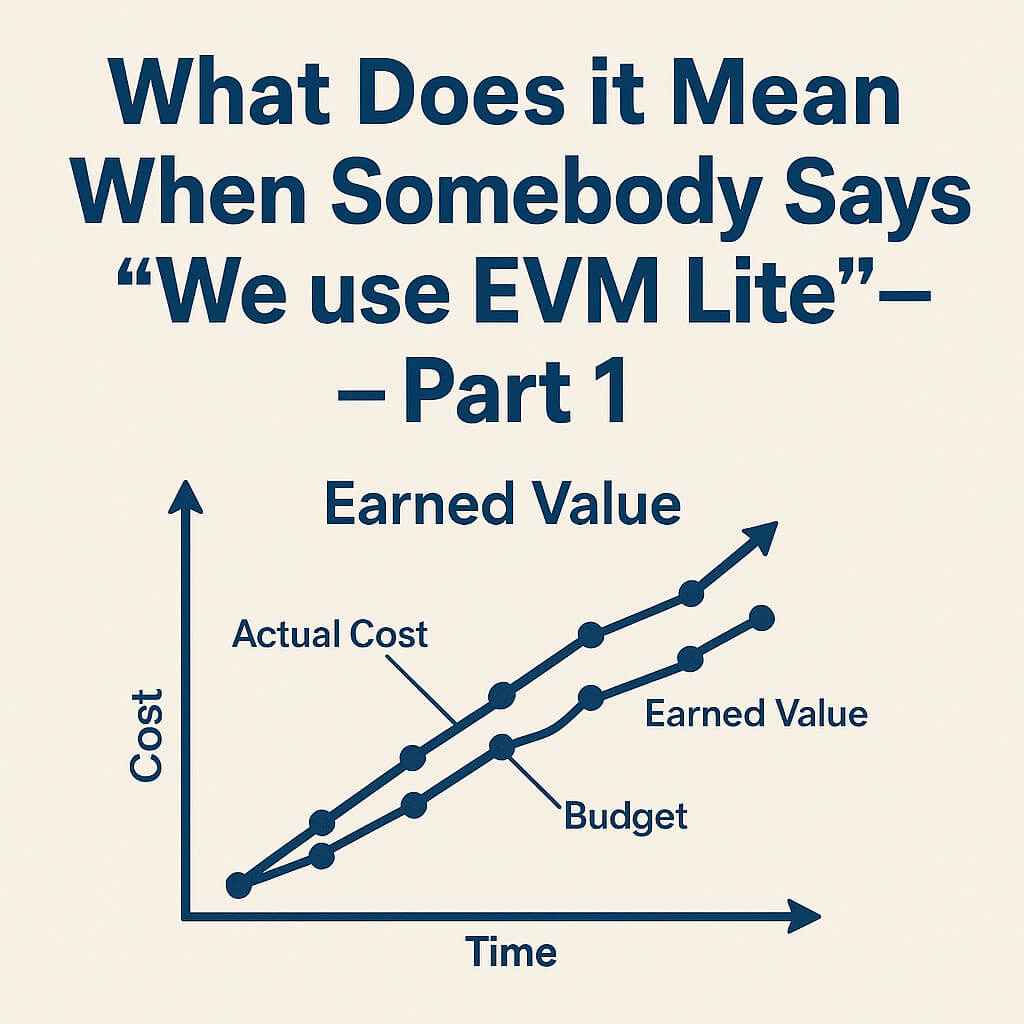
What Does it Mean When Somebody Says “We use EVM Lite” – Part 1

Here is why Humphreys & Associates takes an interest in the EVM Lite approach to Earned Value Management.

Earned Value Management (EVM) “lite” or EV Lite is a hot topic because people recognize that budgets versus actual costs are not meaningful enough for assessing true project technical/schedule/cost status. An awareness exists that there is a significant advantage to using Earned Value (EV) measurement to manage projects.

The EVM Lite approach is common for Independent Research and Development and Firm Fixed Price (FFP) projects. Therefore, it is important to understand what this term means.

EVM Lite is a title that could mean a combination of any of the following:

  • Relaxation of the level of detail (fewer control accounts of larger size, fewer work packages of larger size with less milestones/technical achievement points and  more dependence on subjective earned value techniques )
  • Less rigor in approvals for Work Authorization Documents (WAD) and Budget Change Requests (BCR)
  • Less rigor in Rolling Wave Planning and enforcement of the freeze period
  • Less rigor in the variance analysis process, including looser variance thresholds
  • Compliance with only the 16 “critical” American National Standards Institute, EIA-748 Guidelines
  • Earned Value Management System (EVMS) not subject to third party verification
  • Less detail in the EVM System Description (fewer examples, no “live” data examples)
  • EVMS Cross Reference Checklist only at the Guideline level

EVM Lite implies an EVMS with relaxed requirements or a less rigorous approach that still meets the spirit and intent of the EIA-748 Guidelines. But it is important to note that none of the descriptions of EVM Lite above would pass muster in a DCMA review to determine whether a contractor’s EVMS complies with the EIA-748 Guidelines and cannot be used in that event.

If a contract mandates the use of an EVMS then EVM Lite is not an option. It is important to us our customers know this. However, if your contract does not mandate the use of EVM, then EVM Lite might be a viable option to pursue if management desires insight into their programs.

Part 2 – Tailoring Approaches to EVM Lite 

What Does it Mean When Somebody Says “We use EVM Lite” – Part 1 Read Post »

EIA 748-C Released: EVMS

, , ,

Are you aware that a revision to Electronics Industry Association (EIA) standard 748 Earned Value Management Systems, has been released? The new revision is EIA 748-C. Officials have been discussing the changes at recent industry conferences.

No changes have been made to the 32 EVMS Guidelines in Sections 2.1-2.5 of the standard. The changes are primarily clarifications of the existing text:

Includes a new section about Budget Element Hierarchy. This section describes the components of Contract Target Price from the highest level to the lowest level of cost elements. It includes the same information that is taught in every basic earned value management seminar.

Emphasizes Risk and Opportunity management. Wording has been inserted in numerous sections of the standard (such as comprehensive planning, schedule, management reserve) to emphasize the consideration of risks and opportunities.

Includes Rate and Usage variance formulas in the standard. Labor rate and efficiency variance formulas are now specifically defined in Section 3.8.2. Similarly, material price and usage variance formulas are now specifically defined in Section 3.8.5.

Clarifies Control Account definition. Revisions to the standard note that the Work Breakdown Structure (WBS) is extended to the level at which control accounts are established and includes additional clarification regarding multiple control accounts existing within a lowest level WBS element.

Clarifies material progress points: Receipt, Stock, IssueThe revised standard states that the acceptable points for claiming earned value are when material is received, when it is entered into inventory, or when it is issued from inventory.

Clarifies OTB/OTS text. The revised standard corrects the terminology to use
“Contract Budget Baseline” instead of the Performance Measurement Baseline regarding Over Target Baselines (OTB), removes language about partial OTBs, and recommends reviewing the contract for implementation requirements prior to executing OTBs or Over Target Schedules (OTS).

Adds a list of suggested references. All NDIA guides related to Earned Value Management Systems are included as suggested references but not requirements.

Includes numerous minor clarifications.

  • Clarifies that multiple terms are used interchangeably for “scope”
  • Adds acronyms into the definitions in Section 2.6
  • Clarifies that Estimates at Completion (EACs) are summarized through the WBS and OBS
  • Clarifies that the performance measurement baseline must include all authorized changes, including current period changes
  • Clarifies that the System Description is not required to be a stand-alone document
  • Clarifies that there is no mandated Rolling Wave cycle
  • Emphasizes that planning packages must not start in the current period

In summary, EIA 748-C simply clarifies the text of the standard and does not change any of the implementation, reporting, surveillance, or enforcement aspects of Earned Value Management Systems.

Feel free to contact Humphreys & Associates for more information about the EIA 748 revisions or for expertise in implementation of EVMS contractual requirements. 

EIA 748-C Released: EVMS Read Post »

Control Account Manager – CAM Certification by Humphreys & Associates

Control Account Manager - CAM certificationControl Account Manager (CAM) Certification. This efficient and intensive certification program is perfect for anyone looking to:

  • Distinguish themselves from their peers with a professional CAM certification
  • Advance his or her earned value management (EVM) expertise

Humphreys & Associates effective and comprehensive certification program is intended to further develop on-the-job skills. It includes wide-ranging course work and concludes with a comprehensive exam requiring the student to establish both analytic and technical Earned Value Management Systems proficiency.

Individuals that complete the Humphreys & Associates CAM Certification program have solid evidence of their ability to execute an EVM System effectively and satisfy job requirements as CAMs in the most challenging project control environments.

The course work spans the five EVMS guideline groupings in the EIA-748 Standard for Earned Value Management Systems including:

  1. Organization
  2. Planning, Scheduling, and Budgeting
  3. Accounting Considerations
  4. Analysis and Management Reports
  5. Revisions and Data Maintenance

Important risk management discussions are part of the course and stress data integrity and trace-ability  Earned Value Management best practices are highlighted to provide insights and to illustrate current methods and approaches. This results in better management and decision-making.

Humphreys & Associates CAM certification uses extensive case studies and exercises that bring the EVM concepts to life and help to refine analytic expertise. Each participant will receive:

  • A binder with all course materials
  • The H&A Project Management Using Earned Value textbook
  • The pocket sized H&A Guide to Project Management Using Earned Value

Humphreys & Associates offer two options for completing the CAM program coursework. Contact us today to learn more about Humphreys & Associates Control Account Manager – CAM Certification program at (714) 685-1730.

Control Account Manager – CAM Certification by Humphreys & Associates Read Post »

Authorized Unpriced Work (AUW) and Earned Value Management Systems

, ,

Authorized Unpriced Work (AUW)

Authorized unpriced work (AUW) is an area that can cause contractors difficulties and when not handled properly, can result in a DCMA EVMS review team writing up a Corrective Action Request (CAR) as we have discussed in previous blogs.

At times, contractors can find themselves in a position where projects are not following commonly used and recommended practices that are described in the EIA-748 Standard for EVMS guidelines as well other guidance such as the NDIA Integrated Program Management Division (IPMD) EIA-748 Intent Guide and the DoD Earned Value Management System Interpretation Guide (EVMSIG).

It is always better to be proactive to ensure project personnel have the proper direction they need. H&A suggests that you review your EVM System Description as well as any related procedures to ensure that they:

  1. Reflect the EIA-748 guidelines (for AUW in particular, see Guidelines 8 and 28) as well as related industry and government implementation guidance.
  2. Are clear and specific on how project personnel are to handle authorized unpriced work.

Humphreys & Associates suggest verifying the following items are discussed in your EVM System Description.

  1. How and when work scope and budget are distributed from undistributed budget (UB) to control accounts and subordinate work packages or planning packages. This includes:
    • Describing what controls are placed on the use of UB.
    • Stipulating a specific period of time that work scope and budget can be held in UB for fully negotiated work.
    • Describing how and when UB is distributed to control accounts when the work scope has not been defined (i.e., the work scope represents AUW).
    • The interim budgeting procedure used during the definitization process to distribute the work scope and budget from UB to the work package level for the near term effort (such as three to six months). This interim budgeting procedure should be followed until the AUW scope of work held in UB is definitized and distributed to control account work packages or planning packages.
  2. Incorporating authorized changes in a timely manner. The EVM System Description will need to describe what:
    • Constitutes an authorized change.
    • Indicates authorized changes have been incorporated.
    • Constitutes “timely” incorporation.
  3. The process for establishing internal budgets for authorized but unpriced changes should be based on a resource plan for accomplishing the work. Project managers should have a detailed plan in place for the near term work using cost estimates and resource plans with appropriate direction to notify the customer when spending approaches any not to exceed (NTE) spending limits. It is critical that traceability through all steps of the process can be demonstrated.

For a more in-depth discussion on how to handle authorized unpriced work (AUW), see the article posted on the Humphreys & Associates EVMS Education Center, EVMS Practitioner section.

Humphreys & Associates is available for consulting and information on this topic. Give us a call!

Authorized Unpriced Work (AUW) and Earned Value Management Systems Read Post »

Scroll to Top