Risk Assessment

Schedule Risk Assessment Fundamentals
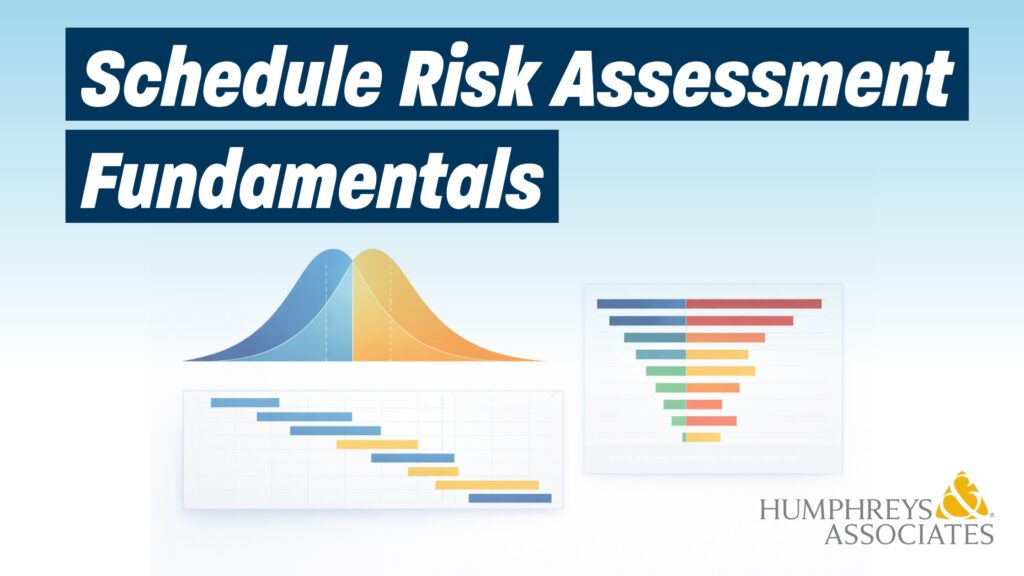
Schedule Risk Assessment Fundamentals

Quick Summary

  • Schedule Risk Assessments (SRAs) use Monte Carlo simulations to model schedule uncertainty, providing probability-based insights into meeting project completion dates and risk drivers.
  • SRAs enhance decision-making by quantifying outcomes (e.g., likelihood of meeting objectives), supporting risk prioritization, scenario analysis, and proactive schedule management for complex projects.
  • Effectiveness depends on quality inputs: well-constructed network schedules and well-defined risks.

Why perform a schedule risk assessment (SRA)? 

SRAs are critical in understanding the likelihood of meeting baseline or forecasted completion dates as well as identifying which risks to focus on for protecting the project schedule. 

An SRA is a Monte Carlo based simulation of the schedule using the existing logic but with different duration inputs in repeated “walk-throughs” of the schedule. In each run through of the schedule a different duration may be used for every task therefore the end date is usually different. When enough simulations are performed, a picture emerges of the distribution of potential outcomes from the shortest, to the longest, and to all those in-between. 

A simple way to think of this is to imagine driving to the grocery store on the same route a thousand times. Sometimes it may be rainy or snowy or maybe even clear and dry. There may be accidents, road work, traffic lights, or other issues. Each trip can have a different duration but overall, with enough trips, we will end up with good picture of how much time we should plan for the trip. We can even have different plans for different conditions.

Of course, you do not have the luxury of performing your project a thousand times. You get one opportunity. But an SRA can help you understand what the journey through your project can look like through simulation.

Performing SRAs and managing the project based on the results can provide project managers with powerful tools to successfully meet project objectives. SRAs are a discipline that supports critical risk and schedule decision making.

Projects are often long durations of five years or more, involve one-of-a-kind systems, facilities, or integrations, and have numerous constraints ranging from security, regulatory, to environmental. In addition, these projects have oversight from organizations such as the Government Accountability Office (GAO), Office of Management and Budget (OMB), and even Congress with expectations set to meet internal milestone commitments such as critical decisions (CDs) and initial operational capabilities (IOCs). While this is a subset of the many challenges facing these projects, they all rely on project managers and the project team meeting schedule commitments.

Purposes of the SRA

The main purposes of the SRA are twofold: 1) to understand the schedule and 2) to understand the probability of achieving the end date in the schedule. 

In a recent H&A workshop a very high-level executive in one of the large government agencies said of the SRA, “I don’t do it, but I receive the “P” numbers.” What she meant was that she receives the result in terms of the probability numbers developed in the SRA. She is informed of the probability of achieving the schedule as part of the program status review.

Understanding the SRA

In simple terms, an SRA is a structured probabilistic analysis by simulation of a project’s schedule that quantifies the likelihood of meeting critical dates. Initially the SRA focuses on the baseline and the probability of achieving the baselined dates. Once progress has been added to the schedule, the emphasis shifts to the current or working schedule and away from the baseline. The SRA uses the latest available information.

Uncertainty can exist in the schedule in terms of duration uncertainty, unplanned events, merge bias, and other such factors. The SRA tries to account for duration uncertainty by using a three-point approach to the task durations. The owners of the tasks are challenged to provide best case, most likely case, and worst-case durations for use in simulating the schedule. 

The SRA uses the project’s schedule logic as well as uncertainty assigned to activities along with the project’s risk register to produce probabilistic outcomes. A probabilistic analysis is a way of understanding outcomes when the future is uncertain. Instead of assuming there is only one single outcome for the schedule, probabilistic analysis takes variation into account based on durations, risks, and other events through simulation. This simulation is then repeated hundreds, sometimes thousands of times to produce statistical analysis that defines what the range of results could be. This statistical analysis will reveal, based on inputs to the model, a distribution of possible outcomes with confidence intervals expressed like this:

  • There is a 50% chance of finishing the project by this date, or
  • There is an 80% chance of meeting this milestone.

The SRA can be used to evaluate an entire project schedule or a subset of the schedule which may be a specific milestone, deliverable, or even a single work package. The scope of the SRA depends upon what part or whole of the schedule you would like to examine based on application needs. 

For this reason, SRAs are useful for project managers, control account managers (CAMs), schedulers, risk managers, and other key stakeholders. Stakeholders can use SRAs to meet compliance requirements, run “what-if” scenarios, or provide inputs into vendor selections and vendor performance management decisions. While the SRA is an excellent management decision tool, it should not be used to provide a static critical path review. It should never be used to create a deterministic “best-case” schedule, and it should not be dependent upon a specific software tool.

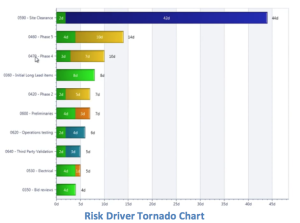
One important output of the SRA is commonly called the “Tornado Chart” because of the shape of the data provided. This analysis identifies the number of times a task acts as a driver in the outcome of the schedule. If a task is often driving the outcome, it should be considered carefully. Potential other approaches should be considered or at least a detailed review of the durations of the task should be performed.

Foundations

The SRA will only be as credible as the schedule it evaluates and the integrity of the risk information that is applied. Prior to the execution of a successful SRA, the schedule integrity should meet established quality standards. 

The DCMA EVMS Compliance Metrics (DECM) specific to schedule data provides a widely accepted benchmark for evaluating integrated master schedule (IMS) health. The NDIA Integrated Program Management Division (IPMD) Planning and Scheduling Excellence Guide (PASEG) includes a section on performing schedule health assessments with a list of often used metrics. Some project teams may customize their IMS quality metrics based on their established and approved EVMS documentation. Areas typically evaluated include logic integrity, critical path integrity, schedule realism, and data quality.

Logic integrity includes the proper use of predecessors and successors with minimal usage of leads and lags and a clear path from start to finish. Critical path integrity ensures that there is an understood set of critical and near-critical paths with logical drivers of key milestones and avoidance of excessive float. Standards for schedule realism include reasonably short activity durations and a limited use of constraints. Data quality requires valid dates, calendars and status updates. All these elements are covered in the generally accepted schedule quality metrics and most SRA tools will validate the schedule as well ensure that the schedule quality is adequate to perform a successful SRA.

Equally important to the SRA is the risk information. Risks should be identified and clearly characterized; their association with the schedule should be mapped. When feasible, mitigation plans should be incorporated into the schedule along with any variations they may have. The identified risks should succinctly state the event, and the cause and effect of the risk. Each risk should be characterized by its probability of occurring and the impact to the schedule if it were to occur. This characterization should be grounded in credible assumptions, usually based on the project’s rubrics for scoring likelihood and impact.

Input of risk events into the schedule provides additional realism. In terms of the simulation there will be times when the risk event happens and times when it does not with different durations as well.

Once quality schedule and risk information is validated, these inputs are imported into the probabilistic tool used by the project team. Since probabilistic analysis is based on the Monte Carlo methodology which uses statistical math, any tool that accommodates schedule and risk inputs should be sufficient. 

Frequency of SRA Application

SRAs can be expensive when time is taken to do the best case, most likely, and worst-case duration analysis by the CAMs. The cost is a limiting factor in the use of the SRA. It is most common for SRAs to be performed:

  1. At the time of baselining to understand the baseline schedule and the probability of success.
  2. When a major change is made to the project schedule.
  3. Before a major event such as the Critical Design Review (CDR) where the nature of the effort changes from design to build and the team wants to understand the probability of success for the remaining effort.

Do not accept a contract that requires performing the SRA when requested by the customer. That is too open ended of a requirement and does not allow you to estimate the cost or control the cost. A contract should specify the number of SRAs to be included so that any additional SRAs can be treated as a compensated change.

Conclusion

When grounded in a high-quality IMS and integrated with disciplined risk management, SRAs provide stakeholders with a realistic view of schedule outcomes and the risk drivers. While often thought of as a compliance requirement, the SRA provides management decision insights and is useful in understanding, as an early warning indicator, any threats to meeting schedule objectives. When properly used, the SRA is a powerful management tool that can contribute to project success.Interested in learning more? H&A master schedulers and risk subject matter experts often assist clients with establishing their SRA process and mentoring project teams to use the SRA outputs to create more realistic schedules with a higher probability of success. Call us today to get started.

Schedule Risk Assessment Fundamentals Read Post »
Risk Analysis and Selective Controls

, , ,


This chapter looks at how risk is evaluated when developing an Earned Value Management System.

Video Contents

You can use the links below to jump to a specific part of the video.
0:00 – A Closer Look at Risk
0:25 – Risk Drives Other Concerns
0:59 – Types of Risk
1:19 – Risk Opportunities
1:38 – Risk Analysis and Selective Controls
1:54 – Balance Cost with Benefit


More EVMS Training

If you liked this video you can purchase the entire course below. This video is an excerpt from the Department of Defense (DOD) version of this eLearning module. We also offer the same course customized for the Department of Energy’s (DOE) specific Earned Value Management (EVM) implementation/requirements, as well as a version of the course customized for NASA’s EVM implementation/requirements.  

— Purchase This Course —
EVMS DOD Virtual Learning Lab

— Purchase the DOE Version of this Course —
EVMS DOE Virtual Learning Lab

— Purchase the NASA Version of this Course —
EVMS NASA Virtual Learning Lab


EVMS Document Matrix

Not sure what the different requirements are between the DOE and NASA? Can’t remember if Cost and Software Data Reporting (CSDR) is required for an NSA contract? Check out our easy to read Earned Value Management Systems Document Matrix


All Online Courses

All Online Courses Available from Humphreys & Associates

Earned Value Training

Other Posts in this Series

Risk Analysis and Selective Controls Read Post »

Video Release – Assessing Schedule Risk Using Deltek’s Acumen Risk 6.1 | Part 2 of 2

, , , , , , , , , , ,

The conclusion of our review of the foundational elements of performing a schedule risk assessment (SRA) using Acumen Risk 6.1

0:17 – Risk Exposure Chart
1:03 – Tornado Chart
2:14 – Parting Thoughts

Read the blog post at:

Assessing Schedule Risk Using Deltek’s Acumen Risk 6.1 | Part 2 of 2

Video Release – Assessing Schedule Risk Using Deltek’s Acumen Risk 6.1 | Part 2 of 2 Read Post »

Video Release – Assessing Schedule Risk Using Deltek’s Acumen Risk 6.1 | Part 1 of 2

, , , , , , , , , , ,


How confident are you that your project will finish on time? Review the foundational elements of performing a schedule risk assessment (SRA) using Acumen Risk 6.1

2:22 – Schedule Health Diagnostics
4:55 – Duration Uncertainty
6:35 – Risk Events
8:20 – Simulation Process
 
Read the blog post at:

Assessing Schedule Risk Using Deltek’s Acumen Risk 6.1 | Part 1 of 2

Video Release – Assessing Schedule Risk Using Deltek’s Acumen Risk 6.1 | Part 1 of 2 Read Post »

Assessing Schedule Risk Using Deltek’s Acumen Risk 6.1 | Part 2 of 2

, , , , , , ,

Schedule Risk Analysis Results

Agile assessments identify, evaluate and assigns risk to projects. Schedule risk analysis results are predominantly communicated in two important sets of intelligence.

Risk Exposure Chart

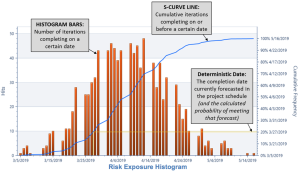
The first, and higher level output, is the Risk Exposure Chart. This chart depicts the level of confidence that the project scope, as modeled in the IMS, can be completed by a certain date. The chart commonly includes a histogram depicting the number of project simulations that are being completed on each specific date, and a curve that shows the cumulative values across time up to a 100% confidence level. Using the Deltek Acumen Risk Exposure histogram, the baseline finish, forecasted finish or any other desired date can be examined, as well as determination of the probability of achieving that date based on the number of simulations completing on or before that point in time.

EVMS: Risk Exposure Chart

Now that you know there are problems, what are you going to do about them? On which tasks should mitigation attempts be made? Is the current critical path comprised of the riskiest tasks? This is where the second area of intelligence output comes into play.

Tornado Chart

Acumen produces a list of “risk drivers” in the form of a Tornado Chart. These are the tasks that are expected to have the greatest influence on risk in the schedule. Put another way, this report highlights the tasks that, if they could be executed in less time, would have the greatest impact on increasing the likelihood of an on-time project completion. Acumen’s rendition of the Tornado Chart also displays the amount of the risk that can be attributed to duration uncertainty, logic, or any of the risk events. New to Acumen 6.1 is the ability to easily display this information in either days or hours.

EVMS: Risk Driver Tornado

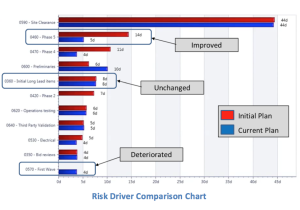
But how does one know if all of the time and effort that has been spent mitigating risk is working? Acumen can help here too. The initial (unmitigated) plan can be compared to the current (mitigated) plan. Has risk been reduced as expected? Or, because of mitigation efforts in one area, has risk increased in other areas (a.k.a. collateral damage)? Stacking the results within the Tornado Chart, it can quickly be seen which risk drivers improved, were unaffected, or deteriorated.

EVMS: Risk Driver Comparison

Parting Thoughts

The goal of any SRA tool is to identify and quantify schedule risk to a project so that action can be taken to improve project execution. Used properly, Acumen Risk does exactly that. With over 20 years as a full-time scheduler, I have dealt with thousands of project schedules and many, many analysis tools. From what I have seen so far, Acumen is an evolutionary step in performing schedule risk assessments. It offers beginners an easy path to perform in-depth schedule analysis with advanced features for more experienced users to help further refine the accuracy of the results. I encourage you to register for a free trial version and test it out for yourself.

Yancy Qualls, PSP

Engagement Director, Schedule Subject Matter Expert

Humphreys & Associates, Inc.

Assessing Schedule Risk Using Deltek’s Acumen Risk 6.1 | Part 2 of 2 Read Post »

Assessing Schedule Risk Using Deltek’s Acumen Risk 6.1 | Part 1 of 2

, , , , , , , , , , ,

Why Perform Schedule Risk Assessments? EVMS and Agile implementations within the same company or on the same project.

Before a project is ready to be baselined, a typical question the customer asks the project manager is, “How confident are you that the project will finish on time?”

This is a more difficult question than you might think.  In competitive environments, guessing is not an option.  The probability of success on a project must be quantified.  The risks that impact the odds for success must also be quantified.  If the risk is managed, the probability of completing the project on time and under budget is improved.

Customers are not blind to the importance of risk management.  This is evidenced by recent changes in government contracting requirements that call for formal risk assessments of project schedules.  Even if risk management were not a contractual requirement, it would be irresponsible for any project manager to ignore the need for risk management and proceed without identifying and assessing the project’s risks.

Schedule risk exists in every project.  This risk can be quantified, analyzed, and mitigated, or it can be ignored.  However, ignoring schedule risk does not make it go away.  Fortunately, there are advanced software tools, such as Deltek’s Acumen Risk, that can help model the expected impacts of risk in the schedule. Then, the answer to “how confident are you that the project will finish on time?” can be answered with quantifiable information.

In the following sections, a few of the foundational elements of performing a schedule risk assessment (SRA) using Acumen Risk 6.1 will be discussed.  The software was designed with the understanding that not everyone is an expert in schedule risk analysis.  The software provides beginners with an easy to follow path to perform in-depth schedule risk analysis as well as advanced features for experienced risk experts.

Along with quick start guides and help documentation, the menu structure is laid out like a schedule maturity timeline.  From left to right, the menu selections take one from the start-up steps of importing the schedule, to analyzing the schedule, assessing schedule risk, accelerating the schedule, and advanced customization features.

Deltek_Acumen-Top-Level_MenusDeltek Acumen – Top-Level Menus


Schedule Health Diagnostics

Before delving into schedule risk assessments, let’s take one minor detour from risk into schedule diagnostics.

Would you trust a broken watch to tell you the correct time?  The same goes for a schedule risk assessment.  A broken schedule network cannot be trusted to yield reliable, and therefore actionable, SRA results.

The National Defense Industrial Association (NDIA) Integrated Program Management Division (IPMD) Planning & Scheduling Excellence Guide (PASEG), is widely regarded as one of the premier references on scheduling best practices.  The PASEG was created by a joint team of both government and industry scheduling experts, thus it has no particular point of view to promote or defend.  One of the scheduling best practices the PASEG discusses is that the integrated master schedule (IMS) should be validated before any SRA is performed.  “Validated” means that the tasks, logic, durations, constraints, and lags in the IMS should be analyzed and corrected as necessary.

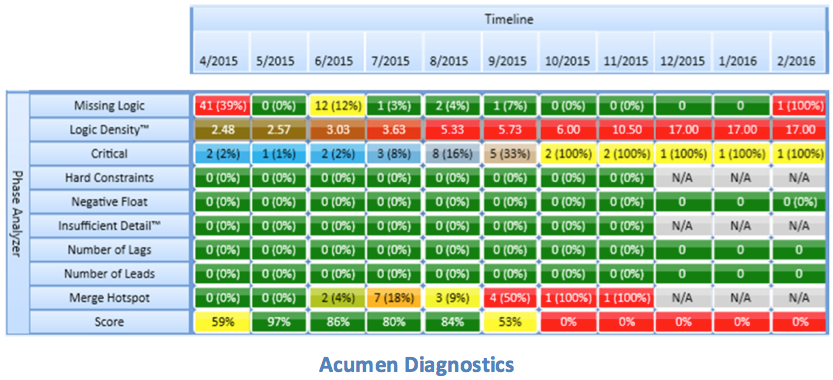
Acumen Fuse provides a complete set of schedule diagnostics.  When I first clicked on the “Diagnostics” tab, I saw an initial set of metrics.

EVMS: Acumen Fuse Schedule diagnostics

Each one of these metrics was applied to the project’s timeline that which makes it easy to see both where and when the issues occur.  What I did not notice at first was that these metrics were just one subset; I was only looking at the “Schedule Quality” subset of the diagnostics.  There were similar subsets in the areas of Logic, Duration, Constraints, Float, and the DCMA 14-point Schedule Assessment, just to name a few.  All of these diagnostic tests can be modified to reflect your company or customer’s standards.

Before leaving the topic of schedule health, there are a few words of caution.  No matter how useful a schedule analysis tool may be, there is no substitute for the task managers taking ownership of the IMS and ensuring that it is in good working order.  For example, analysis software can be used to check to determine if a task has a predecessor and a successor, but only someone familiar with the effort can determine if a task has the “correct” predecessor and successor.  Analysis software is becoming more and more sophisticated, but people still control the success or failure of the project.

Duration Uncertainty

Once a sound schedule has been developed, the next foundational elements of an SRA are the duration uncertainty estimates.  There are two widely accepted methods of assigning duration uncertainty.

The preferred and more precise method is to obtain three-point duration estimates (best case, worst case, and most likely) from the task owners.  At a minimum, this should be performed on all critical and near-critical tasks (and driving and near-driving tasks supporting significant events).  For larger schedule networks, it may not be reasonable to gather this type of information for every task.  If custom three-point estimates are not available, templated duration uncertainty could be applied based on the type of work, the task owner, historical performance, or any other applicable task characteristic.

Acumen Risk handles both methods very easily.  Custom three-point estimates can be entered for each task in days (or hours), or as a percentage of the current remaining duration of the task.  Standard duration uncertainty templates are easily applied to a task by selecting the appropriate risk level on the calibration bar.  To streamline the process, by setting the calibration at any summary level, the uncertainty template is cascaded down to all the “children” tasks.

Description. Calibration.

Risk Events

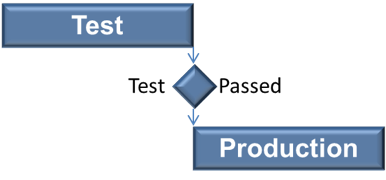
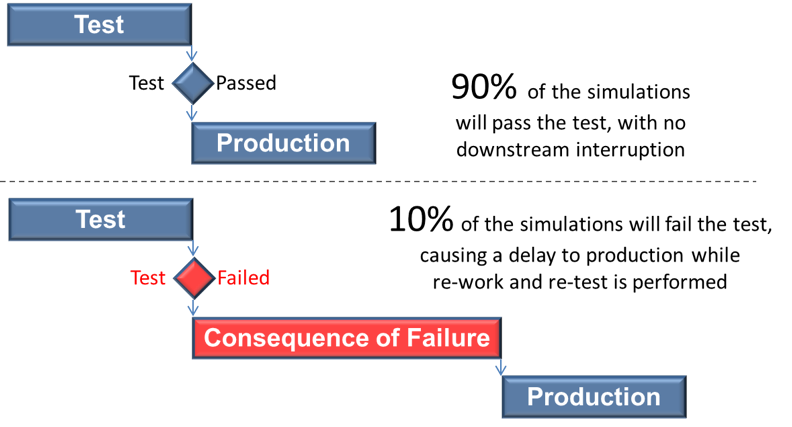
One thing traditional Critical Path Method (CPM) networks do poorly is model unexpected results.  For example, if there is a 90% success rate on fatigue testing, the IMS will generally be constructed to assume the test will be successful, with no disruption to downstream tasks.

EVMS: Critical Path Method

But what happens if the test fails?  While unlikely, there is still a very real possibility that the results will be unfavorable.  If the test does return unfavorable results, there will likely be a significant delay while re-work is performed in the areas of design, build and test.  A traditional CPM network can model a successful test or an unsuccessful test, but not both.  This is not a problem with a schedule risk assessment.  Information from the project’s risk register can be used to model the likelihood of a test failure, as well as the consequence, or delay to downstream tasks resulting from that failure.

EVMS: CPM Risk Events Consequence

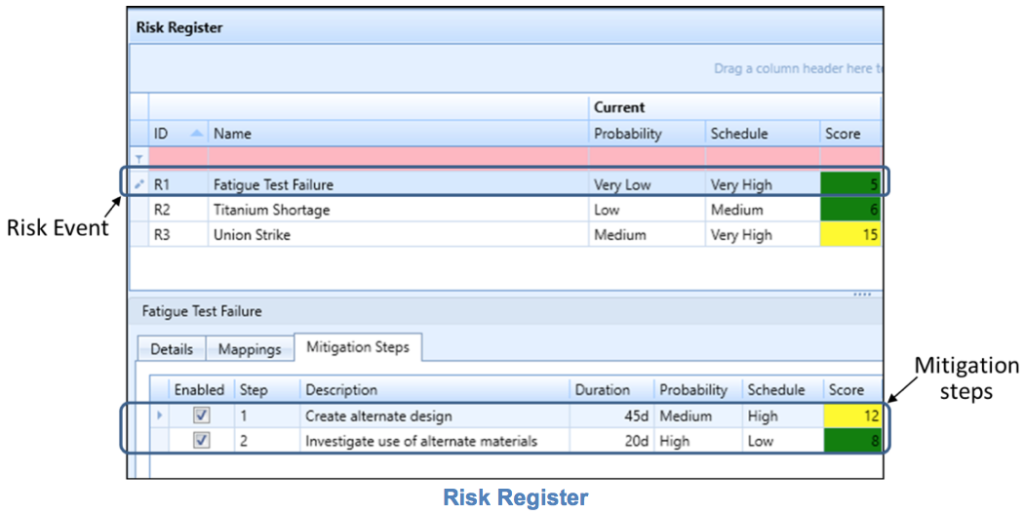
Is this an acceptable risk?  An SRA can quantify the risk and provide information on the likelihood of successful deliveries.  Acumen does not stop there though.  One of its newest features is to organize and track all risk events within its built-in risk register, as well as to track the steps being taken to help mitigate that risk.  Or, if your organization already maintains an external risk register in Excel, it can be imported into Acumen to eliminate the duplicate tracking of risk events.  Whether the risk register is imported from Excel or built from scratch within Acumen, a single risk event can then be mapped to one or more activities, or a single activity can be associated with one or more risk events.

EVMS: risk registers 


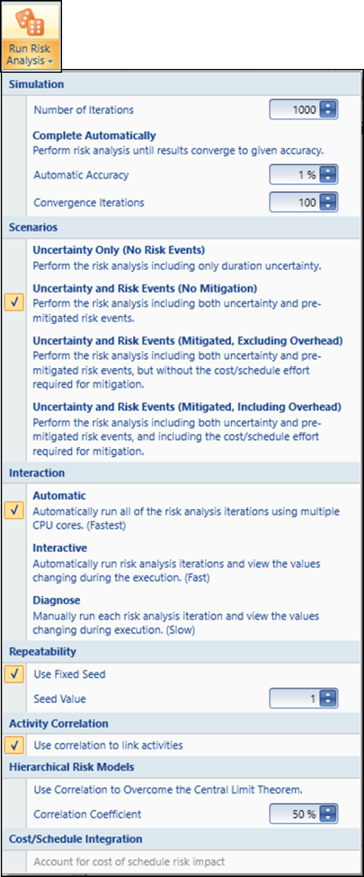
Simulation ProcessEVMS: Simulation Process

A typical SRA uses Monte Carlo techniques to simulate hundreds or thousands of potential project outcomes using the risks and uncertainties that have been supplied.

For most users, simply accepting the default settings and pushing the “Run Risk Analysis” button would be sufficient.  But if terms like “Convergence”, “Correlation Coefficient”, “Central Limits Theorem” and “Seed Value” are part of your normal working environment, Acumen provides a variety of settings that can be customized to tune the SRA to best model your project.

No matter which approach you take, the Acumen toolset provides a quick and easy simulation process.


What to Expect in Part 2

Part 2 of this blog will delve into the interpretation of SRA results.


Yancy Qualls, PSP

Engagement Director, Schedule Subject Matter Expert (SME)

Humphreys & Associates, Inc.

Assessing Schedule Risk Using Deltek’s Acumen Risk 6.1 | Part 1 of 2 Read Post »

Scroll to Top