schedule risk assessment

Maximizing the Value of Schedule Risk Assessments (SRAs)
, , , , , , , ,

Quick Summary

  • SRAs are only as valuable as the intent and quality behind them. Treating them as a check-the-box compliance requirement produces meaningless results that get filed away and never used.
  • Real-world examples show how cost pressure and last-minute guidance changes at kickoff can derail an SRA, leaving project teams with outputs no one trusts or acts on.
  • Focusing three-point estimates on tasks that drive critical and near-critical paths delivers real insight without the prohibitive cost of analyzing every task in a large IMS.
  • Documented assumptions for selected tasks produce derived duration factors that are far more accurate than gut-feel percentages, and the difference shows up directly in the SRA results.

A previous blog, Schedule Risk Assessment Fundamentals, highlighted that when properly used, schedule risk assessments (SRAs) are a powerful management tool that can contribute to project success. It does, however, require a high-quality integrated master schedule (IMS) that is integrated with a disciplined risk management process. When conducted with the intention to gain a realistic view of schedule outcomes and risk drivers, it provides management with additional insight and an early warning indicator of potential threats to meeting schedule objectives.

The Challenge with Conducting SRAs

Schedule risk assessments are frequently a topic of discussion in project management circles and sometimes for the wrong reason. A well-run SRA can provide the confidence levels for achieving different schedule end dates as well as valuable insight into the IMS. However, the SRA is particularly susceptible to the “garbage in – garbage out” (GIGO) principle.

H&A consultants have recently observed discussions that indicate SRAs are not being properly performed or used to help manage projects. Some of these observations reinforce the GIGO principle.

One H&A senior consultant sat in on a meeting with the government program manager for a large project where the consultant, having worked on the just-completed SRA, asked the government program manager what they would do with the results. The amazingly honest answer was, “Sadly, it will just be filed. It is seen as a check-the-box thing we have to do.”

Using the results of the SRA to stuff the drawer might not be as wild a response as it seems. Too many times, we see the SRA being done in a perfunctory manner using inputs that will not yield useful management information and insight. One way people are cutting corners on the SRA is by applying global factors to the existing duration estimates and running the simulation with those durations. Applying a formula across the board is not the same as analysis. Yes, the SRA can be done so poorly it is meaningless. This is especially true if the applied factors are not realistic.

An Example of What to Avoid

One of our consultants observed that in one case the best of intentions were thwarted in the SRA by cost pressures and lack of management commitment. The manager of the SRA provided a form to each CAM for them to provide the best case, worst case, and most likely case duration estimates and provide written explanations for all three cases. The instructions were for the CAMs to use the form for every incomplete task and future task.

There were about 10,000 such tasks distributed among 70 or so CAMs. On average, that would be 140+ tasks for each CAM. Doing three-point estimates for 140 tasks would be a large expense and consume a lot of valuable time, without even mentioning the cost.

The government program manager, who pays the bills, was present at the kickoff meeting for the SRA and intervened immediately when he heard the directions being provided. He stated that he would not pay for all that effort; it would be too costly. Unfortunately, there was no probing to find out what would be reasonable to this manager in terms of details for the SRA.

Instructions for this SRA were revised on-the-fly and the SRA was done. It was done poorly; in some parts due to the disruption at the kickoff meeting and the poor guidance. The intervention of the government program manager had left the impression that the SRA “was not worth it.” That impression was wrong.

The idea of documenting the three-point estimates is a good one, but too time-consuming to be applied to every task. There are valid options that can still benefit from this detailed look at the durations, yet avoid the significant expense of analyzing all the tasks.

A Better Approach

One approach is to do a detailed analysis of the three-point estimates for specific selected tasks that reduces the number of tasks that require detailed manual estimation. The focus should be on the tasks that provide insight into the part of the IMS most likely to cause the end date or a major event date to change. Examples include those tasks that are:

  1. On one or more of the top number of critical paths.
  2. On the path to the next major event (these tasks can be found using the driving path approach).
  3. Known to be or assumed to be prone to duration risk.
  4. Known to require scarce resources that may have limited availability.
  5. Believed to be drivers of duration risk for other reasons.

A simple example will help to understand why documenting the three-point estimates for some tasks is basic to achieving a useful SRA. If you, acting as a CAM, were asked to estimate the time required to drive 10 miles from your home to work by car in a hypothetical town, you would want to understand the scope of the effort. A drive of 10 miles through the countryside, or on a freeway, or on city streets can be very different.

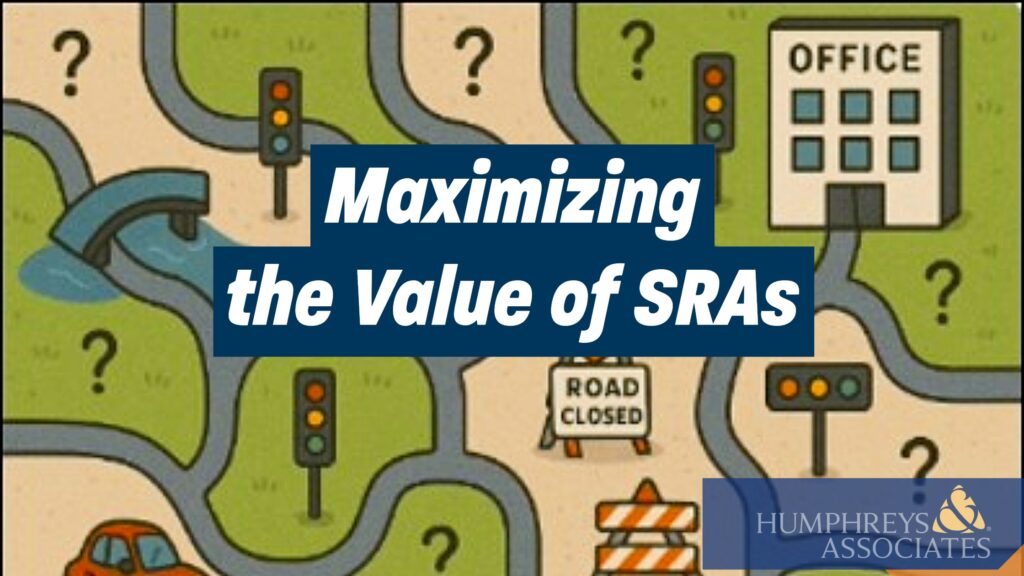
stylized road map of confusing roads

Some help with the assumptions could improve your estimate. If you were told that the first 5 miles of the drive was in town, where the speed limit is 25 mph with the potential for red lights along the way, and the last 5 miles is on the freeway, where the speed limit is 60 mph, this would help you produce a better estimate.

In fact, you will get a better estimate by understanding the scope, the assumptions, the risks, and so on. When doing the three-point estimate, you would employ a process that includes these steps that consider:

  1. The nature of the task. What exactly is to be done in the task?
  2. Past experience. Have we done this or similar work before?
  3. Capabilities. For example, can you drive, does your car work well, can you go up to 60 mph in your car, do you have gas, and are you equipped for potential weather?
  4. Assumptions. How many traffic lights are there along the way? How long would you wait at a red light? What time of year is it? What day of the week? What time of day?
  5. The risks. Are there possible road issues, such as construction? How about traffic issues? Accidents?

Now, suppose you were required to document your estimated durations. Using the assumption details from above, you might end up with this:

Case Duration Assumptions
Best 17 minutes A dry day, early in the morning before traffic, you have all green lights, and you obey the speed limit.
Most Likely 23 minutes The road is fine, first 5 miles is at 25 mph. Only 2 red lights with a wait time of 2 minutes each, and 7 minutes for freeway travel at 45 mph.
Worst Case 32 minutes The road is slippery and you can only travel at 20 mph. You must stop at 3 red lights and sit for 2 minutes each. You have one unexpected stop for 4 minutes because of other drivers. Also, the freeway speed is only 45 mph.

You now have a set of durations you can use in the SRA. You also have the details needed for explaining the duration estimate. Additionally, there is enough information to be able to change the estimates if presented with new facts or revised assumptions. For example, perhaps the project’s period of performance moves to the right and the work will now be performed in the winter. You can adjust your estimates for winter weather impacts.

You also have enough information to be able to derive factors to be used in formulae to generate three-point estimates for other tasks. Be careful to make sure you only use the information to generate a factor on similar work. In this case, the factors would be -26% and +39%. Those are derived factors. For comparison, a common “gut feel” reaction to the question of what factors should be used is usually more like minus 5% and plus 10%. Using derived factors versus a “gut feel” will yield significant differences in the SRA and the value of the results.

Recommendations to Increase the Value of an SRA

Begin with the intention to treat the SRA as the important and valuable tool it is. Choose to change the approach from a “check-the-box” or compliance mentality into a straightforward process that helps to produce a more realistic and executable IMS. No one likes schedule or resulting cost surprises as discussed in another blog, Maintaining a Credible Estimate at Completion (EAC), that also addresses why a credible forecast completion date is equally important. Here are a few suggestions to improve your approach to conducting SRAs:

  1. Provide clear, specific directions to project personnel on what is expected. Highlight why the SRA is an important step.
  2. Verify a quality IMS has been established.
  3. Validate the risk information.
  4. Do focused analysis of discrete tasks on a given number of critical and near-critical paths and document the rationale for the best/worst/most-likely case durations.
  5. Do focused analysis on driving path tasks if not on the critical paths.
  6. Do focused analysis on known risks.
  7. Use realistic factors derived from reality when applying factors to the larger body of IMS tasks.

Taking Action

Producing a quality IMS takes skilled master schedulers that understand the management and predictive value of a well-constructed schedule. The next step up to improve the realism of the IMS is to conduct an SRA when it makes sense. Examples include conducting an SRA as part of the process to establish the baseline schedule, when there is major change, or before a major event such as a Critical Design Review (CDR).

It is not an easy task to distill the steps to conduct a value-added SRA into a well-defined and useful process. H&A master schedulers and risk subject matter experts often work with clients to establish a pragmatic SRA process. They also train and mentor project teams on how to use the SRA outputs to produce realistic schedules with a higher probability of success. Call us today to get started.

Maximizing the Value of Schedule Risk Assessments (SRAs) Read Post »

Maximizing the Value from Integrated Baseline Review (IBR) Investments 

, , , , , , , ,

A previous blog, How Integrated Baseline Reviews (IBRs) Contribute to Project Success, provided an overview of the purpose and scope of IBRs as well as the benefits of conducting an IBR. This blog adds to the discussion on the benefits of conducting an IBR. It reflects observations gathered from our earned value consultants while assisting clients to prepare for IBR events

As a reminder, IBRs provide the opportunity to verify the:

  • Contractor and the customer have a common understanding of the scope of work, technical requirements, and accomplishment criteria. 
  • Contractor has established an executable performance measurement baseline (PMB) for the entire contractual scope of work that accurately reflects how they plan to accomplish the work within the contractual period of performance, negotiated contract cost, and funding profile. 
  • Required resources have been identified and assigned to the project to accomplish the project’s objectives. For example, the staffing plan accurately reflects the sequence of work as well as resource availability and demand.  
  • Technical, schedule, and cost risks/opportunities have been identified, assessed, and captured in a risk/opportunity register. Risk mitigation actions have been incorporated into the PMB to reduce known threats to an acceptable level. This is often the most valuable component of the IBR to ensure all parties have an understanding of the risks/opportunities, assumptions, and risk mitigation or opportunity capture plans. 

Factors that Contribute to a Successful IBR

Treating an IBR as just a contractual requirement limits its value to all parties. IBRs are essential to the successful execution of any project. IBRs require a focused mindset to clearly define as well as assess the measurable benefits gained for the time and effort invested in the IBR. From our observations, contractors that defined what they expected to gain from an IBR, whether the IBR was contractually required or not, made a measurable difference in the outcomes from the IBR. The effectiveness of an IBR is contingent upon management’s commitment to excellence in implementing their EVMS and their desire to ensure they have reliable and useful data for management visibility and control. And that begins with establishing an executable PMB. 

The following list of factors often influence the perceived value of an IBR and hence the approach a contractor takes to planning and conducting their IBRs. 

  • Recognizing the relative importance of the review.
  • Defining the value or measurable benefits they expect to gain from conducting the review.
  • Well defined risk/opportunity management process. 
  • Timely and sufficient review planning and preparation.
  • Joint or collaborative planning and preparation.
  • Well defined objectives as well as entrance and exit criteria. 
  • Tailoring the IBR approach to best accomplish the review objectives.
  • Communication and expectation management.

These factors were ultimately indicative of whether the IBRs were considered value-added (retrospective assessment by the participants) based on the level of understanding, investment in or attention to, or the degree of success in implementing these factors. Based on H&A earned value consultant’s observations, the single factor that tends to drive the IBR approach is clearly defining the value the contractor expects to gain beyond what is mandatory or contractually required. 

IBR Investment Value

The term “IBR investment value” is purposefully used here. The intent is to invite you to re-assess how IBRs are viewed apart from simply meeting government agency IBR requirements. “IBR investment value” is used to mean a qualitative assessment that encapsulates the value-add or measurable benefits teams often have difficulty defining as well as to help provide the impetus and guiding direction for conducting an IBR. It has both intrinsic and extrinsic properties. 

The intrinsic value of the IBR investment resides in those specific elements of information (as identified by the customer in the form of questions or concerns) that are either exchanged, clarified, or refined through the course of discussions between the customer and performing contractor teams. This intrinsic value can be measured by how well the exchanged information supports:

  • A complete, clear and mutual understanding of the work to be accomplished.
  • The resources needed to get the work done.
  • The detailed plan to perform the work.
  • What resources are available to support the plan.
  • What’s missing or unknown that is needed to complete the work correctly and on time.
  • What risks, issues, concerns, or opportunities are associated with contractor’s concept that need to be fully considered to make the plan work. 

The extrinsic value of the IBR Investment rests wholly in the quality of the exchanges (discussions), and the resulting actions generated from the discussions. This extrinsic IBR value addresses how appropriate, rich and comprehensive the information exchanges were, and answers to questions, such as:

  • Were the discussions responsive to a list of customer information requirements and concerns? 
  • Were the right discussions held? At the right level of detail?
  • Were the right people involved in each discussion? 
  • Did the discussions provide sufficient context? Were they comprehensive? Complete?
  • Did the discussions address associated risks, issues, opportunities or other concerns? Relationships to other discussions/elements?
  • Were all the customer’s questions or concerns answered to their satisfaction?
  • Were the discussions documented to support decisions? Alternatives? Changes? Studies?

The exchanges of essential information (intrinsic value) and the quality of those exchanges (extrinsic value) when combined directly translate to the investment value achieved from the IBR. It characterizes how well the information exchanged provides both teams with the necessary details to successfully define, schedule, budget, and manage the contracted effort relative to the investment into the IBR process. A realistic, risk adjusted PMB helps to prevent schedule delays and cost overruns during project execution that often impact a contractor’s profit margins and tarnishes their credibility with their customers. 

What are the characteristics of a value added IBR approach?  

A successful approach H&A earned value consultants have observed contractors implement is a structured process corporate management actively participates in to ensure they gain the most value from all IBR events. 

This is often an outgrowth from corporate initiatives to retain top project management talent and establishing an EVMS self-governance process. It is part of a corporate culture that is committed to excellence in project management and sustaining a best in class EVMS – becoming efficiently expert at EVM

What are some common characteristics of their IBR approach?

  • A chartered authority or corporate team responsible for assisting project personnel with IBR events in addition to EVMS implementation, self governance, and customer surveillance events. A good practice we have seen implemented is to establish rotating members on the IBR teams from different projects as a means to pollinate best practices across projects. It also provides an opportunity to mentor top talent on track to move up to higher management positions.  
  • A standard repeatable process with defined measurable outcomes that can be tailored to the unique project requirements or objectives. This includes maintaining a set of materials for the internal IBR team to effectively plan and execute an IBR as well as to close out any action items. Examples include training materials to prepare project personnel, process description with team member roles and responsibility assignments, data call list, role based interview question forms with assessment criteria, data quality assessment materials and tools, list of data traces to be performed, schedule risk assessment tools, risk/opportunity evaluation criteria, defined assessment criteria (technical, schedule, cost, resources), in-briefing and out-briefing templates, and template to capture action items to track to closure. The corporate team is often responsible for actively maintaining the content for the IBR teams and conducting training. 
  • They place an emphasis on two components that directly impact the quality of the schedule and cost data.  This includes:
    • Well-documented data driven basis of estimates (BOEs) that can be substantiated using historical or bench-marked data with the goal of reducing expert judgement cost estimates to the lowest level possible as a risk reduction strategy.  
    • The quality of the risk/opportunity management plan and the content in the risk/opportunity register. This content directly affects the ability of all parties to gain a better understanding of the risks/opportunities and best options to mitigate a risk or capture an opportunity. A well constructed schedule is required to be able to perform schedule risk assessments (SRAs). SRAs help to identify where duration risk exists in the schedule and to determine a level of confidence in meeting major project milestones as well as the project completion date.  
  • They perform internal IBRs as a standard practice on all projects regardless of contractual requirements. This is particularly important when subcontractors are performing a substantial percentage of the work effort. The corporate team often assists Project Managers with conducting a joint IBR with major subcontractors.  

Need help establishing a corporate IBR process?

H&A earned value consultants often help clients to establish a corporate EVM council or center of excellence with defined responsibilities to ensure project personnel effectively implement their EVMS, integrate risk/opportunity management into the EVMS, as well as define and implement a standard repeatable process for IBRs and self-governance. Clients often need assistance establishing a repeatable process for conducting schedule risk assessments, an essential component of the IBR process. A defined process that clearly articulates the expected measurable outcomes from conducting IBRs is one way to ensure all parties gain the most value from the event with the end objective of ensuring a realistic and executable PMB has been established.  

Call us today to get started.  

Maximizing the Value from Integrated Baseline Review (IBR) Investments  Read Post »

Video Release – Assessing Schedule Risk Using Deltek’s Acumen Risk 6.1 | Part 2 of 2

, , , , , , , , , , ,

The conclusion of our review of the foundational elements of performing a schedule risk assessment (SRA) using Acumen Risk 6.1

0:17 – Risk Exposure Chart
1:03 – Tornado Chart
2:14 – Parting Thoughts

Read the blog post at:

Assessing Schedule Risk Using Deltek’s Acumen Risk 6.1 | Part 2 of 2

Video Release – Assessing Schedule Risk Using Deltek’s Acumen Risk 6.1 | Part 2 of 2 Read Post »

Video Release – Assessing Schedule Risk Using Deltek’s Acumen Risk 6.1 | Part 1 of 2

, , , , , , , , , , ,


How confident are you that your project will finish on time? Review the foundational elements of performing a schedule risk assessment (SRA) using Acumen Risk 6.1

2:22 – Schedule Health Diagnostics
4:55 – Duration Uncertainty
6:35 – Risk Events
8:20 – Simulation Process
 
Read the blog post at:

Assessing Schedule Risk Using Deltek’s Acumen Risk 6.1 | Part 1 of 2

Video Release – Assessing Schedule Risk Using Deltek’s Acumen Risk 6.1 | Part 1 of 2 Read Post »

Assessing Schedule Risk Using Deltek’s Acumen Risk 6.1 | Part 1 of 2

, , , , , , , , , , ,

Why Perform Schedule Risk Assessments? EVMS and Agile implementations within the same company or on the same project.

Before a project is ready to be baselined, a typical question the customer asks the project manager is, “How confident are you that the project will finish on time?”

This is a more difficult question than you might think.  In competitive environments, guessing is not an option.  The probability of success on a project must be quantified.  The risks that impact the odds for success must also be quantified.  If the risk is managed, the probability of completing the project on time and under budget is improved.

Customers are not blind to the importance of risk management.  This is evidenced by recent changes in government contracting requirements that call for formal risk assessments of project schedules.  Even if risk management were not a contractual requirement, it would be irresponsible for any project manager to ignore the need for risk management and proceed without identifying and assessing the project’s risks.

Schedule risk exists in every project.  This risk can be quantified, analyzed, and mitigated, or it can be ignored.  However, ignoring schedule risk does not make it go away.  Fortunately, there are advanced software tools, such as Deltek’s Acumen Risk, that can help model the expected impacts of risk in the schedule. Then, the answer to “how confident are you that the project will finish on time?” can be answered with quantifiable information.

In the following sections, a few of the foundational elements of performing a schedule risk assessment (SRA) using Acumen Risk 6.1 will be discussed.  The software was designed with the understanding that not everyone is an expert in schedule risk analysis.  The software provides beginners with an easy to follow path to perform in-depth schedule risk analysis as well as advanced features for experienced risk experts.

Along with quick start guides and help documentation, the menu structure is laid out like a schedule maturity timeline.  From left to right, the menu selections take one from the start-up steps of importing the schedule, to analyzing the schedule, assessing schedule risk, accelerating the schedule, and advanced customization features.

Deltek_Acumen-Top-Level_MenusDeltek Acumen – Top-Level Menus


Schedule Health Diagnostics

Before delving into schedule risk assessments, let’s take one minor detour from risk into schedule diagnostics.

Would you trust a broken watch to tell you the correct time?  The same goes for a schedule risk assessment.  A broken schedule network cannot be trusted to yield reliable, and therefore actionable, SRA results.

The National Defense Industrial Association (NDIA) Integrated Program Management Division (IPMD) Planning & Scheduling Excellence Guide (PASEG), is widely regarded as one of the premier references on scheduling best practices.  The PASEG was created by a joint team of both government and industry scheduling experts, thus it has no particular point of view to promote or defend.  One of the scheduling best practices the PASEG discusses is that the integrated master schedule (IMS) should be validated before any SRA is performed.  “Validated” means that the tasks, logic, durations, constraints, and lags in the IMS should be analyzed and corrected as necessary.

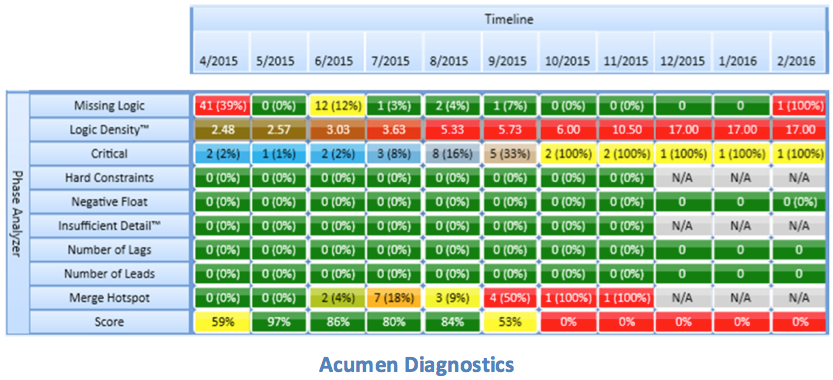
Acumen Fuse provides a complete set of schedule diagnostics.  When I first clicked on the “Diagnostics” tab, I saw an initial set of metrics.

EVMS: Acumen Fuse Schedule diagnostics

Each one of these metrics was applied to the project’s timeline that which makes it easy to see both where and when the issues occur.  What I did not notice at first was that these metrics were just one subset; I was only looking at the “Schedule Quality” subset of the diagnostics.  There were similar subsets in the areas of Logic, Duration, Constraints, Float, and the DCMA 14-point Schedule Assessment, just to name a few.  All of these diagnostic tests can be modified to reflect your company or customer’s standards.

Before leaving the topic of schedule health, there are a few words of caution.  No matter how useful a schedule analysis tool may be, there is no substitute for the task managers taking ownership of the IMS and ensuring that it is in good working order.  For example, analysis software can be used to check to determine if a task has a predecessor and a successor, but only someone familiar with the effort can determine if a task has the “correct” predecessor and successor.  Analysis software is becoming more and more sophisticated, but people still control the success or failure of the project.

Duration Uncertainty

Once a sound schedule has been developed, the next foundational elements of an SRA are the duration uncertainty estimates.  There are two widely accepted methods of assigning duration uncertainty.

The preferred and more precise method is to obtain three-point duration estimates (best case, worst case, and most likely) from the task owners.  At a minimum, this should be performed on all critical and near-critical tasks (and driving and near-driving tasks supporting significant events).  For larger schedule networks, it may not be reasonable to gather this type of information for every task.  If custom three-point estimates are not available, templated duration uncertainty could be applied based on the type of work, the task owner, historical performance, or any other applicable task characteristic.

Acumen Risk handles both methods very easily.  Custom three-point estimates can be entered for each task in days (or hours), or as a percentage of the current remaining duration of the task.  Standard duration uncertainty templates are easily applied to a task by selecting the appropriate risk level on the calibration bar.  To streamline the process, by setting the calibration at any summary level, the uncertainty template is cascaded down to all the “children” tasks.

Description. Calibration.

Risk Events

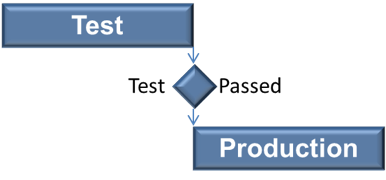
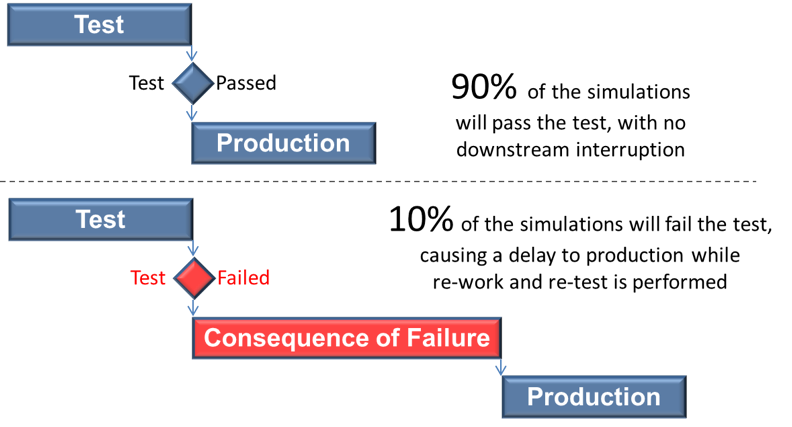
One thing traditional Critical Path Method (CPM) networks do poorly is model unexpected results.  For example, if there is a 90% success rate on fatigue testing, the IMS will generally be constructed to assume the test will be successful, with no disruption to downstream tasks.

EVMS: Critical Path Method

But what happens if the test fails?  While unlikely, there is still a very real possibility that the results will be unfavorable.  If the test does return unfavorable results, there will likely be a significant delay while re-work is performed in the areas of design, build and test.  A traditional CPM network can model a successful test or an unsuccessful test, but not both.  This is not a problem with a schedule risk assessment.  Information from the project’s risk register can be used to model the likelihood of a test failure, as well as the consequence, or delay to downstream tasks resulting from that failure.

EVMS: CPM Risk Events Consequence

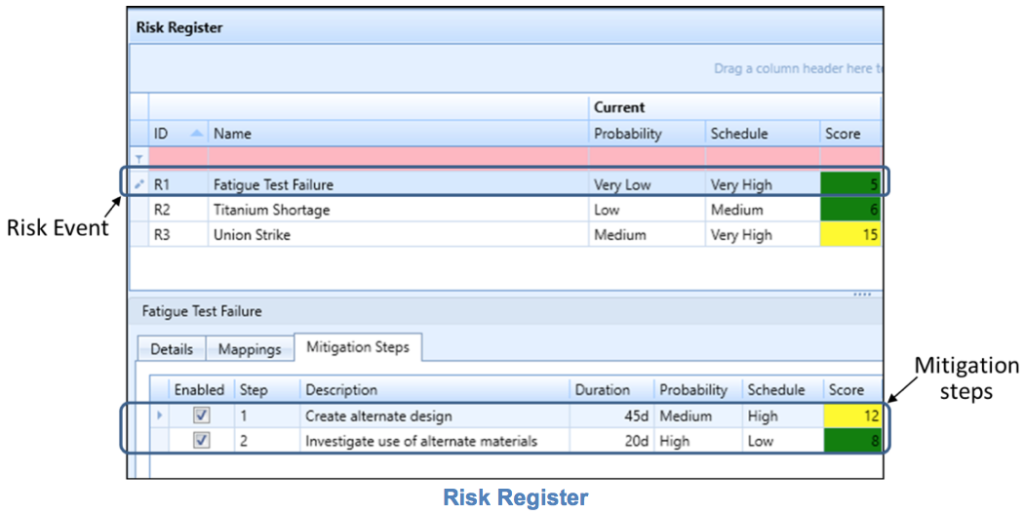
Is this an acceptable risk?  An SRA can quantify the risk and provide information on the likelihood of successful deliveries.  Acumen does not stop there though.  One of its newest features is to organize and track all risk events within its built-in risk register, as well as to track the steps being taken to help mitigate that risk.  Or, if your organization already maintains an external risk register in Excel, it can be imported into Acumen to eliminate the duplicate tracking of risk events.  Whether the risk register is imported from Excel or built from scratch within Acumen, a single risk event can then be mapped to one or more activities, or a single activity can be associated with one or more risk events.

EVMS: risk registers 


Simulation ProcessEVMS: Simulation Process

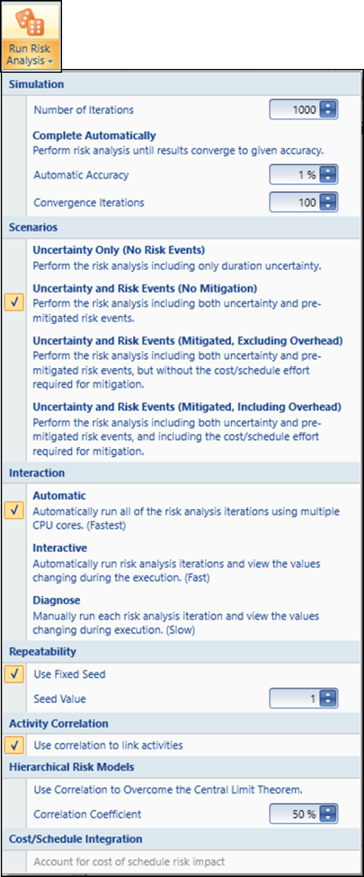
A typical SRA uses Monte Carlo techniques to simulate hundreds or thousands of potential project outcomes using the risks and uncertainties that have been supplied.

For most users, simply accepting the default settings and pushing the “Run Risk Analysis” button would be sufficient.  But if terms like “Convergence”, “Correlation Coefficient”, “Central Limits Theorem” and “Seed Value” are part of your normal working environment, Acumen provides a variety of settings that can be customized to tune the SRA to best model your project.

No matter which approach you take, the Acumen toolset provides a quick and easy simulation process.


What to Expect in Part 2

Part 2 of this blog will delve into the interpretation of SRA results.


Yancy Qualls, PSP

Engagement Director, Schedule Subject Matter Expert (SME)

Humphreys & Associates, Inc.

Assessing Schedule Risk Using Deltek’s Acumen Risk 6.1 | Part 1 of 2 Read Post »

Scroll to Top