A common Earned Value Management System (EVMS) compliance and surveillance review finding are issues with a contractor’s estimate at completion (EAC) process. A credible EAC is essential to successfully manage all contracts and projects.
EACs are important because they provide a projection of the cost at contract or project completion, which is also an estimate of total funds required by the customer. It matters because EACs represent real money. When the most likely EAC exceeds the negotiated contract cost, the contractor’s profit margins may be at risk. It also creates a problem for the customer when the most likely EAC exceeds their funding limits.
We recently updated our blog titled Maintaining a Credible Estimate at Completion (EAC) to highlight why this is a good time to review and potentially update your estimate to complete (ETC) and EAC processes. The updated blog added content specific to:
Incorporating integrated master schedule (IMS) analysis to test the realism of the EAC to identify any disconnects with the cost-based independent EACs (IEACs). It is equally important to determine a realistic forecast completion date (FCD).
Ensuring control account managers (CAMs) are in a position to substantiate their schedule timeline, resource requirements, and cost estimate to complete the remaining work. It is equally important that project managers proactively take the action of “scrubbing” the CAM’s detail ETC/EAC and verifying the data to gain a better understanding of the project’s current state. This improves the quality of the project-level forecast completion date as well as the range of project-level EACs.
Suggested actions to review and enhance current processes from basic steps, such as incorporating an analysis of the IMS Current Execution Index (CEI) to gain an understanding of how well project personnel can forecast into the future, and taking advantage of AI tools to provide additional data analysis insight.
In addition, the publication of the EIA-748-E Standard for EVMS revised 27 guidelines and related updates to government agency guidance such as the DoD EVMS Interpretation Guide (EVMSIG) will require contractors to review and remap EVM System Description content to the revised set of guidelines. The updated blog emphasizes this is a good time to revisit internal ETC/EAC processes and procedures to determine where improvements can be made as well as to ensure project personnel are following the documented processes. The EIA-748-E split the EIA-748-D Guideline 27 into two guidelines. The EIA-748-E Guideline 20 is specific to the control account level EACs and Guideline 23 is specific to the project level EACs. An EVM System Description should have content specific to the process at the control account level as well as the project level that can easily be mapped to the EIA-748-E Guidelines 20 and 23.
Do Your Internal Processes and Procedures Need a Refresh?
H&A earned value consultants routinely assist contractors with updating their internal processes and procedures to reflect the evolving EVMS requirements and guides, regulatory environment, and toolset capabilities. Workflow steps can often be simplified and the quality of performance analysis can be improved with a refreshed approach that reduces the time needed to produce reliable and actionable information. Call us today at (714) 685-1730 to get started.
A budget is a project management metric used to plan and measure performance, while funds are real dollars recorded in the accounting system and spent to perform the work.
Earned Value Management distinguishes planned values (e.g., BCWS, BCWP, BAC) from actual costs and estimates (e.g., ACWP, ETC, EAC) to provide insight into project performance and funding needs.
Contract funding profiles influence how budgets are time-phased, and regular EAC analysis is essential to forecast total funding requirements and avoid breaching funding limits.
While working with numerous clients over the years, H&A earned value consultants frequently observe people using the term “money.” Typically, they mean “funds” when they really mean “budget.” People often confuse the terms, even though they have been used within the project management community long before the advent of earned value management practices.
The intention of this blog is to highlight the difference between “budget” and “funds” and promote a common understanding of the terms. Using the correct term helps to eliminate confusion and improve communication between project team members, management, and the customer.
Examples of Budget and Funds Confusion
Here are a couple of common statements H&A earned value consultants have heard many times:
I am requesting management reserve (MR) to fund my overrun.
I underran my budget, so I am going to return funds to MR.
Why are these inaccurate statements? The people making them have confused the terms or may think that “budget” and “funds” mean the same thing.
Explaining the Difference Between Budget and Funds
The simple definition is that “budget” is a project management metric, a planned value. It cannot be used as funds (i.e., money) to buy something tangible, such as a cup of coffee. “Funds” are real dollars. The purpose for budget is to measure project performance so that as funds are expended (the actual costs) to perform the authorized work, any difference, more or less than what was planned, can alert management.
The table below summarizes the differences between the two terms.
Budget
Funds
Cannot be spent
Money – real dollars being spent or forecasted to be spent. Funding represents the customer’s ability and commitment to pay.
A number on a piece of paper, in a spreadsheet or database – it is a project management metric
Actual costs recorded in the accounting system of record used for financial reporting
Budgeted Cost for Work Scheduled (BCWS)
Time phased budget for required resources to accomplish tasks scheduled in the integrated master schedule (IMS)
Forms the performance measurement baseline(PMB)
Estimate to Complete (ETC)
Funding required to complete the remaining work, exclusive of prime contractor fee
ETC plus ACWP results in the Estimate at Completion (EAC)
Budgeted Cost for Work Performed (BCWP)
The budget value for completed work
Actual Cost of Work Performed (ACWP)
The costs incurred and recorded to accomplish the work performed
Budget at Completion (BAC)
Budget representing all authorized scope of work (SOW)
Cannot change without a change to the SOW with appropriate approval
Estimate at Completion (EAC)
Funding number representing all the money (at the cost level – does not include fee) that will be spent
Can change without a commensurate change in the SOW
An Overview of Budget Terms
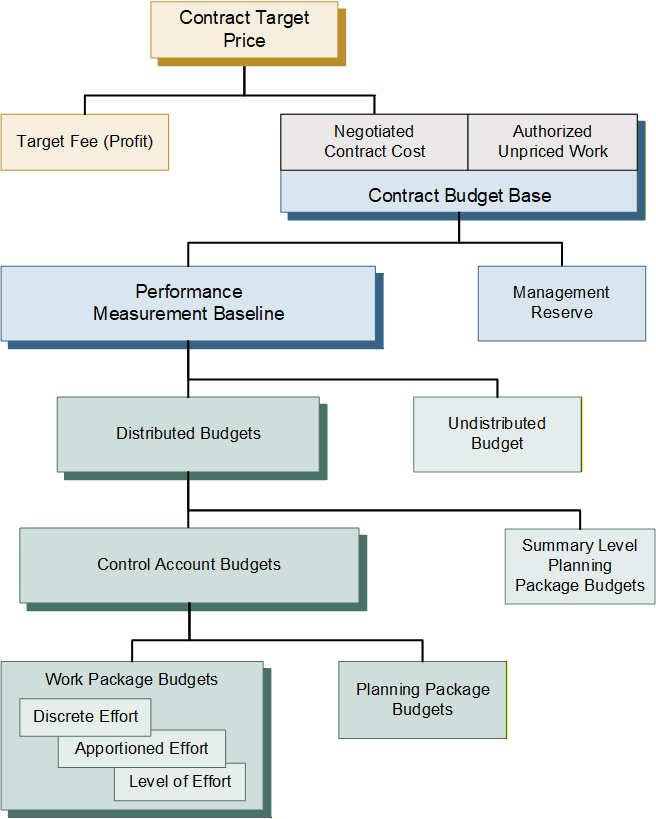
It is often helpful to review the basis for determining and distributing a project’s total budget used for planning and measuring project performance, as illustrated in Figure 1. Note: this is a simplified discussion to highlight the budget terms and does not include nuances such as an Over Target Baseline (OTB) situation.
Figure 1: Budget Distribution and Terms Illustrated
The budgeting process begins with the Contract Target Price (CTP). This is the total negotiated contract value. It includes the negotiated contract cost (NCC) plus the contractor’s planned (target) profit or fee. The Contract Budget Base (CBB) is the starting point for a contractor’s internal budgeting process outlined below.
Budget Component
Definition
Contract Budget Base (CBB)
Represents the financial authorization of the contract and is based on the negotiated contract cost (i.e., price less fee). The CBB is always equal to the negotiated cost for definitized work and the estimated cost for all authorized unpriced work (AUW), also known as Undefinitized Contact Action (UCA). The CBB equals the sum of distributed budgets, undistributed budget, and management reserve (MR). It also equals the sum of the performance measurement baseline (PMB) and MR.
Management Reserve (MR)
Amount of contract budget set aside to handle realized risks and emerging in-scope effort. This effort is in scope to the contract, but out of the scope of distributed and undistributed budget.
Performance Measurement Baseline (PMB)
The PMB is the sum of all distributed direct and indirect budgets against which contract performance is measured. The PMB is the sum of the distributed budgets and undistributed budget. The PMB plus MR is equal to the CBB.
Undistributed Budget (UB)
Budget for authorized work scope that has not yet been identified to a specific WBS element and/or responsible organization at or below the lowest level of reporting to the customer.
Distributed Budgets
Distributed budgets may be comprised of summary level planning package (SLPP) and control account budgets.
Summary Level Planning Package (SLPP) Budgets
Budget may be set aside in SLPPs at the lowest WBS element until the future work effort can be defined in more detail. SLPPs have a high-level scope of work and are scheduled in the IMS with time-phased budgets. They are converted to one or more control accounts with subordinate work packages and planning packages as soon as possible.
Control Account Budgets
Control accounts have a defined scope of work, scheduled start and finish dates, and time-phased budget that reflects the work decomposed to the work package or planning package level. The sum of the time-phased work package and planning package budgets equals the total control account budget.
Work Package/Planning Package Budgets
Work packages and planning packages have a defined scope of work, scheduled start and finish date, and time-phased budget based on the parent control account. This lowest level of budget includes the element of cost detail (labor, material, subcontract, and other direct costs) and value detail (hours, units/quantities, direct costs, and indirect costs).
Notes about Management Reserve
Remember that MR is a budget, is not a financial reserve (i.e., a source of funds). It is not time-phased and is not included in the PMB because there is no related work scope, although it is a part of the CBB. MR budget cannot be used to eliminate cost variances, cover cost overruns, or recover underruns. There is only one MR set aside for a project and the value is never negative.
MR is decreased to provide budget for realized risks or unplanned activities within the contract scope of work. It may be increased whenever the work scope is decreased along with the allocated budget (a contract modification). Customer authorized contract changes, including AUW, should be incorporated into the CBB and PMB as soon as possible; this may include MR budget set aside for added work scope. Only contract changes authorized by the customer’s designated contracting officer may change the CBB value.
Additional note. The MR budget belongs to the contractor’s program manager, not the government customer. MR is not a cost reserve (contingency) for the government customer and may neither be eliminated from contract prices by the customer during subsequent negotiations nor used to absorb the cost of contract changes. For the government customer, contingency is the cost reserve they own, typically associated with a Program Risk-Adjusted Budget (PRB). It is held outside of the project scope, schedule, and budget already provided to the contractor. Reserves held above the program permit senior government management to balance resources within portfolios and among programs. The government customer’s cost reserve could be used to modify the contract to include additional work scope (increases the contractor’s CBB) or provide the funds needed to cover a contract cost overrun.
Budget, Estimates, and Funding Profiles
Contract funding also influences how the PMB budget is allocated and time-phased. The budget distributions are a result of the project planning process (scope of work definition, detailed schedule development, initial cost estimates), MR set aside (risk and opportunity planning), and the funding profile. This is an iterative process to develop the baseline schedule and time-phased budget plan. The budget distributed to the control accounts and any SLPPs is compared to the total PMB/UB value. As needed, adjustments to activities, sequence of work, or resource assignments are made to ensure the overall budget plan reflects the budget limit for the PMB and the contract’s funding profile. For a real-world example of this, see this blog, Understanding the ALAP Scheduling Option in Practical Terms, where a front-loaded schedule was exceeding the funding cap, and how a H&A scheduling consultant helped resolve the issue.
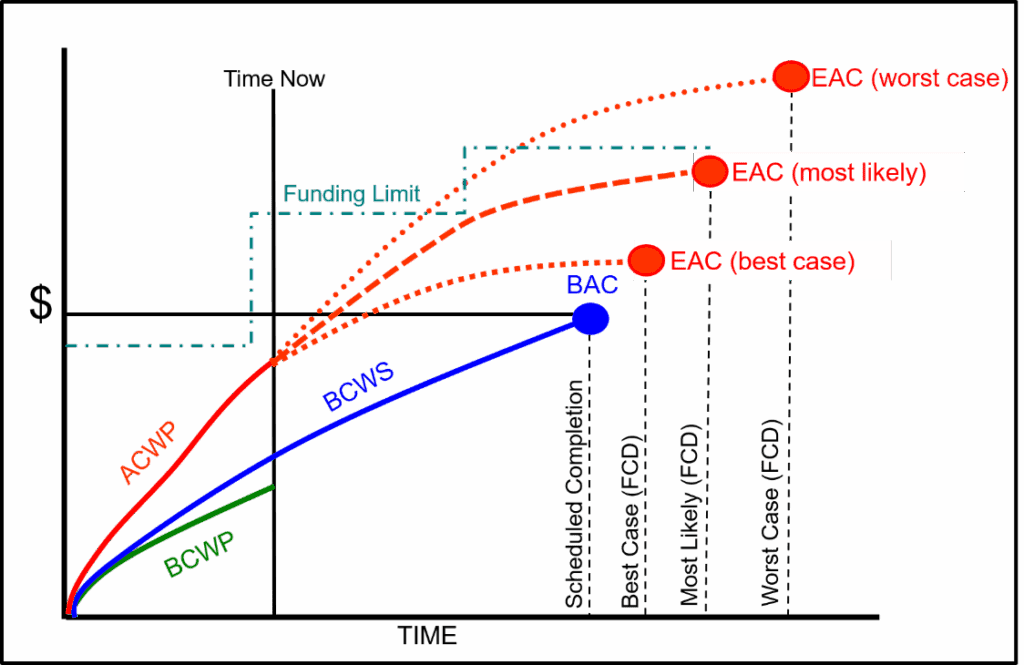
Preparing an EAC every reporting cycle provides an accurate projection of cost at contract completion for internal and external management. It also represents the estimate of total funds required for the contract. The most likely EAC should be within the funding constraints for the contract. Any amounts expended in excess of the contract funding limit puts the contractor at risk. The contractor must notify the customer when their EAC analysis determines there is a potential to breach a funding constraint to address any contract funding issues as quickly as possible.
Figure 2 illustrates a funding profile along with the range of project EACs. In this figure, the most likely EAC is within the contract funding limit.
Figure 2: Management Level EACs with Funding Profile
Reinforcing a Commitment to EVMS Excellence
A common theme of the H&A blogs and articles is helping clients to achieve and maintain a commitment to a high level of excellence in all EVMS process areas. An important part of this is continuous EVM training and project scheduling training, whether for beginners or advanced practitioners. This includes targeted training when clients identify an area where project personnel could use a refresher, more hands-on training, or mentoring. Examples include basic and advanced EVMS workshops, Completing Variance Analysis Reports, Developing an ETC and EAC, as well as short, targeted courses on topics such as Budget versus Funds. Give us a call today at (714) 685-1730 to get started.
We used a quick quiz with some helpful links to give you an opportunity to test your basic understanding of an EVM graph from a real EVMS Program. We go into detail about each concept displayed in the graph and our overall analysis of the project based shown in the graph.