Earned Value Consulting

Earned Value Consulting is support services that an expert in Earned Value Management (EVM) provides to an organization to help them implement an Earned Value Management System (EVMS). EVM consulting services may be offered by organizations that have certified Earned Value professionals on staff, or by service providers who have been trained in EVM and can offer advisory or implementation services.

For a full description of what Earned Value Consulting is and who it is for, see our Knowledge Base article: https://www.humphreys-assoc.com/evms/earned-value-consulting-ta-a-252.html

Navigating EVMS Certification: A Step-by-Step Guide to Compliance

,
Navigating EVMS Certification

In the complex landscape of project management, ensuring compliance with the EIA-748 Standard for Earned Value Management Systems (EVMS) Guidelines is a critical step for companies seeking to secure and successfully manage government contracts. Humphreys & Associates are leaders in earned value consulting, providing comprehensive strategies and solutions tailored to meet the rigorous requirements of the EVMS approval or certification process by a Cognizant Federal Agency (CFA). This article is the first part of a three-part series aimed at guiding organizations through the process of implementing a compliant EVMS and successfully completing a CFA EVMS compliance review.

Understanding the EVMS Approval or Certification Process

Achieving EVMS approval or certification by a CFA such as the Defense Contract Management Agency (DCMA) or the Department of Energy (DOE) is a structured process that requires careful planning and execution. The process begins with a thorough understanding of the EIA-748 Standard for EVMS Guidelines, which is the foundation for determining whether an EVMS is compliant. The EIA-748 Guidelines define the requirements to establish and maintain an effective EVMS. The approval or certification process involves several key steps, beginning with the initial application and concluding with the CFA formal determination a contractor’s EVMS complies with the Guidelines. Throughout this journey, organizations must demonstrate a thorough understanding of the Guideline requirements and how they are implemented within their project management framework as documented in their EVM System Description.

Steps to Achieve EVMS Certification

  1. Preparation and Self-Assessment: Conducting an internal review of the current project management processes and comparing them against the EIA-748 Standard for EVMS Guideline requirements is an important first step to identify gaps in the system that will need to be addressed.
  2. Training and Education: It is crucial for the team responsible for EVMS implementation to receive proper training to understand the Guideline requirements and how to apply them.
  3. System Description Development: A comprehensive EVM System Description that explains how the organization’s processes meet the EIA-748 Guideline requirements must be developed.
  4. Implementation: The EVMS must be implemented on a project, demonstrating the project team’s ability to use the EVMS and EVM data to manage the project, as well as the system’s functionality in a real-world scenario.
  5. Mock Compliance Review: An internal review, often with the help of an independent third party, should be conducted to verify the EVMS complies with the Guideline requirements as well as to verify the quality of the project’s schedule and cost data to provide timely and actionable information for managing the project.
  6. Formal Compliance Review: A CFA conducts a formal review of the EVMS. This includes reviewing the EVM System Description, performing a detailed examination of project schedule and cost data, conducting interviews with project personnel, and assessing how the EVMS has been implemented.

Importance of Complying with the EIA-748 Guidelines

Meeting the EIA-748 Guideline requirements is not just about compliance; it is about integrating a system that enhances the project management capabilities of an organization. A well-implemented EVMS facilitates better project control, provides early warning signs of performance issues, and supports informed decision-making. Compliance with the Guidelines is often a prerequisite for bidding on government contracts, making a formal EVMS approval or certification a strategic necessity for companies in the defense, aerospace, and construction industries, among others.

Key Requirements for an EIA-748 Compliant EVMS

The EIA-748 Standard for EVMS provides the basic guideline requirements for organizations to establish and implement a system that integrates project work scope with the schedule and cost components to enhance project planning and control. The Guidelines are organized into these process areas:

  • Organization: The organization guidelines focus on establishing the framework for decomposing a project’s scope of work to level where it is possible to identify management responsibility for the work scope, schedule, and cost components.
  • Planning, Scheduling, and Budgeting: The organization guidelines are the framework for the planning, scheduling, and budgeting process required to establish the performance measurement baseline, a common point of reference for measuring completed work and communicating the project’s current status.
  • Accounting Considerations: These guidelines focus on the recurring processes for determining progress and collecting the actual costs for work performed. The objective is to ensure alignment between the budget plan, performance claimed (earned value), and actual costs to continually assess and analyze project performance for potential corrective action.
  • Analysis and Management Reports: These guidelines facilitate the analysis and use of the performance data to proactively manage the project. An EVMS generates variance data that helps management to focus on areas that are not performing to plan for potential corrective action.
  • Revisions and Data Maintenance: The integrity of the performance measurement baseline must be maintained to manage the remaining work on a project. These guidelines focus on establishing a controlled process to document, authorize, track, and manage revisions to a project’s scope, schedule, and budget.

Frequency and Importance of Surveillance Reviews

Surveillance reviews are an important part of maintaining a compliant EVMS. Once the CFA has approved or certified a contractor’s EVMS, the contractor is responsible for implementing an annual self-surveillance or self-governance process to ensure the EVMS continues to be implemented on projects in an effective and consistent manner in compliance with the EIA-748 Guidelines. It also ensures the contractor’s EVMS process and procedures, training, and tools are actively maintained over time. The government customer also conducts surveillance for the life a contract, typically on an annual basis. This is a recurring evaluation of the contractor’s management control practices and samples of internal and external reported data. The focus is typically on major system activities, problem identification, and tracking any corrective actions to closure.

The successful implementation of an EVMS that complies with the EIA-748 Guideline requirements is a testament to an organization’s commitment to project excellence. It demonstrates a capability many government agencies require, making it an essential investment for businesses looking to expand their opportunities within this sector. The subsequent articles in this series will delve into the specifics of the EVMS implementation process and the intricacies of preparing for EVMS compliance and surveillance reviews.

Stay tuned to learn more about effective EVMS implementation for government contracts in our next blog, “Effective EVMS Implementation for Government Contracts: Roles and Challenges,” and how to prepare for surveillance or compliance reviews in “Preparing for EVMS Reviews: Strategies for Success with Humphreys & Associates.”

This article has provided an overview of the EVMS approval or certification process by a CFA and the importance of complying with EIA-748 Standard for EVMS Guidelines. 

Navigating EVMS Certification: A Step-by-Step Guide to Compliance Read Post »

Preparing for EVMS Reviews: Strategies for Success with Humphreys & Associates 

Preparing for EVMS Reviews

Facing an Earned Value Management System (EVMS) compliance review can be an imposing prospect for any organization with EVMS contractual requirements. With strategic preparation and expert guidance from Humphreys & Associates, renowned for their leadership in earned value consulting, this necessity can be transformed into an opportunity for process improvement to ensure an effective and efficient EVMS can be implemented on any project. This comprehensive guide, the first in a three-part series, takes a closer look at the strategic approach necessary for preparing for a Cognizant Federal Agency (CFA) EVMS compliance review. CFAs include the Defense Contract Management Agency (DCMA) for DoD and NASA contracts and the Department of Energy (DOE). A CFA conducts a formal review to determine whether the contractor’s EVMS is compliant with the EIA-748 Standard for EVMS Guidelines. A formally approved or certified EVMS is an EVMS the CFA has determined to be compliant with the EIA-748 Guidelines.

Key Elements in Preparing for an EVMS Compliance Review

A successful EVMS compliance review is predicated on several fundamental elements. Being well-prepared in these areas can make the difference between a review that goes smoothly and one that uncovers issues that require corrective action.

  • Thorough Documentation: Proper documentation is the backbone of any review process. It’s essential to maintain an EVM System Description that explains how the system complies with the EIA-748 Guideline requirements as well as any agency specific EVMS requirements. This includes documented policies and procedures as well as process flowcharts illustrating system inputs and outputs with responsibility assignments.
  • Mock Reviews: Conducting internal mock reviews can serve as a rehearsal for the actual review. These practice runs help to uncover any weaknesses in the system and provide a chance to correct them beforehand. Mock reviews also help familiarize the team with the compliance review process, reducing anxiety and ensuring that everyone knows what to expect.
  • Continuous Training: Regular and comprehensive training ensures that project personnel are familiar with the EVMS processes, know how to use the EVM data, and understand the importance of their role in maintaining quality schedule and cost data. This training should be updated regularly to reflect any changes in EVMS requirements, software tools, or company procedures.
  • Data Integrity: The accuracy and completeness of project data are crucial. Regular validation checks should be conducted to ensure data in the EVMS are valid, reliable, and traceable. This includes verifying the project data aligns with the corporate financial records and that the system accurately reflects the project’s current status.
  • Stakeholder Engagement: Effective reviews require the cooperation and understanding of all stakeholders. Engaging them early in the review process helps ensure everyone is on the same page and that the roles and responsibilities are clearly defined. This engagement includes regular communication and involvement in the compliance review preparation process.

Assistance in the Review Preparation Process

Humphreys & Associates provides comprehensive services designed to support organizations throughout the compliance review preparation process. This includes:

  • Compliance Review Readiness Assessments: These assessments are crucial in determining the readiness of an organization’s system, personnel, and data quality for a compliance review. The assessment identifies areas of strength and those requiring improvement, enabling targeted action to enhance readiness.
  • Preparation Workshops: Workshops conducted by experienced consultants can train and prepare the team for the compliance. These sessions cover everything from the basics of EVM to the nuances of the review process, tailored to the specific needs of the organization.
  • Documentation Review: Prior to an compliance review, it’s beneficial to have an external review of the documentation that will be presented. This review can identify areas where additional information is needed and ensure that the documentation accurately reflects the EVMS and compliance with the EIA-748 Guidelines.
  • Support Services: During the review, having expert support available can alleviate the challenges that may arise. This includes on-the-spot advice and assistance in addressing the CFA’s questions and concerns. Should the CFA issue formal corrective action requests (CARs), Humphreys & Associates can assist with producing and implementing the corrective action plans (CAPs) to resolve the deficiencies as quickly as possible.

Common EVMS Review Findings and Remediation

There are several common findings that an EVMS compliance review might reveal that could potentially impact an organization’s ability to obtain a formal CFA EVMS compliance approval or certification. Being aware of these potential findings and understanding how to address them is key to success.

  • Inadequate Baseline Control: Maintaining a current and accurate performance measurement baseline is essential. When a government review team finds baseline control to be lacking, it’s often due to inadequate processes for incorporating changes into the baseline or failing to maintain traceability of the changes.
  • Insufficient Documentation: Documentation gaps can lead to findings of non-compliance. Government review teams need to see evidence that a complete set of processes are in place and that these processes are being followed. This includes having proper version control and evidence of management approvals.
  • Data Discrepancies: Differences between what’s reported in the project reports and the actual project data can indicate serious issues with data management systems. Ensuring that the EVMS software is properly configured, data validation checks are routinely performed, and that schedule and cost data align can prevent such discrepancies.

To address and prevent these common issues, Humphreys & Associates recommends a proactive stance, with robust change control processes, continuous enhancement of documented practices, and improvements to data management systems to ensure accuracy and traceability.

Preparing for an EVMS compliance review is a critical task that can significantly impact the management and success of government contracts. With the strategies provided here and the support of Humphreys & Associates, organizations can confidently navigate the EVMS compliance review process.

Explore the nuances of the implementation phase in “Effective EVMS Implementation for Government Contracts: Roles and Challenges,” and enhance your understanding of the certification process in “Navigating EVMS Certification: A Step-by-Step Guide to Compliance.”

Preparing for EVMS Reviews: Strategies for Success with Humphreys & Associates  Read Post »

Effective EVMS Implementation for Government Contracts: Roles and Challenges

, ,
Effective EVMS Implementation for Government Contracts

Embarking on implementing an Earned Value Management System (EVMS) for government contracts is a complex task. With the expert guidance of Humphreys & Associates, leaders in earned value consulting, organizations can effectively navigate this intricate process. This detailed exploration, the second in a three-part series, delves into the best practices, key roles, and common challenges of implementing an EVMS on government projects.

Best Practices for Implementing an EVMS on Government Projects

The implementation of an EVMS for a government project demands team work and strategic planning. Following best practices facilitates the EVMS compliance process and enhances overall project performance.

  1. Begin with a Clear Strategy: Starting with a clear strategy requires a full understanding of the scope of contract requirements and aligning project management processes with the EIA-748 Standard for EVMS Guidelines. This means establishing clear technical, schedule, and cost objectives as well as establishing a performance measurement baseline that are in harmony with contractual obligations.
  2. Use a Phased Approach: A phased approach to EVMS implementation allows for better management of resources and more focused attention on each aspect of the system. By prioritizing critical areas, such as organizing and decomposing the entire contractual scope of work into manageable product-oriented elements that can assigned to responsible managers, organizations can ensure that the foundational elements of an EVMS are solid before expanding to other areas.
  3. Involve All Stakeholders Early: The early involvement of all stakeholders, including project managers, project controls team, finance, procurement, and even suppliers, ensures that everyone understands the EVMS requirements and their role in the implementation. This early buy-in helps to streamline the integration of EVMS into existing processes and encourages collaborative problem-solving.
  4. Ensure Adequate Training: Comprehensive training programs are essential to equip all team members with the necessary knowledge of EVMS principles as well as how to use the schedule and cost tools that support the EVMS. This training should be tailored to the various roles within the team and include practical exercises that reflect the challenges they will face during implementation.
  5. Focus on Data Quality: High-quality data is the cornerstone of an effective EVMS. Ensuring accuracy, timeliness, and reliability of project data involves setting up rigorous data collection and processing systems, continuous data verification, and validation processes.
  6. Continuously Improve: Continuous improvement involves regularly reviewing and refining the EVMS processes based on project performance, self-governance feedback, and lessons learned. It’s about fostering a culture of constant enhancement to adapt to project changes and industry advancements.

Who’s Who in EVMS Development and Deployment

A successful EVMS implementation relies on the collaborative efforts of a dedicated team, each member plays a critical role.

  • Project Managers: They are the linchpins in ensuring that the EVMS is implemented as intended on the project. They coordinate between different teams, manage resources, and ensure that project contractual objectives are being met.
  • Control Account Managers (CAMs): CAMs have a focused role in managing specific project segments of work. They are responsible for the scope of the work, schedule, and budget for their control accounts that are decomposed into detail work packages or planning packages.  They are critical in ensuring work completion, developing and implementing corrective actions when needed, and providing accurate work status information.
  • EVMS Analysts: These specialists monitor and analyze project performance against the established baselines. They provide forecasts, identify variances, and offer insights that guide decision-making and corrective actions.
  • Finance Personnel: The finance team ensures the integrity of project accounting and its alignment with EVMS requirements. They are responsible for cost recording, allocation, and reporting, playing a vital role in the financial aspect of project control.

Common Challenges and Solutions for an EVMS Implementation

While implementing an EVMS, organizations may encounter several challenges, but with the right strategies, these can be mitigated.

  • Promote Organizational Buy-In: Resistance to change is a common barrier. Overcoming this requires demonstrating the value of the EVMS to the stakeholders, highlighting its benefits in terms of improved project visibility and control. Engaging team members by making them part of the implementation process can foster acceptance and support.
  • Maintain Data Integrity: To ensure the accuracy and completeness of data, it’s imperative to establish standard data governance practices. This includes documenting best practices to help project personnel develop and maintain quality schedule and cost data, performing regular data quality assessments, and conducting continuous training.
  • Seek Expert Advice: Leveraging the knowledge and expertise of EVMS consultants like Humphreys & Associates can be invaluable. Consultants can offer guidance, best practices, and training that are tailored to the organization’s specific needs and challenges.

The implementation of an EVMS is a critical step towards achieving project success, especially in the highly regulated government contracting environment. The insights provided here, coupled with the expertise of Humphreys & Associates, can help organizations to navigate the EVMS implementation landscape effectively.

For a deeper dive into this topic, read our full article, “Navigating EVMS Certification: A Step-by-Step Guide to Compliance.” And stay tuned for the final installment in this series, where we will explore strategies for preparing for compliance or surveillance reviews in “Preparing for EVMS Reviews: Strategies for Success with Humphreys & Associates.”

Effective EVMS Implementation for Government Contracts: Roles and Challenges Read Post »

Incorporating IMS Information Directly into Independent Estimate at Completion (IEAC) Formulas

, , ,
Incorporating IMS Information Directly into Independent Estimate at Completion (IEAC) Formulas

“When you need to discuss the schedule, look at the schedule.”

– A Scheduler’s Lament

There are many existing formulas for calculating an Independent Estimate at Complete (IEAC) from earned value data. A recent study of a sample of projects found that the calculated IEACs analyzed at the 25%, 50%, and 75% complete points were not accurate when compared to the final actual cost of work performed (ACWP). The following table lists the thresholds used to assess the accuracy of the IEACs at the different complete points for the sample projects.

Percent CompleteAccuracy Threshold
25%Within +/- 10% of final ACWP
50%Within +/- 7% of final ACWP
75%Within +/- 5% of final ACWP

While working on that study of the accuracy of commonly applied IEAC formulas as well as on a small project as an analyst for a customer, the idea for using data directly from the integrated master schedule (IMS) in conjunction with the cost performance data to create a new IEAC formula emerged.

Using Data Directly from the IMS to Calculate an IEAC

It should be noted that none of the generally used IEAC formulas use data directly from the IMS. The IEAC formulas use data found in the cost performance portion of the earned value monthly reports to customers.

IMS data is only used indirectly in the IEAC formulas. When a task is started and progress updated, the earned value (the budgeted cost for work performed or BCWP) is developed from the progress reported. This is measured against the cost baseline (the budgeted cost for work scheduled or BCWS).

At the same time, in the IMS environment, the schedule analysts are calculating the Baseline Execution Index (BEI) for task completions/finishes. BEI (for finishes) measures how many of the tasks baselined to be completed by the cut-off date were completed. If all the tasks were done (BEI = 1), their value would have been earned. Of course, other tasks could have started, progressed, and maybe even finished. For this example, the Schedule Performance Index (SPI) calculated at that point (BCWP/BCWS) should be at least 1 and potentially higher. The SPI reflects the baseline value of completed tasks plus the in-process claimed baseline value. The in-process claimed value can be subjective in some cases.

The argument, if there were one, might be there is no need to try and include BEI or similar schedule measures in the IEAC formulas since they already include SPI.

However, there is a whole different and unique set of information coming from the IMS that is not currently used in the IEAC formulas. That information is what we chose to call “Duration Performance” and “Realism Ratio.” These are measures of the actual duration for completed tasks and the forecast duration for future tasks.

Calculating Duration Performance

The IMS data includes the baseline number of days assigned to each task as well as the actual number of days to complete each task. If a task is baselined to take 10 days (Baseline Duration = 10) and the task took 15 days to complete (Actual Duration = 15) then it is taking 150% of baseline to do the work.

This is similar to the Cost Performance Index (CPI) that uses the BCWP and the ACWP to determine how efficient the work performance has been. The formula BCWP/ACWP shows how the work accomplished compares to the cost of that work performed.

If we assume, for labor at least, that taking longer to complete a task often leads to costing more than baselined, we can use the Duration Performance to develop an IEAC.

To develop the Duration Performance, we would use the IMS from the month being analyzed to perform the following actions:

  1. Filter out all summary tasks and look only at real work tasks.
  2. Decide what to do with level of effort (LOE) – keep it or ignore it.
  3. Filter for all tasks that are completed (100% complete).
  4. Add up the baseline duration in days for all these completed tasks.
  5. Add up the actual duration days for these same completed tasks.
  6. Compare the actual duration days used to the baseline duration days.

An example would be:

  • 100 completed tasks
  • Total baseline days duration = 1,000
  • Total actual days duration = 1,500
  • Duration Performance = 1,000 / 1,500 = .67

One of the common IEAC formulas is the “SPI times CPI” that is calculated like this: ACWP + Budgeted Cost of Work Remaining (BCWR) / (CPI x SPI) where BCWR = Budget at Completion (BAC) – cumulative to date BCWP.

Now that we have a duration performance factor, we can develop a new IEAC. The Duration Performance IEAC would be done using the CPI from the same month as the IMS where ACWP + BCWR / (CPI x Duration Performance Index).

Using some actual data from a project for a single month we see:

  • Duration Performance Index = .82
  • BEI = .72
  • CPI = .92
  • SPI = .94 (significantly higher than the BEI)
  • ACWP = $9.2M
  • BCWR = $18.3M
  • IEAC using standard formula with CPI x SPI = $9.2 + $18.3 / (.92 x .94) = $30.3M
  • IEAC (Duration Performance) = $9.2 +$18.3 / (.92 x .82) = $33.5M

Assessing the Realism Ratio

When we look at the remaining tasks to be completed, we can use the Realism Ratio to assess how the future forecast durations compare to the performance so far.

The data needed are the baseline duration and the forecasted duration for all tasks that have not been started. This concept excludes in-process tasks. In our example from before, the data we created looked like this:

  • 100 completed tasks
  • Total baseline days duration = 1,000
  • Total actual days duration = 1,500
  • Duration Performance = 1,000 / 1,500 = .67

We would use the same IMS to do this:

  1. Filter out all summary tasks and look only at real work tasks.
  2. Decide what to do with LOE – keep it or ignore it.
  3. Filter for all tasks that are not started.
  4. Add up the baseline duration in days for all these tasks not started.
  5. Add up the forecasted duration days for these same tasks not started.
  6. Compare the forecasted duration days to the baseline duration days.

Let’s say there were 100 tasks not started. If the forecasted days were 1,000 and the baseline days were 1,000 that would yield 100%. When we did the example, the Duration Performance was .67. This means that performance to date was .67 but the future will be 100% or 1. You can see the disconnect. That disconnect we call the Realism Ratio (in this example, .67/1).

Data from the actual project for the same month as discussed earlier shows:

  • Duration Performance = 122% of baseline
  • Future Performance = .86 or 86% of baseline.

This means that the future durations are cut significantly.

We would use this data to develop a factor called a Realism Ratio (86/122 = .70) and that would be used to develop an IEAC using this formula: IEAC (Realism Ratio) = ACWP + BCWR / (CPI x Realism Ratio).

Using the same sample project data from above and adding in an assessment of the forecasted durations for the remaining work, we see:

  • Duration Performance = .82
  • BEI = .72
  • CPI = .92
  • SPI = .94 (significantly higher than the BEI)
  • ACWP = $9.2M
  • BCWR = $18.3M
  • Realism Ratio = .70
  • IEAC using standard formula with CPI x SPI = $9.2 + $18.3 / (.92 x .94) = $30.3M
  • IEAC (Duration Performance) = $9.2 +$18.3 / (.92 x .82) = $33.5M
  • IEAC (Realism Ratio) = $9.2 +$18.3 / (.92 x .70) = $37.6M

The project is not complete, so the final ACWP position is not known. There is a dramatic difference between the three IEACs. The difference between BEI and SPI indicates that in-process tasks and other factors such as LOE are potentially affecting SPI.

What can we learn from this sample project?

In this example, additional investigation is warranted. There are potential issues with the realism of the baseline and current schedule that are signaling a cost growth issue is likely to occur. Relying on just the time-phased cost data for IEAC calculations may not be sufficient to assess whether a contractor’s range of EACs included in their monthly cost performance reports are realistic. For more discussion, see the blog on Maintaining a Credible Estimate to Completion (EAC) and the blog on Using EVM Performance Metrics for Evaluating EACs.

Are there lurking cost growth surprises in your projects? You may want to consider revisiting your estimate to complete (ETC) and EAC process to verify there is an integrated assessment of the schedule and cost data to identify potential disconnects. H&A earned value consultants can provide an independent assessment of the quality of the data as well processes and procedures to help you verify your EACs are realistic. Call us today at (714) 685-1730.

Incorporating IMS Information Directly into Independent Estimate at Completion (IEAC) Formulas Read Post »

Introduction to the IPMDAR Data Deliverable – Tips for Producing the Outputs

Contractors new to earned value management (EVM) often give us a call to help them respond to a government customer request for proposal (RFP) that includes the FAR or DFARS Notice of Earned Value Management System (EVMS) contract clause. Depending on the contract value threshold, the contractor will need to implement an EVMS that can at least produce the contract performance data submittals ($20M or greater) or complete a formal EVMS compliance review ($100M or greater) by a cognizant federal agency (CFA) such as the Defense Contract Management Agency (DCMA). Required data deliverables for a DoD or NASA customer reference the Integrated Program Management and Data Analysis Report (IPMDAR) Data Item Description (DID) as the means to submit monthly performance data. 

What is the objective for placing the IPMDAR on contract?

The government customer wants the monthly source schedule and cost data from the contractor for their own contract performance analysis in a standard format. They need to have reliable schedule and cost data for visibility into current contract performance as well as credible schedule and cost projections for the remaining work. Will the contractor complete the remaining work effort within the contractual schedule and cost targets? The government program manager needs this information for their own planning and budgeting as well as forecasting their funding requirements.

A standard format for collecting the data is important for the government customer so they can perform program portfolio analysis. The DoD established their EVM Central Repository (EVM-CR) to routinely collect contractor data submittals for program portfolio analysis. The data is organized using the MIL-STD-881 (the DoD Standard for Work Breakdown Structures or WBS), as a common basis to organize program data. The IMPDAR DID data submission requirements are defined in the File Format Specifications (FFS) and Data Exchange Instructions (DEI). The FFS and DEI specify the required set of data tables using JSON encoding for the IPMDAR cost and schedule data submissions while narrative text is submitted using Microsoft Word or PDF files so the customer can perform text searches. 

The government program manager can tailor the IPMDAR requirements as defined in the DoD IMPDAR Implementation and Tailoring Guide that complements the DID. For example, they can specify the level of data detail (control account or work package level), whether data can be delivered incrementally, variance analysis options, and requirements for the Performance Narrative Report content.

What is included in the IPMDAR deliverable?

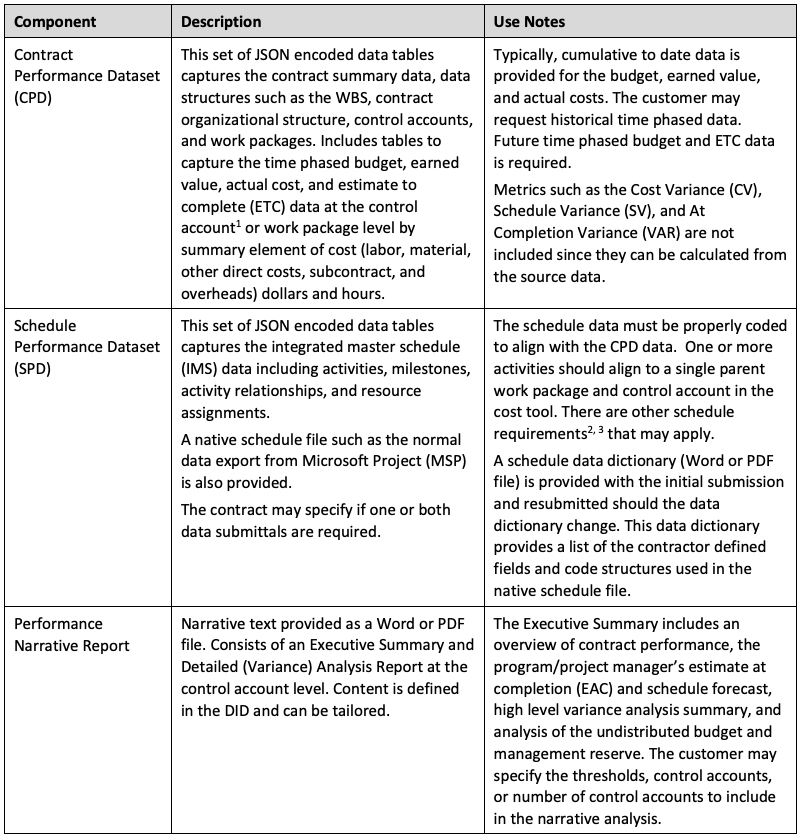
There are three components as outlined below

IPMDAR Components

Notes:

  1. At a minimum, the IPMDAR requires data at the control account level with summary element of cost detail. The contract may specify work package level data.
  2. Inputs from a recent schedule risk assessment (SRA) should be included in the native schedule file submission when available. Depending on the schedule tool, the SRA data may need to be a separate file submission (Word or PDF). Results from the SRA along with other schedule analysis discussions (critical path, driving path, and schedule margin) are required to be included in the Detailed Analysis Report narrative. 
  3. The customer may request the results from a schedule data quality assessment and health metrics be included in the Detail Analysis Report narrative. 

What is required to produce the IPMDAR deliverables? 

For contractors new to EVM, one of their first objectives is to figure out what schedule and cost tools they need to be able to provide the required IPMDAR data and narrative analysis to their customer. H&A earned value consultants are sometimes asked to provide recommendations on commercial off the shelf (COTS) tools for this purpose. Much depends on what the contractor already has in place. 

Common schedule COTS tools such as MSP or Oracle Primavera P6 that have already been implemented will require an add-on to produce the SPD. Keep in mind that the IPMDAR does require SRA data and may require results from performing routine schedule data quality assessments. Some COTS add-ons to MSP or P6 are able to produce the typical schedule data quality metrics as well as produce the SPD. Other COTS scheduling tools such as Deltek Open Plan incorporate the SRA functionality, data quality metrics, and the ability to produce the SPD as part of the core product capabilities.

In most instances, contractors new to EVM do have an accounting/financial system in place to at least capture some level of contract or program/project budget and actual cost data. There may also be some capability to produce ETC data required for EAC financial analysis. The issue is organizing the complete set of time phased cost data (budget, earned value, actual cost, ETC) at the control account and work package level by summary element of cost that aligns with the schedule activity data. A contractor may be able to get by with Excel for a small project, however, it is time and cost prohibitive to create Excel macros to produce the CPD. Most COTS EVM cost tools are able to produce the CPD and have successfully completed the DoD EVM-CR data submission validation checks. This is a better alternative to building an in-house tool.

A data analysis tool such as Encore Analytics Empower is also a good option. Empower can import the time phased cost data from Excel or other COTS EVM tools and produce the CPD output. Empower can also import data from common COTS schedule tools. The benefit to using Empower is the ability to analyze the schedule and cost data in one place to verify alignment, produce interactive dashboards and a variety of analysis data views, and produce the IPMDAR Performance Narrative Executive Summary and Detailed Analysis Report.

Top Three Tips for Implementing Tools to Produce the IPMDAR Outputs

Here are a few tips from H&A’s earned value consultants on implementing tools to support the IPMDAR data submittals. Focus on getting the basics right.

  • Continuously verify the quality of the schedule and cost data. Routinely perform schedule data quality assessment and health checks to proactively resolve schedule construction, status, or data issues. Perform routine cost data validation checks such as earned value and no actual costs for a work package or the cumulative to date earned value exceeds the budget at completion (BAC). Correct all data anomalies before producing the deliverables.
  • Continuously verify the schedule and cost data are in alignment. Consistent schedule and cost data coding is critical to ensure integration and traceability. 
  • Anticipate the scope and level of data detail required. This can impact tool configuration, data structures, and data pulled from other business systems such accounting. For example, be prepared to provide the work package level of detail; actual costs will need to be available at this level. Another example is providing schedule risk assessment inputs; this is usually required at intervals specified in the CDRL.

H&A earned value consultants routinely help clients with constructing the schedule to support the IPMDAR data requirements, setting up the process to do routine data quality checks, integrating the schedule and cost data, and verifying the data before producing the performance reporting data submittals. Another common focus is producing clear and concise variance analysis narrative content

We can do the same for you. Call us today at (714) 685-1730 to get started.

Introduction to the IPMDAR Data Deliverable – Tips for Producing the Outputs Read Post »

Determining Responsibility for Indirect Cost Variance Analysis – Part 3

, , ,

Indirect Cost Variance Analysis Process

The debate that has continued since the inception of the earned value concepts in the 1960’s has been: “Who should report on and analyze the cost variances attributable to indirect costs?”

This blog is the third in the series of blogs to help answer this question.  The first blog covered a few fundamentals about how indirect cost rates are established to set the stage.  The second blog discussed how indirect rates are applied and how project personnel display indirect costs for internal or performance reporting.  This blog concludes the discussion on the indirect cost variance analysis process.  It covers what the EIA-748 Standard for Earned Value Management Systems (EVMS) and related government agency guides have to say on the subject as well as discussing the best option for determining who is responsible for indirect cost variance analysis.  

Throughout a project’s execution phase, project managers and control account managers (CAMs) conduct their respective performance analysis at varying levels of detail to identify significant cost and schedule variances as well as variances at completion (VAC).  They use variance thresholds to focus on the work elements where challenges or problems are occurring.  As needed, they identify the root cause of the variance and determine the best path forward to mitigate or otherwise reduce the impact of an unfavorable variance.  

This effort includes performing additional analysis not just by the direct elements of cost (labor, material, subcontract, or other direct costs (ODCs)), but also by the indirect costs applied to those direct cost elements to identify the root cause.  For example, the CAMs check for labor variances (rate or efficiency/volume) and material variances (price or usage) to identify any potential issues.  As a side note, remember the rates used to calculate earned value are the same rates used for budget values.  Likewise, actual costs are collected into the same direct cost elements of cost and indirect cost pools as the budget plan elements of cost.  Those actual rates may vary from the budget/earned value rates.

At the total project level, a project manager performs indirect element of cost analysis.  They need to assess whether indirect costs are contributing to the project’s cost variances and quantify the impact.  Since indirect costs are directly related to the base time phased direct costs, it follows the variances for the element of cost categories are similarly skewed.  Figure 1 shows an example (produced from Encore Analytics Empower) of a contract with the variances attributable to the elements of cost (see previous 3-part blog: Planning and Managing EVM by Elements of Cost (EOC)). The indirect cost variances tend to vary with the changes in the direct costs base and/or indirect elements of cost over time at a pool level.  While not common, these could be different from month to month (the lightest blue shaded boxes in Figure 1) when annual, semi-annual, or quarterly rate adjustments occur (the project manager would be notified when these occur).  

Figure 1: Example Cumulative Variance Analysis by Elements of Cost

The project manager and CAMs are also responsible for completing their variance analysis reports.  These include the Integrated Program Management Report (IPMR) Format 5 (Explanation and Problem Analysis) or Integrated Program Management Data and Analysis Report (IPMDAR) Performance Narrative Report.  As part of this analysis, they need to discuss whether rate changes are impacting the project’s current and cumulative cost and schedule variances, as well as the calculated EAC (cumulative to date actual costs plus ETC). 

Customers often require additional indirect cost detail on the formal performance reports when thresholds are exceeded.  The narrative reports are used to address those indirect cost pool base versus rate variances.  Project managers and CAMs (when indirect costs are displayed as part of their budgets), need base versus rate variance analysis from finance or accounting.  Finance or accounting is responsible for establishing the indirect cost rates to date and forecasting what the indirect rates will be for future fiscal years. 

Who is responsible for the indirect cost variance analysis?

Back to our original question: “Who should report on and analyze the cost variances attributable to indirect costs?”  Can the EIA-748 Standard for Earned Value Management Systems (EVMS) 32 guidelines provide any guidance?  There are also various government agencies that place EVMS requirements on contracts.  Do their policies, compliance business practices, or standard operating procedures provide any guidance?  

The fact is, the EIA-748 Guidelines, dating back to the Cost/Schedule Control Systems Criteria (C/SCSC) in the 1960s, have never specified the level where the management and analysis of indirect costs must occur.  The founders of the earned value concept realized there are several levels of management where indirect rates are applied versus the level at which they are displayed for management.  

The EIA-748 Standard for EVMS (Rev D) Guidelines say the following:

4. Identify the organization or function responsible for controlling overhead (indirect costs).

13. Establish overhead budgets for each significant organizational component of the company for expenses, which will become indirect costs. Reflect in the program budgets, at the appropriate level, the amounts in overhead pools that are planned to be allocated to the program as indirect costs.

19. Record all indirect costs which will be allocated to the program consistent with the overhead budgets.

24. Identify budgeted and applied (or actual) indirect costs at the level and frequency needed by management for effective control, along with the reasons for any significant variances.

The Defense Contract Management Agency (DCMA) Cross Reference Checklist (CRC) sub-questions for these guidelines do not specify any particular level where these actions must occur, and do not even mention the control account level.  For example, for the Guideline 4 sub-questions, they reference “the management position” assigned the responsibility and authority for controlling indirect costs.  For one of the Guideline 24 sub-questions, they ask: “Are the variances between budgeted and actual indirect costs identified and analyzed at the level of assigned responsibility for their control (indirect pool, department, etc.)?”  

Likewise, the Department of Energy’s (DOE) detailed Compliance Review Checklist is equally non-specific on the level of management where these actions occur.  Below are excerpts from that DOE document with text highlighted for reference.

E.1E.1 – Indirect Account Organization Structure 
E.1.1Indirect procedures must clearly identify managers who are assigned responsibility and authority for establishing budgets and controlling indirect costs and who have the authority to approve expenditure of resources.
E.1.3The management process for establishing and controlling indirect cost rates should be documented to ensure responsibility is clear.
E.2E.2 – Indirect Budget Management 
E.2.2The contractor must establish indirect (i.e., overhead, burden, cost of money, and G&A expense) budgets at the appropriate organizational level for each pool and cost sub‐ element.
E.2.3Contractor recurring DOE rate performance reviews should be conducted on a regular basis (i.e. monthly, quarterly, etc.) to ensure effective control and management of the indirect expenses and indirect budgets.
E.3E.3 – Record/Allocate Indirect Costs 
E.3.2Periodically, reviews must be made to assure that indirect costs are being charged to the appropriate indirect pools and by the appropriate incurring organization.
E.3.3If incurred indirect costs vary significantly from budgets, periodic adjustments must be made to prevent the need for a significant year‐end adjustment.
E.4E.4 – Indirect Variance Analysis
E.4.1This guideline requires a monthly documented indirect cost analysis to be performed by those assigned responsibility, comparing indirect budgets to indirect actual costs and explaining the cause of resultant variance(s).
E.4.4The contractor should define thresholds for each budget category and a process for management by exception for indirect performance and analysis.

It is not by accident the Guidelines and supporting questions/attributes do not specify any one way all contractors have to manage, analyze, and report on indirect cost variances.  Indirect costs can be handled in a number of different ways.  The Guidelines have always been designed to give contractors the flexibility to manage their projects within the bounds of those Guidelines.  

So, what is a best answer?

While contractors may choose other viable options, a best practice is for the corporate entity responsible for controlling those indirect costs to do the indirect cost variance analysis at the pool levels.  They control the rates, know the reason for variances, and can forecast what the rates will be over time.    As the first blog in this series pointed out, finance or accounting is responsible for establishing and maintaining the direct and indirect rates based on the contractor’s firm and potential direct business base (or volume).  

The designated higher level management entity should also be responsible for providing the necessary indirect cost variance analysis, rate impacts and narrative details to the project managers.  The project managers need to be aware of corporate actions and potential indirect rate revisions that impact the range of EACs they need to prepare for the IPMR or IMPDAR submittals.  This communication is essential so they have the data and narrative text necessary for managing their project, as well as for producing their performance reports explaining the source and impact of indirect cost variances on the project’s EAC to their customer. 

While not a hard requirement, many contractors elect to include both direct and indirect costs in the CAM control account work authorizations.  This does not make the CAMs responsible for these indirect costs since they have little to no control over the indirect rates – they simply apply the current or forecast rates that accounting provides.  But this format does  provide for the necessary visibility CAMs must have regardless in order to conduct the expected variance analysis, inclusive of an assessment of all cost elements (direct and indirect) and price/usage analysis, in order to explain impacts on performance and on their EACs. (See previous blog: EVMS Variance Analysis — EVMS Analysis and Management Reports.) They then forward these to higher level management to incorporate and to provide the rationale for the variances and to determine any corrective action to mitigate the problems. 

Another important advantage of providing CAMs fully burdened budgets, earned value, and actual cost data broken out by the direct and indirect cost elements includes but is not limited to facilitating “make to buy” and “buy to make” decisions because a CAM has an apples-to-apples cost comparison as noted in the second blog

Need help sorting out the best levels for reporting and managing your direct and indirect costs?  Call us today at (714) 685-1730.  


Other Posts from this Series

Determining Responsibility for Indirect Cost Variance Analysis – Part 3 Read Post »

Scroll to Top