EIA-748

Revitalizing Earned Value Management Systems (EVMS)

, , , , , , ,
Revitalizing Earned Value Management Systems (EVMS)

Quick Summary

  • Regulatory changes and updated standards are creating an opportunity to revitalize EVM Systems. The FAR overhaul, revised agency thresholds, and the EIA-748-E streamlined requirements while reinforcing the continued need for an effective EVMS.
  • Organizations have an opportunity to refocus on value-driven EVM practices. Rather than treating EVMS as a check-the-box requirement, this is an opportunity to renovate bloated processes and remove non-value-added activities to establish a flexible “living” system that supports proactive project management and credible forecasting.
  • BI and AI tools can transform EVM data into a real-time decision-making advantage. When supported by reliable, integrated data, these tools can rapidly organize information, improve visibility, identify risks early, and help project teams respond faster to changing priorities as well as technical, schedule, and cost challenges.

With the recent changes in the government regulatory requirements, the publication of the EIA-748-E Standard for EVMS, and evolving Business Intelligence (BI) and AI tools, the components for revitalizing Earned Value Management Systems (EVMS) are falling into place. This is an opportunity to refocus on the original purpose of an EVMS and effective use of real-time EVM data to quickly address problems before they become critical.

As highlighted in a previous blog, “Earned Value Management (EVM): How Much is Enough?”, being merely “compliant” with the EIA-748 Guidelines should not be the goal. That strategy fails to take advantage of the benefits of an EVMS; it is also short-sighted. Too often an EVMS is perceived as a contractual check-the-box exercise or focused on detailed score keeping.

The goal should be about being efficiently expert at EVM; a commitment to become “best-in-class” as expert practitioners of EVM. Following this strategy, an organization’s EVMS is actively maintained and used to ensure it provides relevant, useful information needed to manage projects for success. EVM is a powerful project management methodology that integrates scope, schedule, and cost management to provide a clear picture of project performance, the forecast completion date, and estimate at completion. BI and AI tools are enhancing the ability to rapidly organize and analyze real-time EVM data for proactive management and clear transparent communication with the customer. This also aligns with the need for speed in delivering capabilities to the customer when trade offs between requirements, schedule, and cost must be made.

Trimming Contractual and Guideline Requirements

The regulatory environment has been evolving; government entities are either simplifying or changing the requirements for an EVMS. As a reminder, the Capital Programming Guide Supplement to the Office of Management and Budget (OMB) Circular A-11 Planning, Budgeting, and Acquisition of Capital Assets establishes the government major acquisition requirements for an EVMS. This Guide states contractors must use an EVMS that meets the EIA-748 guideline requirements to monitor contract performance. All agency EVMS regulations point to the A-11.

A summary of recent changes follows.

Revolutionary Federal Acquisition Regulation (FAR) Overhaul that began in May 2025 focused on removing most non-statutory rules and rewriting requirements in plain language. Subpart 34.2 – Earned Value Management System was trimmed to the basic EVMS and Integrated Baseline Review (IBR) requirements. The Pre-Award IBR and Notice of EVMS Post-Award IBR clauses were removed; it now just states an IBR is required. Subpart 52.234-4 – Contract Clause for EVMS text was streamlined. Key takeaways: Reaffirmed the value of an EVMS and IBRs. What is unchanged: An EVMS is required for major acquisitions for development contracts, requirements flow down to subcontractors, and IBRs are required.

Defense Federal Acquisition Regulation Supplement (DFARS) Class Deviations (2026-O0011 February 2026), in response to the FAR Overhaul. Subpart 234.2 Earned Value Management System, 234.201 Policy raised the contract value threshold from ≥ $20M to ≥ $50M for EVMS reporting and incorporated the 2015 Class Deviation Memo increasing the contract value threshold for compliance reviews to ≥ $100M. There are also new related Class Deviation Clauses: 252.234-7001 is now 252.234-7998 Notice of EVMS; 252.234-7002 is now 252.234-7999 EVMS.

NASA FAR Supplement 1834.201 Policy Class Deviation (June 2025) as well as their solicitation clause (1852.234-1) and contract clause (1852.234-2) align with the DoD contract value threshold changes and revised clauses.

National Nuclear Security Administration (NNSA). Although NNSA is part of the DOE, as of September 2025 they are the Cognizant Federal Agency (CFA) for NNSA projects. They purposely simplified their compliance and surveillance process to be able to rapidly respond to threats. Contractors self-assess their EVMS. NNSA uses an EIA-748 Guideline checklist, reviews data artifacts, and conducts interviews for evidence of compliance. Certification reviews are required when the Total Project Cost is > $300M and are subject to surveillance reviews.

EIA-748-E Standard for EVMS approved and published in February 2026. This long overdue update reduced the number of guidelines to 27 and reflects current business system capabilities. The previous set of 32 guidelines were revised or merged, two were added, and four were deleted to improve clarity.

With the publication of the EIA-748-E, industry guides as well as government agency compliance and surveillance review materials have been or are in the process of being updated. The NDIA IPMD Intent Guide for EIA-748-E will be available on the NDIA IPMD web site once it completes the membership review and approval process. The DoD Earned Value Management System Interpretation Guide (EVMSIG) is also being updated to reflect the EIA-748-E. Once the EVMSIG is published the DCMA EVMS Group will be updating their Business Practices, appendices, and EVMS Compliance Metrics (DECM). DCMA has already trimmed their DECMs to a set of 60 standard, 10 conditional, and 72 low priority tests.

Impact of BI and AI Enabled Tools and Apps

BI and AI tools speed up the process to pull data from different sources for defined use cases and to organize it for analysis. The time lag to view current data can be eliminated with the right business system interfaces and tools. These tools can quickly produce a variety of dashboards or data views with the ability to drill down into the data as well as to sort and filter as needed for root cause analysis. AI agents designed for specific use cases can also speed up the process to organize and present data for real-time decision making. These dashboards and views can be tailored for specific users such as project managers, control account managers (CAMs), functional managers, schedulers, finance, material or subcontract management, and others.

Taking advantage of BI and AI does require a defined enterprise strategy to successfully leverage these powerful tools. Data is the backbone of any AI model – data is needed to “teach” AI how to spot patterns and make predictions. This includes the vast volume of an organization’s transaction records, analytics, and proprietary information across multiple systems.

The problem? Organizations often lack a consistent, verified version of data (the single source of truth) – there is uncertainty about what data should be used to analyze and “feed” their AI models. Internal proprietary data must not be exposed to the outside world. The single source of truth must exist in a governed and curated environment; it must be organized and integrated with a defined data model to be able to analyze real-time streams of data while avoiding multiple versions of the truth.

The challenge is that many organizations are still doing their enterprise planning, including estimating, budgeting and many other functions, in spreadsheets. It is not accessible to others or captured in a common database. Employees end up debating discrepancies between spreadsheets rather than analyzing the data in question.

Once the system that contains the official single source of truth has been determined and how data is organized and integrated, there are a variety of commercial off the shelf (COTS) tools available for the next step. Employees (the power users) familiar with BI and AI tools can quickly turn ideas into apps in a matter of hours or days that help them and their team to get things done. They can quickly build business environment specific dashboards, analyze real-time data pulled from various data sets, and produce outputs designed for different users or use cases.

Putting All the Pieces Together

What are the three primary takeaways?

The requirement to provide a fact-based assessment of project progress and forecast isn’t going away. The FAR overhaul didn’t do away with EVMS or the related fundamental requirements. It does, however, require organizations to be efficiently expert at EVM. A “living” EVMS (i.e., actively maintained and used) that can be scaled/tailored to management needs for each project is essential.

Changes to the requirements provides an opportunity to update “bloated” processes and procedures or that haven’t been updated to reflect new tools. Since the EVMS will need to be reviewed anyway to verify it supports the revised guidelines as well as updated agency requirements, there may be non-value added content or steps that can be eliminated.

BI and AI tools are useful for organizing real-time data into actionable information. Organizations taking advantage of these tools can rapidly respond to realized or emerging risks and changing scope or priorities in response to evolving threats. This creates a competitive advantage.

Returning to a Focus on Proactive Management

This is an opportunity to return to the original objective of an EVMS: timely and relevant information for proactive decision making to ensure project success and a happy customer. The effectiveness of an EVMS should be measured by the technical, schedule, and cost performance metrics. Product acceptance and in-process controls are examples of technical performance metrics. Schedule status and forecast, cumulative to date cost performance index (CPI), estimate at completion (EAC), and the to complete performance index (TCPI) are examples of schedule and cost performance metrics.

Too often the perceived approach to a “compliant” EVMS is to drive the data to an excessive level of detail along with restrictive rules and guidance that result in a system that is cumbersome and painful to use. It reinforces the perception that EVMS is too costly – something the customer doesn’t want to pay for because they don’t see the value.

The alternative? An organization that is efficiently expert at EVM where the customer has directly experienced the value of using real-time performance data to successfully manage their program. Non-value activities have been eliminated. An actively maintained and used EVMS is also resilient; project teams can quickly respond to evolving priorities and threats. Taking advantage of the power and agility of BI and AI tools/apps can help project teams to focus on what matters with real-time data and analytics.

Taking Advantage of the Opportunity to Revitalize EVM

Changing the view that EVMS is burdensome, costly, and of no value will take time. It depends upon organizations choosing to become efficiently expert at EVM.

Recent changes in requirements and the guidelines will require organizations to review the state of their EVM Systems. It creates an opportunity to eliminate non-value added activities. At the same time, powerful BI/AI tools enable real-time data analysis so project teams can be more proactive as well as renovate EVMS functions. The effectiveness of the EVMS is apparent because it provides real-time visibility into project performance with a credible forecast completion date and estimate at completion.

There is no need for excessive oversight by government customers that drives up the cost of managing projects when the customer has confidence the organization’s EVMS provides the visibility they need – and that earned value based project management is a valuable tool.

Next Steps

Consider having an independent third party complete a thorough assessment of your EVMS process areas and documentation to identify where content can be trimmed and clarified or where non-value added steps can be removed – particularly if you are starting to integrate BI and/or AI tools into your EVMS and other business systems. Call us today to get started.

Revitalizing Earned Value Management Systems (EVMS) Read Post »
Planning Ahead for the EIA-748 Standard for EVMS Revision E

, ,

EIA-748 Revision E is here! Streamlined, clarified, and ready for action. Planning Ahead IA-748 Standard for EVMS Revision E

For anyone following the process to update the SAE EIA-748 Standard for EVMS Revision D to Revision E, the NDIA Integrated Program Management Division (IPMD) EIA-748 Committee is getting closer to the finish line. As the author and steward of the EIA-748 Standard for EVMS, the IPMD is responsible for working with the SAE International standards organization to maintain the EIA-748 following SAE’s protocols.

At the March 2025 IPMD meeting, the EIA-748 Committee briefed membership on the coming Revision E publication. A summary of the scope of the Revision E changes follows.

  • Section 1, Scope of EVMS. General refresh of the Revision D content.
  • Section 2, EVMS Guidelines. There are now 27 guidelines that were agreed upon and adjudicated with the joint government and industry team. This also included a general refresh of content in Section 2.6 Common Terminology.
  • Section 3, EVMS Process Discussion. Mostly unchanged from Revision D with minor updates. The NDIA IPMD EIA-748 Intent Guide provides additional context to the guidelines in Section 2.
  • Sections 4, System Documentation and Section 5, System Evaluation. General refresh of the Revision D content.

Following the current schedule, any comments for Revision E will be adjudicated by May 31, 2025 and finalized for publication. Revision E will then be available on the SAE web site for purchase. The next step for the NDIA IPMD EIA-748 Committee is to update and publish the IPMD EIA-748 Intent Guide for the Revision E set of 27 guidelines. This guide will be available for download from the NDIA IPMD Guides and Resources page once completed and approved by IPMD membership.

What’s the same and what’s different in the set of guidelines?

The guidelines are organized into the same five process categories with an update to the name of one category to improve clarity. As part of the guideline updates, the order of some of the guidelines changed to more accurately follow the typical project life cycle process, others were merged. Four guidelines were deleted. Two were added resulting in final set of 27 guidelines. In some instances, the guideline text was modified to improve clarity. A summary of these changes along with an impact assessment by category follows.

NOTE: The final order and/or text of the guidelines are subject to change as a result of the SAE comment and adjudication process. Refer to the published EIA-748-E for the official set of guidelines and text. The NDIA IPMD March presentation is available for download at the end of this blog. This presentation includes the full text for the revised set of guidelines.

Guideline Map Process Category: Organization
748 D 748 E Guideline
D 1 E 1 2.1a Decompose Scope Using a Work Breakdown Structure
D 2 E 2 2.1b Identify Organizational Responsibilities for the Work
D 5 E 3 2.1c Integrate WBS/OBS to Create Control Accounts
D 3 E 4 2.1d Integrate Management Processes Using the WBS and OBS

D Guideline 4, Identify Overhead Management was deleted.

Assessment: No impact as E Guidelines 1 to 4 reflect the same requirements as D Guidelines 1, 2, 3, and 5.

Guideline Map Process Category: Planning, Scheduling and Budgeting
748 D 748 E Guideline Description
D 6 E 5 2.2a Schedule the Authorized Work
D 7 E 6 2.2b Identify Indicators to Measure Progress
D 8 E 7 2.2c Establish and Maintain a Time Phased Budget Baseline
D 9 E 8 2.2d Authorize Scope, Schedule and Budget by Cost Elements
D 10 E 9 2.2e Plan Scope, Schedule and Budget into WP/PPs
D 10, 12 E 10 2.2f Establish Work Package Performance Measurement Criteria
D 13 E 11 2.2g Develop/Apply Indirect Rates to Determine Indirect Budgets
D 14 E 12 2.2h Identify any Undistributed Budget and Management Reserve
D 11, 15 E 13 2.2i Reconcile to Target Cost Goals

D Guidelines 10 (Determine Discrete Work) and 12 (LOE) were merged/modified and became E Guideline 10. D Guidelines 11 (Sum Detail Budgets to Control Accounts) and 15 (Reconcile to Target Cost) were merged/modified and became E Guideline 13. The text for E Guidelines 9 and 11 were modified.

Assessment: Minimal impact as E Guidelines 5 to 13 reflect the same requirements as D Guidelines 6 to 15.

Guideline Map Process Category: Progress Assessment and Data Collection
748 D 748 E Guideline Description
ADD E 14 2.3a Measure Progress and Determine Earned Value
D 16, 19 E 15 2.3b Collect Actual Costs by Cost Elements
D 21 E 16 2.3c Account for Purchased Material

The title for the process category changed to more accurately reflect the guideline requirements. E Guideline 14 was added to explicitly state the requirement to measure progress and calculate earned value. D Guidelines 16 (Record Direct Costs) and 19 (Record/Allocate Indirect Costs) were merged into E Guideline 15. D Guidelines 17 and 18 on summarizing direct costs by WBS/OBS were deleted as cost management software does this automatically. D Guideline 20 on identifying unit and lot costs was deleted; this is a separate business system function.

Assessment: Minimal impact. Clarified and streamlined requirements. One potential exception is text add to E Guideline 15 that states: “Where actual costs are not available for comparison, estimated costs will be entered into the EVMS.”

Guideline Map Process Category: Analysis and Management Reports
748 D 748 E Guideline Description
D 22 E 17 2.4a Generate Schedule and Cost Variances
D 23 E 18 2.4b Identify and Evaluate Significant Variances
D 24 E 19 2.4c Evaluate Indirect Cost Variances
ADD E 20 2.4d Update Control Account Estimates at Completion
D 25 E 21 2.4e Summarize, Review, Evaluate Performance Data and Variances
D 26 E 22 2.4f Implement Management Actions in Response to EVM Data
D 27 E 23 2.4g Develop Revised Program Estimate at Completion

D Guideline 27 was split into two E guidelines to highlight the difference and purpose of the control account and program level EACs. E Guideline 20 was added to explicitly state the requirement to maintain control account level ETCs and EACs. E Guideline 23 text was modified for clarity and scope of the EAC at the program level.

Assessment: Minimal impact. Clarified requirements.

Guideline Map Process Category: Revisions and Data Maintenance
748 D 748 E Guideline Description
D 28 E 24 2.5a Incorporate Customer Directed Changes
D 29, 32 E 25 2.5b Document and Reconcile Internal Replanning Changes
D 30 E 26 2.5c Control Retroactive Changes
D 31 E 27 2.5d Over Target Baseline or Over Target Schedule

This process category was significantly improved to eliminate redundancy and to clearly separate out the types of changes: 1) customer directed, 2) internal replanning (merged D Guidelines 29 and 32), or 3) OTB/OTS situation. In all instances, retroactive changes must be controlled.

Assessment: Minimal impact. Clarified requirements.

What is the impact to EVM System Descriptions?

If your EVM System Description is organized somewhat in alignment with the EIA-748 five guideline process categories or the nine process groups as illustrated in the following table, there should be minimal impact. In general, the requirements are the same.

EIA-748 Five Guideline Process Categories Nine Process Groups
Organization Organization
Planning, Scheduling and Budgeting Planning and Scheduling
Work Authorization and Budgeting
Accounting Considerations Accounting Considerations
Indirect Management
Analysis and Management Reporting Analysis and Management Reporting
Change Management Change Management
  Material Management
  Subcontract Management

With the publication of the EIA-748-E, use this opportunity to make EVM System Description content improvements. In particular, review content related to:

  • Use of estimated costs (Guideline 15). Verify this is addressed in your EVM System Description.
  • Managing changes. Potentially align with the types of changes identified in Revision E.
  • ETC/EAC process. Verify content is clear on purpose/requirements at the control account level versus the program level.
  • Discussion on unit/lot costs as a result of the Revision D Guideline 20 deletion. This is often dependent upon whether your business environment includes production. Your EVM System Description may include content about supporting other contractual reporting requirements for production such the Contractor Cost and Data Reporting (CCDR) DIDs.

What will require an update is mapping the EVM System Description sections to the EIA-748-E set of guidelines. Also remember to review the content in your self-surveillance or self-governance section to see what may need to be updated.

Caveats

Note that the Cognizant Federal Agencies (CFAs) such as DCMA, NASA, DOE, and others will need to update their EVMS compliance or surveillance processes and materials to reflect the EIA-748-E once it is published. Timing is unknown, however, representatives from the various agencies participated in the IPMD joint government and industry team that produced the final set of guidelines. They are aware of the changes and have been planning to make the necessary updates to documents such as the DoD EVMS Interpretation Guide (EVMSIG). The updates to these agency documents have the potential to impact a contractor’s EVM System Description.

Note that government agency regulations (FAR, DFARS) refer to the EIA-748 guideline requirements (Section 2 only), not the entire standard. They ignore the rest of the standard as they define their process for evaluating whether a contractor complies with the Section 2 guidelines; an example is the DoD EVMSIG.

Planning Ahead

This is a good time to consider updates to improve or streamline your EVM System Description or related processes as industry and government both need to digest the EIA-748-E. Likely your training materials will need a refresh as well. Hopefully, your EVM System Description was not organized by Guideline. In that case, you may have significant work ahead. If you have a CFA approved EVMS, be sure to coordinate with them on the updates to your EVM System Description as they will need to review your changes.

H&A earned value consultants often review and assess EVM System Descriptions. If you need an independent third party to assess your EVMS documentation and provide recommendations on what could be improved, simplified, or clarified, give us a call today at (714) 685-1730.

Planning Ahead for the EIA-748 Standard for EVMS Revision E Read Post »

EVM and Unified Risk Management

, , , ,

Working with numerous clients, H&A earned value consultants have observed many instances where project management teams consider the risk and opportunity (R&O) management process to be something technical in nature, run by engineers and focused on the technical aspects of the project’s product. Meanwhile, there is often a separate risk process going on much less formally to consider risks in terms of the project’s schedule and cost goals. This bifurcated approach is a source of risk itself.

Procuring agencies such as the DoD, NASA, DOE, and others have published their own risk management guides. The Government Accountability Office (GAO) has various reports on this topic including examples of their findings. DCMA mentions risk in their Business Practice 4  Guideline Evaluation Template (GET) Process/Implementation Verification Points often used by contractors to check whether their earned value management system (EVMS) meets the intent of the EIA-748 Standard for EVMS guidelines. The exact questions asked by DCMA are important but the overall idea that risk and EVMS are co-dependent is the critical aspect. This is also true for the DOE. They identify risk management as one of the 10 subprocesses necessary for an EVMS.

Setting the Stage

Risk is defined as a factor, element, constraint, or course of action that introduces an uncertainty of outcome that should it occur, could negatively impact the ability to meet the project’s planned technical, schedule, or cost objectives. Negative impacts are sometimes called a threat where the objective is to mitigate the risk. A realized risk becomes an issue that must be resolved to minimize the impact. An opportunity is defined as a positive risk where the objective is to capture the beneficial impacts. Opportunities are not as common as threats.

R&O management is defined as the process of identifying, assessing, and responding to risks and opportunities throughout the project’s life cycle. The goal of R&O management is to identify potential risks and opportunities, determine the likelihood or probability the risk or opportunity will occur, and determine the impact should a risk be realized, or an opportunity is captured. Risks and opportunities are prioritized so that those with greater impact and a higher probability of occurring receive a greater share of resources and attention.

In this blog, we are using the term risk with a focus on the negative impacts or threats to a project.

Example of Common Project Risks and Risk Assessment Approach

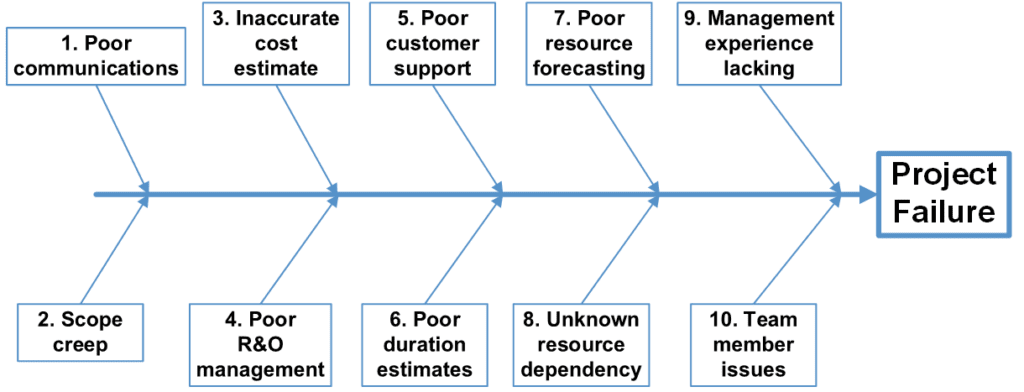
H&A’s senior management routinely reviews literature, considers our work with clients, and discusses with our earned value consultants the main contributors to project failure. These findings are updated regularly and presented in H&A training materials as an Ishikawa Fishbone Cause and Effect diagram. Figure 1 is an example of this type of diagram. 

Figure 1: Example of an Ishikawa Fishbone Case and Effect Diagram

Figure 1: Example of an Ishikawa Fishbone Case and Effect Diagram

When this approach is used for risk assessments, each contributing risk is assessed, and the response documented. An example of a risk/response table is shown below for the first three identified risks.

Risk ItemGood Example of a Real Project Response to an Identified Risk
Poor communicationsGoals are known and documented. Communications plan is in place. Have an established cadence for weekly internal and customer meetings to quickly resolve issues. An internal project performance management dashboard is updated daily with current data. Updated IMS and risk register are broadcast weekly to the team. A strong business rhythm has been established.
Scope creepWork scope (requirements and SOW) are well defined and a change control process is in place. Performers are trained in spotting scope creep and how to handle potential changes in scope.
Inaccurate cost estimateImplemented a process enabling cost estimators to search historical actual cost data, identify analogous tasks, substantiate, and document the basis of estimate. For high risk areas, techniques such as the Delphi method, SMEs, and non-advocate reviews are used. Performance is constantly monitored to spot work elements where the actual costs do not align with the budgeted costs or the estimate at completion (EAC) is triggering internal variance at completion (VAC) thresholds. 

This same type of approach can be used by the project control team to create risk Ishikawa diagrams to identify technical risks that could impact the ability to achieve schedule and cost goals. Likewise, risk Ishikawa diagrams can be used to identify risks in the integrated master schedule (IMS) and time phased budget or estimate to complete (ETC) and EAC.

A Unified Approach to Risk

A unified approach includes technical, schedule, cost, and other risk identification and assessment that is an integral part of a contractor’s EVMS. R&O management should be integrated into the EVMS subsystems including work organization, planning and scheduling, work authorization and budgeting, management analysis and reporting, and change management. 

Identified risks are analyzed and quantified to develop a risk handling strategy. Where applicable, risk mitigation tasks have been entered into the IMS. Ideally a schedule risk assessment (SRA) has been completed to gain an understanding of duration risks that can help to improve the accuracy of the schedule. Assuming the IMS is resource loaded and leveled, the result is a more accurate time phased budget plan as it incorporates the risk handling strategies when the performance measurement baseline (PMB) is established. The R&O process also provides the necessary rationale for determining the budget amount set aside for management reserve (MR).

The R&O assessments should be a normal part of generating the Variance Analysis Reports (VARs) and updating the ETC and EAC. These assessments can also drive the need for processing baseline change requests (BCRs) as well as determining the best approach for corrective actions. 

Using Directed Searches of Identified Risks

To facilitate a unified approach, we recommend establishing a cadence of standing risk review sessions that are conducted in a methodical way to ensure the project manager, integrated product team (IPT) leads, control account managers (CAMs), schedulers, and financial analysts routinely walk through the identified risks that have the potential to impact the project’s IMS or time phased cost.

The intent is to establish a framework such as Ishikawa diagram to guide the risk review session, a directed search of the identified risks should anything further need to be addressed. It is important that a “does anyone have a risk to suggest” approach is not used. Every topic should be covered in every session by walking the Ishikawa risk items. Most of the time it will be a quick “no change” response. Separate Ishikawa diagrams could be used to guide the discussions for the contributing technical, schedule, and cost risks. The meeting room should have the ability to view the live IMS, cost data, and performance analysis data. Team members should be prepared to take notes during the meeting to compile action items.

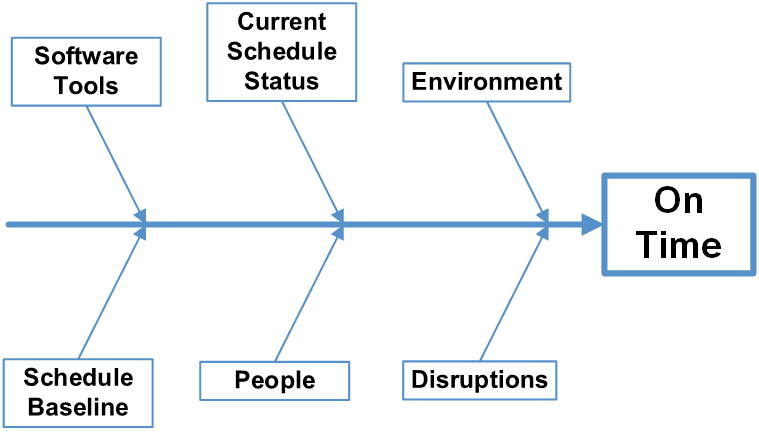
Figure 2 is an example of a basic Ishikawa diagram of IMS risks the project control team could focus on for the risk review session. This would reflect the project control team’s identified risks to the IMS they routinely monitor.

Figure 2: Example of an IMS Ishikawa Fishbone Case and Effect Diagram

Figure 2: Example of an IMS Ishikawa Fishbone Case and Effect Diagram

For example, updating the current schedule every reporting period has the potential to compromise the integrity of the IMS to provide accurate forecast information about the project’s remaining work. Perhaps the project control team has identified a list of contributing schedule status risks, risk response, and example directed questions for each review meeting. These questions could be focused at the CAM level. The following table is a simple example. 

Risk ItemRisk ResponseExample Directed Questions
IMS critical or driving pathsVerify logic. Verify traceability exists and has not been damaged by updates. Review constraints, deadlines, and milestones. Perform data quality check, correct errors.Did milestones move? Did the end date move? What were the baseline dates for starts or finishes that fall into the period?What were the forecasted dates for starts and finishes that fall into the period?What did not happen? Why?
RealismCalculate and assess the Baseline Execution Index (BEI) and Current Execution Index (CEI). Compare the ratio of actual performance to the ratio of future performance.Is the BEI/CEI result within goals? Are there performance discrepancies? Does the forecast need to be updated to align with reality? Is the forecast showing the performance the team can achieve based on what has been achieved?
Quality of ETC/EACVerify updates are occurring. Compare current ETC/EAC to previous ETC/EAC.Has the ETC been updated? What changed and why? For example, for activities with material requirements, price or usage variances may impact the ETC/EAC. For activities with labor requirements, availability or personnel changes may impact future work effort ETC/EAC.

The same approach would be used for guided budget and cost risk discussions. Tailored cause and effect diagrams should be created for a company business environment and each project’s unique characteristics.

Interested in learning more?

H&A’s training courses purposely include content on R&O management and integrating it into the EVMS. H&A’s Project Scheduling as well as Advanced Earned Value Management Techniques (AEVMT) workshops in particular include more discussion on R&O topics.

A company’s EVMS should be designed to aid the identification and management of risks and opportunities. For example, during the process of developing the schedule and budget baseline, activity durations, resource requirements, and budget distribution can be refined to reflect identified and assessed risks. Proactively identifying and managing risks improves project performance. The expectation of specific risks occurring leads to contingency plans that lower the likelihood and impact of risks as well as the establishment of schedule margin and MR to address identified and assessed risks.

Call us today at (714) 685-1730 to get started.

EVM and Unified Risk Management Read Post »

Scroll to Top