EIA-748

EIA 748-D Released – Change Notes

,

EIA 748 D Released

Portions extracted from the EIA-748-D © SAE International (with permission).

Are you aware that a revision to the Society of Automotive Engineers (SAE) / Electronics Industry Alliance (EIA)  Standard 748 Earned Value Management Systems, has been released? The new revision is SAE / EIA 748-D. Officials have been discussing the changes at recent industry conferences.

Sections 2.1-2.5 – No Changes to EVMS Guidelines

No changes have been made to the 32 EVMS Guidelines in Sections 2.1-2.5 of the standard. The changes are primarily clarifications of the existing text:

Section 1 – Additional 4th Note

Section 1 “Scope of EVMS” previously “Introduction” in 748-C now has an additional 4th Note:

“Note 4: There are occasions where it is beneficial for complementary systems or methodologies (e.g., Enterprise/ Manufacturing Resource Planning, Agile Software Development, Theory of Constraints) to interface with the EVM System. These complementary systems or methodologies can be used to deliver functionality and value to the customer while EVM provides a standardized method for measuring progress and reporting across the contract. The EVMS documentation should describe the interface content as well as the recurring control process to maintain data conformance and system compliance.” © SAE

Section 2.6 –  Six Additional Terms

Section 2.6 “Common Terminology” includes six additional terms:

ACTIVITY OR TASK: An element of work with an expected duration in the network schedule that is performed during the course of a project. Activities generally have expected resource requirements used to determine the budget for the work effort. One or more activities may relate to a work package.

AUTHORIZED UNPRICED WORK (AUW): A contract scope change which has been directed by the customer’s contracting officer but has not yet been fully negotiated/definitized. It includes a value, excluding fee or profit, typically associated with the authorized, unpriced change order.

ELEMENT OF COST (EOC): The categories of cost such as labor, material, subcontractor, and other direct costs as defined by company accounting practices.

OVER TARGET SCHEDULE (OTS): A replanned schedule baseline that extends beyond contract milestone dates, delivery dates, or completion date. An OTS is usually accompanied by an increase in budgets resulting in a corresponding Over Target Baseline (OTB). It typically requires customer approval to implement.

RISK AND OPPORTUNITY (R&O): An uncertain future event or situation that could impact the ability to achieve overall project requirements within defined cost, schedule, and technical objectives. Risk has two components: (1) the probability (or likelihood) of a particular outcome and (2) the consequences (or impact) of that outcome. The consequences of risks are typically thought of as negative that may need to be mitigated to minimize the impact to the project. A risk event with positive consequences is referred to as an opportunity that may be captured as a benefit to the project.

SUMMARY LEVEL PLANNING PACKAGE (SLPP): An aggregation of far-term work efforts (scope, schedule, and budget) that are not able to be identified at the control account level but can be distributed to reporting level WBS elements.

Section 2.6 – Term Changes

Section 2.6 “Common Terminology” includes changes/clarifications to existing terms:

ESTIMATE AT COMPLETION (EAC): The current estimated total cost for authorized project work. It equals the cumulative to date Actual Cost of Work Performed (ACWP) plus the estimated costs to complete (Estimate to Complete or ETC) the authorized work remaining.

LEVEL OF EFFORT (LOE): Support type activities that lack measurable output or product that cannot be discretely planned or objectively measured in a practical manner. LOE automatically earns performance with the passage of time, an earned value technique.

MANAGEMENT RESERVE (MR): An amount of the total budget set aside for unplanned, in scope effort that may arise during the course of the project which cannot be identified in advance and is used to handle execution risks. Management reserve budget should be commensurate with the level of project risk. It is not part of the Performance Measurement Baseline (PMB).

OVER-TARGET BASELINE (OTB): A Performance Measurement Baseline (PMB) that exceeds the Contract Budget Base (CBB). It is implemented to produce a realistic schedule and budget plan for the project’s remaining work. It typically requires customer approval to implement.

Section 2.7 – 3 Additional References

Section 2.7 “List of Suggested References” has been updated to include 3 additional references. The complete list is below:

– NDIA IPMD EVMS Intent Guide
– NDIA IPMD IBR Guide
– NDIA IPMD Surveillance Guide
– NDIA IPMD EVMS Acceptance Guide
– NDIA IPMD EVMS Application Guide
– NDIA IPMD Planning and Scheduling Excellence Guide (PASEG)
– NDIA IPMD Industry Practice Guide for Agile on Earned Value Management Programs (New)
– NDIA IPMD Master Definitions List for IPMD Guides (New)
– NDIA IPMD Earned Value Management System Guideline Scalability Guide (New)

Sections 3 thru 5

In Section 3.2.1 WBS Dictionary, discussion regarding segregation by WBS element for direct costs has been removed.

In Section 3.3.1 Control Accounts, discussion regarding guidance that a Control Account shall not span multiple WBS elements has been removed.

In Section 3.3.1, a new figure, Figure 1 – Establishing Control Accounts was added.

In Section 3.4.3 Subcontract/Procurement Schedules, the phrase “high risk” has been removed.

In Section 3.8.2 Cost Performance, The Labor Rate and Efficiency variance calculations were corrected. The corrected equations are below.

• Labor Rate Variance Calculation = Actual Hours x (Earned Rate – Actual Rate)
• Efficiency Variance Calculation = Earned Rate x (Earned Hours – Actual hours)

In Section 3.8.2 Cost Performance, the acronym “EAC” has been replaced with “ETC”.

In Section 3.10.2 Authorized Changes, discussion regarding allowable changes for optimum utility has been removed.

In Section 4 System Documentation, the term “GEIA” has been replaced with “SAE”.

In Section 5.1, Evaluation Process, the term “officer” has been replaced with “authority”.

In summary, EIA 748-D has added/modified a few items for clarification but does not change any of the implementation, reporting, surveillance, or enforcement aspects of Earned Value Management Systems.

Purchase a copy of the standard here: https://www.sae.org/standards/content/eia748d/

EIA 748-D Released – Change Notes Read Post »

Clarification on the New Department of Defense Earned Value Management System EVMS Thresholds | DOD & DPAP

, , , , , , , , , , , , , , , ,

New Department of Defense Earned Value Management System (EVMS) ThresholdsOn September 28, 2015, the Defense Procurement and Acquisition Policy Directorate (<abbr=”Defense Procurement and Acquisition Policy Directorate”>DPAP) released a memorandum entitled “Class Deviation – Earned Value Management System Threshold”. In this memo the DoD changed the threshold for <abbr=”Earned Value Management System”>EVMS application to $100 million for compliance with EIA-748 for cost or incentive contracts and subcontracts. That same memorandum stated that no EVMS surveillance activities will be routinely conducted by the Defense Contract Management Agency (<abbr=”Defense Contract Management Agency”>DCMA) on contracts or subcontracts between $20 million to $100 million. As attachments to this memorandum, there was a reissuance of the Notice of Earned Value Management System <abbr=”Department of Defense Federal Acquisition Regulations”>DFARs clause (252.234-7001) and the Earned Value Management Systems DFARs clause (252.234-7002), with both reflecting the new $100 million threshold.In response to this guidance, a series of questions from both contractors and other government personnel were submitted to Shane Olsen of the DCMA EVM Implementation Division (<abbr=”EVM Implementation Division”>EVMID). Below are the salient points from this communication:

  • There will be no EVMS surveillance of DFARs contracts under $100 million. Contracts without the DFARs clause, such as those under other agencies using the FAR EVM clause, will continue surveillance under their current thresholds.
  • The $100 million threshold is determined on the larger of the contract’s Ceiling Price or Target Price; as reported on the Integrated Program Management Report (IPMR) or Contract Performance Report (CPR) Format 1.
  • The threshold is based on the Contract Value including fee (at Price) as noted above. If there is an approved Over Target Baseline (OTB) which increases the Total Allocated Budget (TAB), this cannot push a contract over the threshold.
  • The new thresholds not only apply to subcontracts, but also Inter-organizational work orders with an EVMS flow-down.
  • Regardless of the circumstances, the DCMA will not conduct surveillance on contracts less than $100 million. However, if there are Earned Value issues that the buying command or other parties believe need to be reviewed, then the DCMA may conduct a Review for Cause (RFC) of the system against potentially affected guidelines.
  • The DCMA Operations EVM Implementation Division (EVMID) will not be conducting Compliance Reviews in FY-2016 unless there is an “emergent need”.
  • If a site is selected for a Compliance Review, only contracts greater than $100 million would be in the initial scope of the Implementation Review (IR). However, if an issue is discovered that requires the team to “open the aperture”, other contracts are not precluded.

The DCMA is still working on a response to the following questions:

  • How do I handle a contract that is currently below $100 million but has options that, in aggregate, would exceed $100 million?
  • How is the contract value determined on:
    • Indefinite Delivery/Indefinite Quantity (ID/IQ) Contracts
    • Non-ID/IQ with Multiple CLIN-Level or Task Order reports?

This blog will be updated and reposted as answers to these questions are given.

Clarification on the New Department of Defense Earned Value Management System EVMS Thresholds | DOD & DPAP Read Post »

EVMS Variance Analysis — EVMS Analysis and Management Reports

, , , ,

A Variance Analysis Report (VAR) that includes specific information about the cause, impact, and corrective action “provides management with early insight into the extent of problems and allows corrective actions to be implemented in time to affect the future course of the program” [reference: NDIA, IPMD EIA-748 (Revision D) EVMS Intent Guide]. Unfortunately, variance analysis is an easy target for criticism during EVMS reviews. There are many examples of inadequate variance analysis to choose from, but what they all have in common is the lack of specific information on the “why, what, how, when, and who” of any variance. The variance analysis reporting requirements are found in the EIA-748 (Revision D) Guidelines in Section IV., Analysis and Management Reports, Guidelines 22-27.

EIA-748 Guidelines
Section IV. Analysis and Management Reports
22 2-4a Control Account Monthly Summary, Identification of CV and SV
23* 2-4b Explain Significant Variances | Earned Value Management
24 2-4c Identify and Explain Indirect Cost Variances
25 2-4d Summarize Data Elements and Variances thru WBS/OBS for Management
26* 2-4e Implement Management Actions as Result of EVM Analysis
27* 2-4f Revise EAC Based on Performance Data; Calculate VAC


A VAR that includes specific information and data about a problem will allow management to make informed decisions and mitigate project risk. Getting specific about variance analysis reporting includes the following elements.

Overall:

  • Emphasis on the quantitative, not qualitative
  • Emphasis on the specific, not the general
  • Emphasis on significant problems, not all problems
  • Define abbreviations and acronyms at first use
  • The Control Account Manager (CAM) is the most knowledgeable person to write the variance analysis report but will need information from the business support team

Cause:

  • Isolate significant variances
  • Discuss cost and schedule variances separately
  • Clearly identify the reason (root cause) for the variance (ties to the corrective action plan)
  • Clear, concise explanation of the technical reason for the variance
  • Provide cost element analysis
    • Labor – hours, direct rates, skill mix, overtime (rate & volume)
    • Material – unplanned requirements, excess quantities, unfavorable prices (price & usage)
    • Subcontracts – changing requirements, additional in-scope work, schedule changes
    • Other Direct Costs – unanticipated usage, in-house vendor
    • Overhead (indirect) – direct base, rate changes
  • Identify what tasks are behind schedule and why

Impact:

  • Describe specific cost, schedule, and technical impact on the project
  • Project future control account performance (continuing problem)
  • Address effect on immediate tasks, intermediate schedules, critical path, driving paths, risk mitigation tasks
  • Describe erosion of schedule margin, impacts to contractual milestones or delivery dates, and when the schedule variance will become zero (this may only mean the work getting completed late (BCWPcum =BCWScum); and does not necessarily mean getting “back on schedule”
  • Describe any impact to other control accounts
  • Assess the need to revise and provide rationale for the Estimate at Completion (justify ETC realism – CPI to TCPI comparison, impacts of corrective action plan, risk mitigation, open commitments, staffing changes, etc.)
  • Note: If there is a root cause, there will be an impact. It could be related to cost, schedule, lessons learned to be applied to future activity, an update required to a process to support the corrective action or a re-prioritization of resources to meet a schedule.

Corrective Action Planning:

  • Describe specific actions being taken, or to be taken, to alleviate or minimize the impact of the problem
  • Include the individual or organization responsible for the required action
  • Include schedules for the actions and estimated completion dates (ECD)
  • If no corrective action is possible, explain why
  • Include results of corrective action plans in previous VARs.

Ask yourself, is the analyses presented in a manner that is understandable? Does the data support the narrative? Does the variance explanation provide specifics of:

why” the problem occurred,
what” is impacted now or in the future,
how” the corrective action is being taken,
when” the corrective actions will occur,
when” the schedule variance will become zero, and/ or the work gets “back on schedule”
who” is responsible for implementing the corrections?

Remember, a well-developed Variance Analysis Report can reduce the risk of a Corrective Action Request (CAR) during an EVMS review.

EVMS Variance Analysis — EVMS Analysis and Management Reports Read Post »

DoD Earned Value Management System Interpretation Guide | EVMSIG

, , , , ,

The updated DoD Earned Value Management System Interpretation Guide (EVMSIG), dated February 18, 2015 was released in March, 2015.

This DoD update, per the GAO, focuses on “(1) problems facing the cost/schedule control system (CS2) process; (2) progress DOD has made with reforms; and (3) challenges DOD faces in fostering and managing potentially significant changes”.

The update commences with:

EVMSIG INTRODUCTION

1.1 Purpose of Guide

Earned Value Management (EVM) is a widely accepted industry best practice for program management that is used across the Department of Defense (DoD), the Federal government, and the commercial sector. Government and industry program managers use EVM as a program management tool to provide joint situational awareness of program status and to assess the cost, schedule, and technical performance of programs for proactive course correction. An EVM System (EVMS) is the management control system that integrates a program’s work scope, schedule, and cost parameters for optimum program planning and control. To be useful as a program management tool, program managers must incorporate EVM into their acquisition decision-making processes; the EVM performance data generated by the EVMS must be timely, accurate, reliable, and auditable; and the EVMS must be implemented in a disciplined manner consistent with the 32 EVMS Guidelines prescribed in Section 2 of the Electronic Industries Alliance Standard-748 EVMS (EIA-748) (Reference (a)), hereafter referred to as “the 32 Guidelines.”

The DoD EVMS Interpretation Guide (EVMSIG), hereafter referred to as “the Guide”, provides the overarching DoD interpretation of the 32 Guidelines where an EVMS requirement is applied. It serves as the authoritative source for EVMS interpretive guidance and is used as the basis for the DoD to assess EVMS compliance to the 32 Guidelines in accordance with Defense Federal Acquisition Regulation Supplement (DFARS) Subpart 234.2 and 234.201 (References (b) and (c)). The Guide provides the DoD Strategic Intent behind each guideline as well as the specific attributes required in a compliant EVMS. Those attributes are the general qualities of effective implementation that are tested in support of determining EVMS compliance as it relates to the 32 Guidelines. As applicable, the DoD Strategic Intent section may clarify where differences in guideline interpretation exist for development and production type work. DoD agencies and organizations charged with conducting initial and continuing EVMS compliance activities will establish amplifying agency procedures and/or guidance to clarify how they are implementing this Guide to include the development of evaluation methods for the attributes associated with each of the 32 Guidelines.

1.2 EVM Policy

The Office of Management and Budget Circular No. A-11 (Reference (d)), the Federal Acquisition Regulation (FAR) Subpart 34.2 and Part 52 (References (e) through (h)) require federal government agency contractors to establish, maintain, and use an EVMS that is compliant with the 32 Guidelines on all major capital asset acquisitions. Based on these federal regulations and the DoD Instruction 5000.02 (DoDI 5000.02) (Reference (i)), the DoD established the Defense Federal Acquisition Regulation Supplement (DFARS) 234.201 (Reference (c)), which prescribes application of an EVMS, via the DFARS 252.234-7002 EVMS clause (Reference (j)). When EVM reporting is contractually required, the contractor must submit to the government an Integrated Program Management Report (IPMR) (DI-MGMT-81861) (Reference (k)) to report program cost and schedule performance data. The IPMR is being phased in to replace the Contract Performance Report (CPR) (DI-MGMT-81466) and the Integrated Master Schedule (IMS) (DI-MGMT-81650). Hereafter, for simplicity purposes, the term “IPMR” is used to reference legacy or current CPR/IMS DIDs. There are times in this Guide when the IMS reference is to an output of the contractor’s internal management system, i.e., a work product, which may not be referred to in the same context as the IPMR. [The full EVMSIG update is found here.]

Furthermore, also in March, 2015 the GAO released its “Report to the Committee on Armed Services, House of Representatives: Defense Acquisition | Better Approach Needed to Account for Number, Cost, and Performance of Non-Major Programs”.

An overview:

The Department of Defense (DOD) could not provide sufficiently reliable data for GAO to determine the number, total cost, or performance of DOD’s current acquisition category (ACAT) II and III programs (GAO-15-188Better Approach Needed to Account for Number, Cost, and Performance of Non-Major Programsoverview). These non-major programs range from a multibillion dollar aircraft radar modernization program to soldier clothing and protective equipment programs in the tens of millions of dollars. GAO found that the accuracy, completeness, and consistency of DOD’s data on these programs were undermined by widespread data entry issues, missing data, and inconsistent identification of current ACAT II and III programs. See the figure below for selected data reliability issues GAO identified. [The full GAO-15-188 document is found here.]

DoD Earned Value Management System Interpretation Guide | EVMSIG Read Post »

Using the Same Rate for BCWS and BCWP

, , , , , ,
Using the Same Rate for Budgeted Cost for Work Scheduled (BCWS) and Budgeted Cost for Work Performed (BCWP)
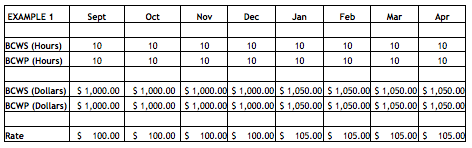
There is often an EVMS project managers debate regarding which rates to use for common budget costing EVMS data elements. For Actual Cost of Work Performed (ACWP), it is fairly obvious as the most recently approved actual rates are applied. A planning rate is generally used for BCWS and BCWP, but many in the EVM project management industry use incorrect rate application for the BCWP calculation. In some cases EVM contractors use a weighted average rate; the percent complete in hours multiplied by the dollarized BAC to derive the BCWP in dollars. This method is noncompliant with the EIA-748 Guideline 22 which states that if work is planned on a measured basis, then the BCWP must be calculated on a measured basis using the same rates and values. In other words, the rate and methods used to calculate BCWS and BCWP must be the same. As shown in Example #1, it can be seen that work planned in hours (BCWS) was performed as scheduled (BCWP) each month. Each hour was planned at a rate of $100/hour until the end of the calendar year when the rate increased to $105/hour. In this example, the rates used to calculate BCWS and BCWP are the same.
EVMS: BCWS & BCWP rate calculation example table #1

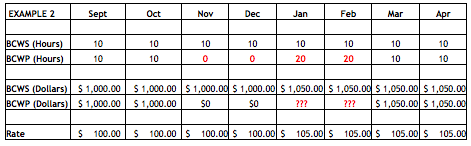
Example #2 below illustrates a very common scenario. In this example work that was planned in November and December was not completed until the next year. In January, the rate increased from $100 to $105. What should the BCWP in dollars be for both January and February?

EVMS: BCWS & BCWP rate calculation example table #2

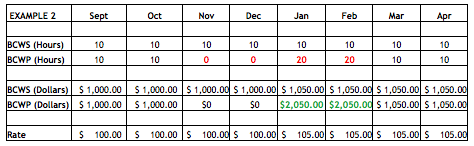
For both January and February, the original 10 hours planned was earned at $105/hour equaling $1,050. The work that was planned in November and December, but completed late in January and February, was earned at its planned rate of $100/hour resulting in $1,000 of BCWP.  The sum ($1,050 + $1,000) equals the BCWP of $2,050 in each month. See the Example #3 graphic below:

EVMS: BCWS & BCWP rate calculation example table #3

Even though the rate was escalated in the new year, the BCWP that should have been earned in the prior year is calculated using the rate that was originally planned. The same approach would be logical if the work planned at $105 per hour were performed ahead of schedule in let us say, December of the prior year. It would be earned at $105 per hour even though it was performed in a time frame where the planning rate is $100 per hour. In some instances, business systems are programmed to earn as a percent of the entire Budget at Completion (BAC). This could result in an inaccurate BCWP dollar value. As an example, let us assume 10 hours are earned in September. If those 10 hours were 1/8 of the total BAC, then the BCWP dollars associated with this 10 hours would be $102.50 per hour and the contractor would be earning too much for those 10 hours. They must earn at the planned $100 per hour! Thus the rate used for BCWP is the same as for BCWS and is compliant with Guideline 22; one earns in the same manner as they plan to earn.

In summary, EVM concepts require that in order for the work to be complete, cumulative values of BCWS and BCWP must equal the BAC.  So, from a common-sense standpoint, if BCWP is earned at a different rate than that used for planning the BCWS, the Control Account (or even the Contract) cannot be closed properly.  Examples:

  • If BCWP earns at a lower rate, the BCWP would be, say, 98% of the BAC when the actual work is done.
  • Likewise, if BCWP earns at a higher rate, the BCWP would be, say, 105% of the BAC when the actual work is concluded.

Both of these scenarios violate the EVM concepts.

Using the Same Rate for BCWS and BCWP Read Post »

Scroll to Top