Earned Value Management System (EVMS)

Revitalizing Earned Value Management Systems (EVMS)

, , , , , , ,
Revitalizing Earned Value Management Systems (EVMS)

Quick Summary

  • Regulatory changes and updated standards are creating an opportunity to revitalize EVM Systems. The FAR overhaul, revised agency thresholds, and the EIA-748-E streamlined requirements while reinforcing the continued need for an effective EVMS.
  • Organizations have an opportunity to refocus on value-driven EVM practices. Rather than treating EVMS as a check-the-box requirement, this is an opportunity to renovate bloated processes and remove non-value-added activities to establish a flexible “living” system that supports proactive project management and credible forecasting.
  • BI and AI tools can transform EVM data into a real-time decision-making advantage. When supported by reliable, integrated data, these tools can rapidly organize information, improve visibility, identify risks early, and help project teams respond faster to changing priorities as well as technical, schedule, and cost challenges.

With the recent changes in the government regulatory requirements, the publication of the EIA-748-E Standard for EVMS, and evolving Business Intelligence (BI) and AI tools, the components for revitalizing Earned Value Management Systems (EVMS) are falling into place. This is an opportunity to refocus on the original purpose of an EVMS and effective use of real-time EVM data to quickly address problems before they become critical.

As highlighted in a previous blog, “Earned Value Management (EVM): How Much is Enough?”, being merely “compliant” with the EIA-748 Guidelines should not be the goal. That strategy fails to take advantage of the benefits of an EVMS; it is also short-sighted. Too often an EVMS is perceived as a contractual check-the-box exercise or focused on detailed score keeping.

The goal should be about being efficiently expert at EVM; a commitment to become “best-in-class” as expert practitioners of EVM. Following this strategy, an organization’s EVMS is actively maintained and used to ensure it provides relevant, useful information needed to manage projects for success. EVM is a powerful project management methodology that integrates scope, schedule, and cost management to provide a clear picture of project performance, the forecast completion date, and estimate at completion. BI and AI tools are enhancing the ability to rapidly organize and analyze real-time EVM data for proactive management and clear transparent communication with the customer. This also aligns with the need for speed in delivering capabilities to the customer when trade offs between requirements, schedule, and cost must be made.

Trimming Contractual and Guideline Requirements

The regulatory environment has been evolving; government entities are either simplifying or changing the requirements for an EVMS. As a reminder, the Capital Programming Guide Supplement to the Office of Management and Budget (OMB) Circular A-11 Planning, Budgeting, and Acquisition of Capital Assets establishes the government major acquisition requirements for an EVMS. This Guide states contractors must use an EVMS that meets the EIA-748 guideline requirements to monitor contract performance. All agency EVMS regulations point to the A-11.

A summary of recent changes follows.

Revolutionary Federal Acquisition Regulation (FAR) Overhaul that began in May 2025 focused on removing most non-statutory rules and rewriting requirements in plain language. Subpart 34.2 – Earned Value Management System was trimmed to the basic EVMS and Integrated Baseline Review (IBR) requirements. The Pre-Award IBR and Notice of EVMS Post-Award IBR clauses were removed; it now just states an IBR is required. Subpart 52.234-4 – Contract Clause for EVMS text was streamlined. Key takeaways: Reaffirmed the value of an EVMS and IBRs. What is unchanged: An EVMS is required for major acquisitions for development contracts, requirements flow down to subcontractors, and IBRs are required.

Defense Federal Acquisition Regulation Supplement (DFARS) Class Deviations (2026-O0011 February 2026), in response to the FAR Overhaul. Subpart 234.2 Earned Value Management System, 234.201 Policy raised the contract value threshold from ≥ $20M to ≥ $50M for EVMS reporting and incorporated the 2015 Class Deviation Memo increasing the contract value threshold for compliance reviews to ≥ $100M. There are also new related Class Deviation Clauses: 252.234-7001 is now 252.234-7998 Notice of EVMS; 252.234-7002 is now 252.234-7999 EVMS.

NASA FAR Supplement 1834.201 Policy Class Deviation (June 2025) as well as their solicitation clause (1852.234-1) and contract clause (1852.234-2) align with the DoD contract value threshold changes and revised clauses.

National Nuclear Security Administration (NNSA). Although NNSA is part of the DOE, as of September 2025 they are the Cognizant Federal Agency (CFA) for NNSA projects. They purposely simplified their compliance and surveillance process to be able to rapidly respond to threats. Contractors self-assess their EVMS. NNSA uses an EIA-748 Guideline checklist, reviews data artifacts, and conducts interviews for evidence of compliance. Certification reviews are required when the Total Project Cost is > $300M and are subject to surveillance reviews.

EIA-748-E Standard for EVMS approved and published in February 2026. This long overdue update reduced the number of guidelines to 27 and reflects current business system capabilities. The previous set of 32 guidelines were revised or merged, two were added, and four were deleted to improve clarity.

With the publication of the EIA-748-E, industry guides as well as government agency compliance and surveillance review materials have been or are in the process of being updated. The NDIA IPMD Intent Guide for EIA-748-E will be available on the NDIA IPMD web site once it completes the membership review and approval process. The DoD Earned Value Management System Interpretation Guide (EVMSIG) is also being updated to reflect the EIA-748-E. Once the EVMSIG is published the DCMA EVMS Group will be updating their Business Practices, appendices, and EVMS Compliance Metrics (DECM). DCMA has already trimmed their DECMs to a set of 60 standard, 10 conditional, and 72 low priority tests.

Impact of BI and AI Enabled Tools and Apps

BI and AI tools speed up the process to pull data from different sources for defined use cases and to organize it for analysis. The time lag to view current data can be eliminated with the right business system interfaces and tools. These tools can quickly produce a variety of dashboards or data views with the ability to drill down into the data as well as to sort and filter as needed for root cause analysis. AI agents designed for specific use cases can also speed up the process to organize and present data for real-time decision making. These dashboards and views can be tailored for specific users such as project managers, control account managers (CAMs), functional managers, schedulers, finance, material or subcontract management, and others.

Taking advantage of BI and AI does require a defined enterprise strategy to successfully leverage these powerful tools. Data is the backbone of any AI model – data is needed to “teach” AI how to spot patterns and make predictions. This includes the vast volume of an organization’s transaction records, analytics, and proprietary information across multiple systems.

The problem? Organizations often lack a consistent, verified version of data (the single source of truth) – there is uncertainty about what data should be used to analyze and “feed” their AI models. Internal proprietary data must not be exposed to the outside world. The single source of truth must exist in a governed and curated environment; it must be organized and integrated with a defined data model to be able to analyze real-time streams of data while avoiding multiple versions of the truth.

The challenge is that many organizations are still doing their enterprise planning, including estimating, budgeting and many other functions, in spreadsheets. It is not accessible to others or captured in a common database. Employees end up debating discrepancies between spreadsheets rather than analyzing the data in question.

Once the system that contains the official single source of truth has been determined and how data is organized and integrated, there are a variety of commercial off the shelf (COTS) tools available for the next step. Employees (the power users) familiar with BI and AI tools can quickly turn ideas into apps in a matter of hours or days that help them and their team to get things done. They can quickly build business environment specific dashboards, analyze real-time data pulled from various data sets, and produce outputs designed for different users or use cases.

Putting All the Pieces Together

What are the three primary takeaways?

The requirement to provide a fact-based assessment of project progress and forecast isn’t going away. The FAR overhaul didn’t do away with EVMS or the related fundamental requirements. It does, however, require organizations to be efficiently expert at EVM. A “living” EVMS (i.e., actively maintained and used) that can be scaled/tailored to management needs for each project is essential.

Changes to the requirements provides an opportunity to update “bloated” processes and procedures or that haven’t been updated to reflect new tools. Since the EVMS will need to be reviewed anyway to verify it supports the revised guidelines as well as updated agency requirements, there may be non-value added content or steps that can be eliminated.

BI and AI tools are useful for organizing real-time data into actionable information. Organizations taking advantage of these tools can rapidly respond to realized or emerging risks and changing scope or priorities in response to evolving threats. This creates a competitive advantage.

Returning to a Focus on Proactive Management

This is an opportunity to return to the original objective of an EVMS: timely and relevant information for proactive decision making to ensure project success and a happy customer. The effectiveness of an EVMS should be measured by the technical, schedule, and cost performance metrics. Product acceptance and in-process controls are examples of technical performance metrics. Schedule status and forecast, cumulative to date cost performance index (CPI), estimate at completion (EAC), and the to complete performance index (TCPI) are examples of schedule and cost performance metrics.

Too often the perceived approach to a “compliant” EVMS is to drive the data to an excessive level of detail along with restrictive rules and guidance that result in a system that is cumbersome and painful to use. It reinforces the perception that EVMS is too costly – something the customer doesn’t want to pay for because they don’t see the value.

The alternative? An organization that is efficiently expert at EVM where the customer has directly experienced the value of using real-time performance data to successfully manage their program. Non-value activities have been eliminated. An actively maintained and used EVMS is also resilient; project teams can quickly respond to evolving priorities and threats. Taking advantage of the power and agility of BI and AI tools/apps can help project teams to focus on what matters with real-time data and analytics.

Taking Advantage of the Opportunity to Revitalize EVM

Changing the view that EVMS is burdensome, costly, and of no value will take time. It depends upon organizations choosing to become efficiently expert at EVM.

Recent changes in requirements and the guidelines will require organizations to review the state of their EVM Systems. It creates an opportunity to eliminate non-value added activities. At the same time, powerful BI/AI tools enable real-time data analysis so project teams can be more proactive as well as renovate EVMS functions. The effectiveness of the EVMS is apparent because it provides real-time visibility into project performance with a credible forecast completion date and estimate at completion.

There is no need for excessive oversight by government customers that drives up the cost of managing projects when the customer has confidence the organization’s EVMS provides the visibility they need – and that earned value based project management is a valuable tool.

Next Steps

Consider having an independent third party complete a thorough assessment of your EVMS process areas and documentation to identify where content can be trimmed and clarified or where non-value added steps can be removed – particularly if you are starting to integrate BI and/or AI tools into your EVMS and other business systems. Call us today to get started.

Revitalizing Earned Value Management Systems (EVMS) Read Post »

Integrating Subcontractor Data into an Integrated Master Schedule

, , , , , , ,

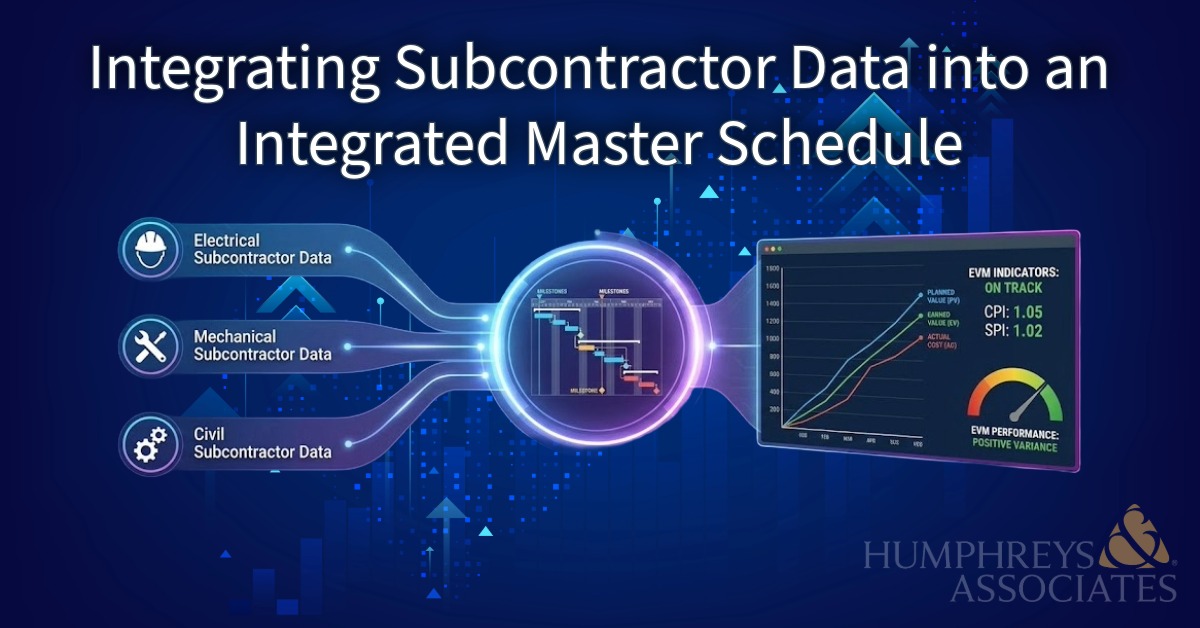
Generating and maintaining a project’s Integrated Master Schedule (IMS) that meets management needs as well as customer requirements is difficult under the best of circumstances. The challenge becomes even more complex when subcontractor work effort must be incorporated. Issuing a subcontract is, in effect, handing off a portion of the work scope to an outside entity that becomes responsible for performing that work and meeting all technical requirements. 

Another consideration for contractors where Earned Value Management System (EVMS) contractual requirements apply is whether the subcontractor is considered a major subcontractor because of the contract value, scope of work, or high risk factors. The EVMS requirements are flowed down to these major subcontractors; they will have the same contractual requirements and challenges as the prime contractor. Most subcontracts do not fall into this category. Many are small, short term, or firm fixed price (FFP) subcontracts. 

Regardless of the category of the subcontractor, the subcontractors and the prime contractor all need an IMS to plan and coordinate work effort as well to measure progress. Using FFP subcontracts on development projects has the potential to increase risk significantly when expectations for scheduling rigor are not clearly defined. 

A Real World Example

H&A EVM consultants supported a multi-billion dollar development project that illustrates the challenges with integrating subcontractor schedules into a prime’s IMS. The prime contractor had two major subcontractors with EVMS flow down requirements. They also had 22 FFP subcontracts without EVMS flow down requirements. 

These FFP subcontracts were also mission-critical. The prime’s first priority was to define the required schedule format and data content in the request for proposal (RFP) to the subcontractors. Standardization was essential, along with specific instructions to ensure the schedule data could easily be incorporated in the prime’s IMS. 

As the basis for a customized project specification, the team selected the Integrated Master Schedule (IMS) Data Item Description (DID) DI-MGMT-81650, an earlier DID that preceded the Integrated Program Management Report (IPMR) and Integrated Program Management Data and Analysis Report (IPMDAR) DIDs. The requirements were simplified and trimmed to selected sections in the DID for the detailed schedules. The document was assigned a specification number within the prime’s document management system so it could be used for future procurements. 

Early Schedule Submittals: A Wake-Up Call

All the subcontractors dutifully proposed and were awarded subcontracts. The FFP subcontractors were required to submit initial schedules using the scheduling tool of their choice at the end of the first month of performance. To ensure compliance, the prime contractor tied the subcontractor’s first payment milestone to the acceptance (receipt, review, and approval) of their first schedule. 

This turned out to be one of the best decisions made during project startup. 

Those first schedules quickly revealed that many of the lower tier subcontractors had no experience developing logic-driven schedules that could comply with the reduced requirements document. They were unable to generate even the most basic project schedule. It was an eye opener to realize that while the first tier companies and most of the second tier companies did know about project scheduling, some of the second tier and all of the lower tier companies lacked that expertise.

The Solution: A Prime-Led Schedule Development Workshop

The prime’s schedule team, largely comprised of H&A schedulers, quickly initiated a week long on-site workshop open to all subcontractors who wanted help building their IMS. Every one of them signed up as they recognized acceptance of their schedule was a prerequisite for payment. 

Prime contractor personnel were assigned to each subcontractor to help them build schedules that met the requirements. Most of the subcontractors were able to produce an acceptable schedule within the first three days. The other subcontractors required the full week.

The workshop approach provided two major benefits.

  1. The subcontractors gained experience in developing a logic-driven schedule that they could maintain and status. They had a better understanding of what the prime contractor expected them to provide. 

  2. The prime’s schedule team gained a better understanding of each subcontractor’s scope of work and execution strategy. They had a better picture of the entire IMS as well as interdependencies. Without this knowledge, the next step of determining the best strategy to incorporate the subcontractor’s schedule data into the prime’s IMS would have failed. 

Strategies for Incorporating Subcontractor Data into the Prime’s IMS

The NDIA Integrated Program Management Division (IPMD) Planning and Scheduling Excellence Guide (PASEG) is a useful source of information on scheduling best practices. The section on External Schedule Integration offers basic guidance on flowing down detailed scheduling requirements to subcontractors. It also provides a short list of things to consider, such as coordinating dates and change control:

“Status dates should be consistent between the prime contractor and supplier schedules. If the subcontractor’s schedule update is to a different point in time, it could potentially affect the IMS analysis results. If it is not possible to have consistent status dates between the various schedule elements then implement a strict process, with support of all parties, to manage the impacts.

Change control procedures are established and understood. The prime contractor should clearly communicate which type of schedule changes will require pre-approval before incorporation and which type will require coordination only or documentation upon submittal. The lack of a disciplined change control process can result in disconnects between the prime contractor and subcontractor’s schedule.”

Remember the prime contractor’s IMS includes a baseline and a current schedule. The complications can be significant when all the variables are considered such as calendars, mix of schedule tools and options, scheduling techniques, resource loading, and custom fields.

That still leaves the question of how to incorporate the schedule data from an external source into the prime’s IMS. The PASEG outlines three approaches.

  1. Full integration where the entire subcontract schedule is incorporated into the prime’s IMS. 

    Pros: Provides maximum visibility into the critical and driving paths as well as forecast completion dates.

    Cons: Often not feasible with a large number of subcontractors. Mix of scheduling tools complicates the process. 

    Use Notes: This option is often reserved for major subcontractors or teaming partners. Works best when the prime and subcontractor are using a common scheduling tool or the subcontractor has direct access to the prime’s IMS scheduling tool to maintain their data. Otherwise, the prime must incorporate additional processes to import the external data into their IMS. There are other complications, as different schedule tools calculate dates differently, that will need to be handled in the integration process. 

  2. Using interface milestones. 

    Pros: Easier to implement and maintain. Yields the best results with less complex or lower risk subcontractors. 

    Cons: Provides less insight into the subcontractor’s current schedule performance. It does not easily support critical path analysis when paths run through subcontract work effort.

    Use Notes: Requires the manual update of each interface milestone to reflect the latest forecasted dates from the subcontractor’s schedule. The prime must ensure their IMS is properly coded. Contractors often use “External Inbound” and External Outbound” codes along with a subcontractor code and any other codes needed to identify who is receiving/giving to whom.

  3. Representative model. This is a middle ground approach between integrating the entire subcontractor’s schedule into the prime’s IMS and using interface milestones. Requires a summarization or representation of the subcontractor’s work to be entered into the prime’s IMS.

    Pros: Provides a summarized version of the subcontractor work effort that retains enough schedule logic for critical and driving path analysis. 

    Cons: IMS content must be carefully entered and maintained to retain the required relationships to the external schedules for accurate critical path analysis. Requires a higher level of schedule discipline and a defined process to ensure the accuracy of the data between the external schedules and the prime’s IMS. 

    Use Notes: It is often beneficial to provide the subcontractor with a copy of their schedule that includes an extra column that identifies the prime’s task ID that is the “parent” of the summarized or consolidated work. In the initial IMS submission from the subcontractor, the prime added a custom field (Prime Parent ID). That IMS file was returned to the subcontractor, and the use of the special field was agreed upon. In each subsequent submission by the subcontractor, the prime team checked for tasks with no “Prime Parent ID” and added one that would allow integration. This kept the two companies’ schedules synchronized. If changes were made by the prime team that changed the field data in the subcontractor’s IMS, the changes were coordinated. A recommended practice is to group and sort the subcontractor schedule by the prime’s IDs to ensure that it is done properly. 

What Worked for the Complex Development Project

In the situation described earlier, the schedule team determined a hybrid approach was the best solution, depending upon the subcontractor’s scope of work.

  • The full integration approach was quickly eliminated; it was impractical. There were too many schedules, and some were too complex. It would have been a logistical nightmare. 
  • Selected simple FFP subcontract work effort was incorporated using the milestone method. The schedule milestones were carefully aligned to the payment plan milestones so that one set of milestones served both purposes.
  • For the subcontracts with EVMS flow down requirements and the other subcontracts, including some FFP subcontracts, the representative model was used. The prime’s control account manager (CAM), responsible for the subcontractor’s scope of work, was required to condense the subcontract schedule into a representative model that made sense to the CAM. The most common ratio turned out to the 10:1, with 10 subcontractor tasks rolling up to 1 prime contractor IMS task, carefully maintaining the prime’s control account and work package structure. With proper coding, the subcontractor schedule could be easily reviewed and analyzed by the CAM as well as other project personnel.

Need help establishing strategies to integrate subcontractor schedule data?

Every project presents unique scheduling challenges, and the approach for integrating subcontractor data often needs to be tailored to fit the situation. H&A earned value consultants and master schedulers have seen and solved them all. With deep experience across diverse industries and project types, our experts deliver the insight and leadership needed to help contractors implement practical, results-driven solutions for integrating subcontractor data. Call us today to get started.  

Integrating Subcontractor Data into an Integrated Master Schedule Read Post »

Maximizing the Value from Integrated Baseline Review (IBR) Investments 

, , , , , , , ,

A previous blog, How Integrated Baseline Reviews (IBRs) Contribute to Project Success, provided an overview of the purpose and scope of IBRs as well as the benefits of conducting an IBR. This blog adds to the discussion on the benefits of conducting an IBR. It reflects observations gathered from our earned value consultants while assisting clients to prepare for IBR events

As a reminder, IBRs provide the opportunity to verify the:

  • Contractor and the customer have a common understanding of the scope of work, technical requirements, and accomplishment criteria. 
  • Contractor has established an executable performance measurement baseline (PMB) for the entire contractual scope of work that accurately reflects how they plan to accomplish the work within the contractual period of performance, negotiated contract cost, and funding profile. 
  • Required resources have been identified and assigned to the project to accomplish the project’s objectives. For example, the staffing plan accurately reflects the sequence of work as well as resource availability and demand.  
  • Technical, schedule, and cost risks/opportunities have been identified, assessed, and captured in a risk/opportunity register. Risk mitigation actions have been incorporated into the PMB to reduce known threats to an acceptable level. This is often the most valuable component of the IBR to ensure all parties have an understanding of the risks/opportunities, assumptions, and risk mitigation or opportunity capture plans. 

Factors that Contribute to a Successful IBR

Treating an IBR as just a contractual requirement limits its value to all parties. IBRs are essential to the successful execution of any project. IBRs require a focused mindset to clearly define as well as assess the measurable benefits gained for the time and effort invested in the IBR. From our observations, contractors that defined what they expected to gain from an IBR, whether the IBR was contractually required or not, made a measurable difference in the outcomes from the IBR. The effectiveness of an IBR is contingent upon management’s commitment to excellence in implementing their EVMS and their desire to ensure they have reliable and useful data for management visibility and control. And that begins with establishing an executable PMB. 

The following list of factors often influence the perceived value of an IBR and hence the approach a contractor takes to planning and conducting their IBRs. 

  • Recognizing the relative importance of the review.
  • Defining the value or measurable benefits they expect to gain from conducting the review.
  • Well defined risk/opportunity management process. 
  • Timely and sufficient review planning and preparation.
  • Joint or collaborative planning and preparation.
  • Well defined objectives as well as entrance and exit criteria. 
  • Tailoring the IBR approach to best accomplish the review objectives.
  • Communication and expectation management.

These factors were ultimately indicative of whether the IBRs were considered value-added (retrospective assessment by the participants) based on the level of understanding, investment in or attention to, or the degree of success in implementing these factors. Based on H&A earned value consultant’s observations, the single factor that tends to drive the IBR approach is clearly defining the value the contractor expects to gain beyond what is mandatory or contractually required. 

IBR Investment Value

The term “IBR investment value” is purposefully used here. The intent is to invite you to re-assess how IBRs are viewed apart from simply meeting government agency IBR requirements. “IBR investment value” is used to mean a qualitative assessment that encapsulates the value-add or measurable benefits teams often have difficulty defining as well as to help provide the impetus and guiding direction for conducting an IBR. It has both intrinsic and extrinsic properties. 

The intrinsic value of the IBR investment resides in those specific elements of information (as identified by the customer in the form of questions or concerns) that are either exchanged, clarified, or refined through the course of discussions between the customer and performing contractor teams. This intrinsic value can be measured by how well the exchanged information supports:

  • A complete, clear and mutual understanding of the work to be accomplished.
  • The resources needed to get the work done.
  • The detailed plan to perform the work.
  • What resources are available to support the plan.
  • What’s missing or unknown that is needed to complete the work correctly and on time.
  • What risks, issues, concerns, or opportunities are associated with contractor’s concept that need to be fully considered to make the plan work. 

The extrinsic value of the IBR Investment rests wholly in the quality of the exchanges (discussions), and the resulting actions generated from the discussions. This extrinsic IBR value addresses how appropriate, rich and comprehensive the information exchanges were, and answers to questions, such as:

  • Were the discussions responsive to a list of customer information requirements and concerns? 
  • Were the right discussions held? At the right level of detail?
  • Were the right people involved in each discussion? 
  • Did the discussions provide sufficient context? Were they comprehensive? Complete?
  • Did the discussions address associated risks, issues, opportunities or other concerns? Relationships to other discussions/elements?
  • Were all the customer’s questions or concerns answered to their satisfaction?
  • Were the discussions documented to support decisions? Alternatives? Changes? Studies?

The exchanges of essential information (intrinsic value) and the quality of those exchanges (extrinsic value) when combined directly translate to the investment value achieved from the IBR. It characterizes how well the information exchanged provides both teams with the necessary details to successfully define, schedule, budget, and manage the contracted effort relative to the investment into the IBR process. A realistic, risk adjusted PMB helps to prevent schedule delays and cost overruns during project execution that often impact a contractor’s profit margins and tarnishes their credibility with their customers. 

What are the characteristics of a value added IBR approach?  

A successful approach H&A earned value consultants have observed contractors implement is a structured process corporate management actively participates in to ensure they gain the most value from all IBR events. 

This is often an outgrowth from corporate initiatives to retain top project management talent and establishing an EVMS self-governance process. It is part of a corporate culture that is committed to excellence in project management and sustaining a best in class EVMS – becoming efficiently expert at EVM

What are some common characteristics of their IBR approach?

  • A chartered authority or corporate team responsible for assisting project personnel with IBR events in addition to EVMS implementation, self governance, and customer surveillance events. A good practice we have seen implemented is to establish rotating members on the IBR teams from different projects as a means to pollinate best practices across projects. It also provides an opportunity to mentor top talent on track to move up to higher management positions.  
  • A standard repeatable process with defined measurable outcomes that can be tailored to the unique project requirements or objectives. This includes maintaining a set of materials for the internal IBR team to effectively plan and execute an IBR as well as to close out any action items. Examples include training materials to prepare project personnel, process description with team member roles and responsibility assignments, data call list, role based interview question forms with assessment criteria, data quality assessment materials and tools, list of data traces to be performed, schedule risk assessment tools, risk/opportunity evaluation criteria, defined assessment criteria (technical, schedule, cost, resources), in-briefing and out-briefing templates, and template to capture action items to track to closure. The corporate team is often responsible for actively maintaining the content for the IBR teams and conducting training. 
  • They place an emphasis on two components that directly impact the quality of the schedule and cost data.  This includes:
    • Well-documented data driven basis of estimates (BOEs) that can be substantiated using historical or bench-marked data with the goal of reducing expert judgement cost estimates to the lowest level possible as a risk reduction strategy.  
    • The quality of the risk/opportunity management plan and the content in the risk/opportunity register. This content directly affects the ability of all parties to gain a better understanding of the risks/opportunities and best options to mitigate a risk or capture an opportunity. A well constructed schedule is required to be able to perform schedule risk assessments (SRAs). SRAs help to identify where duration risk exists in the schedule and to determine a level of confidence in meeting major project milestones as well as the project completion date.  
  • They perform internal IBRs as a standard practice on all projects regardless of contractual requirements. This is particularly important when subcontractors are performing a substantial percentage of the work effort. The corporate team often assists Project Managers with conducting a joint IBR with major subcontractors.  

Need help establishing a corporate IBR process?

H&A earned value consultants often help clients to establish a corporate EVM council or center of excellence with defined responsibilities to ensure project personnel effectively implement their EVMS, integrate risk/opportunity management into the EVMS, as well as define and implement a standard repeatable process for IBRs and self-governance. Clients often need assistance establishing a repeatable process for conducting schedule risk assessments, an essential component of the IBR process. A defined process that clearly articulates the expected measurable outcomes from conducting IBRs is one way to ensure all parties gain the most value from the event with the end objective of ensuring a realistic and executable PMB has been established.  

Call us today to get started.  

Maximizing the Value from Integrated Baseline Review (IBR) Investments  Read Post »

Strategy for Implementing an Earned Value Management System (EVMS) on a New Project

,

H&A is often called in to help our clients resolve a myriad of issues with the design or implementation of their EVMS on a project. This is typically during the project’s execution phase when they belatedly realize the project work organization and planning approach was not adequately defined. Project personnel often lack sufficient direction during the project definition and start-up phase. The root cause was the lack of an integrated program/project plan produced immediately following contract award that would have provided the necessary guidance to the project team on how to implement the EVMS using the project control tools of choice to fit the unique requirements of the project.

The advantage of working with a wide range of clients for over four decades is that H&A has the benefit of observing strategies that companies with a commitment to excellence in project management have implemented. The goal of these companies is to ensure project teams have the necessary guidance they need immediately following contract award or authorization to proceed.

Common Components

One of the best strategies H&A earned value consultants have observed at client sites included establishing a core support team whose charter was to ensure the efficient implementation of standard integrated project management practices and tools on all projects. This began with the decision to bid on a contract and flowed through the processes of producing the proposal, initiating the start up activities immediately following contract award, transitioning to the execution phase, supporting the execution phase business rhythm, and conducting self-surveillance. This core team eliminated the functional, process, resource, and data silos that typically exist between new business development, bid and proposal, and project execution. They provided the single focus on the underlying project management approach to ensure project success and a happy customer as well as to meet target profit goals. They also ensured the EVMS was actively maintained to reflect advances in processes, managing data, and software tools. 

There are a few common attributes to this approach. For example, these companies:

  1. Have a proven and established standard, repeatable processes in place. Project personnel are continuously trained on these processes and standard practices using a standard set of schedule, cost, analysis, and risk tools. This may also include standard Agile tools.
  2. Have established a cross-functional core team whose roles and responsibilities are focused on providing targeted support to proposal and project teams when needed. The composition of the core team reflected the products or services unique to the client. The core team members included subject matter experts (SMEs) from systems engineering, technical disciplines, risk management, finance, contracts, scheduling, cost estimating, EVMS, material management, manufacturing, and Agile. They provide the consistency in approach for the entire project life cycle as well as across projects. 
  3. Have templates and other assets available for project teams. This saves time and helps to establish a common framework for organizing and planning project work effort. This included schedule and cost software tool configuration templates to ensure new projects are set up properly in the tools for integrating data and producing data deliverables. Common utilities or automated interfaces were in place to extract data from business systems such as accounting or the M/ERP system for use in the EVMS.
  4. Established a “hand-off” process between the proposal team and the project team after contract award with the objective of establishing the performance measurement baseline (PMB) as quickly as possible. The project team could start with the source data and other content from the proposal submission and modify the source content as needed to reflect the negotiated contract. This typically included the WBS, technical and management approach, functional organization requirements (staffing plan), integrated master plan (IMP), integrated master schedule (IMS), cost basis of estimates, risks and assumptions, as well as subcontractor and material requirements. This significantly reduces the time required to produce the PMB and increases the quality of the schedule and cost data.
  5. Conducted internal and external kick-off meetings with the government customer to ensure everyone on the project team had a clear understanding of the scope of work, deliverables/components, major milestones, major assumptions, required resources, roles and responsibilities of the organizations involved, identified risks, timing and sequence of activities, time frame to complete the work effort, and target budget. Many contracts include the requirement for a post-award conference for just this exact purpose.

Time and Cost Benefits

The time and cost benefits of this approach aligns with H&A observations. The following images illustrate the results from informal surveys H&A earned value consultants have routinely conducted over the years. A “big bang” or accelerated approach to implementing an EVMS is better way to go – get it done and move on. The objective is to get the PMB in place as soon as possible and quickly settle into the execution phase. It may take more personnel up front; however, the time frame is shortened. Figure 1 illustrates where there is a short burst of dedicated personnel for three months to get the project team off and running. The support team then moves on to the next project.

Figure 1: Accelerated EVMS Implementation

Figure 1: Accelerated EVMS Implementation

As Figure 2 illustrates, it often takes twice as long with a slow ramp-up. In this example, six people are supporting the project for the foreseeable future instead of enabling the project team to function on their own. The project team is continually in a catch-up mode because they haven’t committed to a standard process. It takes longer to get the PMB in place. Data quality is often compromised when the team lacks clear direction on how to proceed or is struggling with how to use the software tools. The support team must remain in place for an extended duration to provide direction to the team on a multitude of levels which limits their ability to help other project teams.

Figure 2: Incremental EVMS Implementation

Things to Consider

Granted it takes time and resources to establish a core team, define all the components, and execute this approach at the corporate level. This is dependent upon management’s commitment to a given level of program/project control excellence and their desire to ensure they have reliable and useful data on all projects for management visibility and control regardless of EVM reporting or EVMS contractual requirements. Usually an internal return on investment (ROI) analysis provided the fact-based information needed to determine it was more cost effective to establish common repeatable processes and standard tools with a cross-discipline core support team. It was a much better alternative than ad-hoc project control implementations or unrealistic schedule/cost baselines that resulted in ugly surprises in the forecasted completion date and estimated cost at completion or contractual penalties that ate into the company’s profit margins.

How do you get started?

You may or may not be in a position to establish a cross-functional project management core support team. An option is to incorporate some of the elements these core support teams use to improve your company’s project management practices. Target areas that can help the project teams to be more efficient or to implement repeatable processes and eliminate ad-hoc approaches where possible. Examples include:

  • Establishing a set of templates for new projects that reflect the requirements identified in your EVM System Description. This could include common artifacts such as a WBS Dictionary, forms such as a work authorization document or baseline change request, or outputs such as a variance analysis report. Include these templates and examples on how to use them in your scheduling and EVM training courses.
  • Establishing a standard new project configuration template in the schedule and cost software tools of choice that provides a common coding structure foundation with options to incorporate project specific requirements. There could be one or more templates depending upon the work scope or type of contract. The objective is to ensure the tools are properly configured to enable schedule and cost integration and there is a standard base framework for organizing and coding the data. An established base framework also makes it easier to perform cross-project or portfolio analysis using business intelligence tools and generative AI tools. 
  • Conducting a project kick-off meeting with the customer immediately following contract award to ensure the project team has a common understanding of the contact scope of work, requirements, and objectives. This helps to establish open communications with the customer from the beginning to clarify assumptions and expectations, confirm roles and responsibilities, and identify likely risks as well as risk mitigation strategies.

H&A earned value consultants routinely assist clients to define successful strategies and tactics for designing and implementing a best in class EVMS in a variety of business environments regardless of the client’s point of departure. One of the best opportunities for establishing a best in class EVMS occurs with clients who are new to EVM and are beginning to sort out what they need to do. Other clients often need to do a refresh of their EVMS and how they train their project personnel to improve the effectiveness of their system. As noted in a recent blog “Earned Value Management (EVM): How Much is Enough? ”, maintaining the status quo is a myth – an EVMS requires constant improvement in areas critical to success.

We can help you determine the right strategy for your situation. Call us today at (714) 685-1730 to get started.

Strategy for Implementing an Earned Value Management System (EVMS) on a New Project Read Post »

Scroll to Top